Showing posts with label books. Show all posts

Saturday, June 29, 2013

Book Review: The Summer Prince

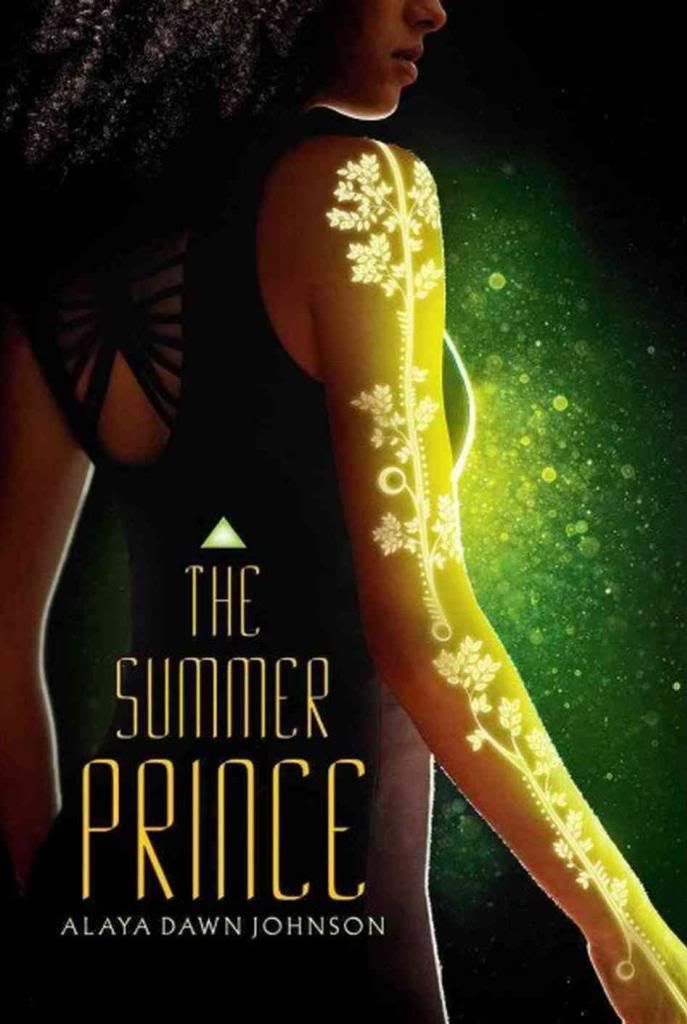
This is a book that I was really hoping to have a chance to read (futuristic Brazil sci-fi? I'm in!) and I was surprised that I found it so quickly at my not-so-local library, although I feel like they either do a better job at getting YA books faster or at least make their new books more visible. And even without already knowing about this book I think I would have picked it up anyway because of how gorgeous the cover is, normally I'm a little leary of putting green and yellow right next to each other (it can make things look sickly really easy) but, if the cover here doesn't fully convey it, it makes the cover just pop and I hope a lot of other people pick it up for either of those reasons.


The Summer Prince by Alaya Dawn Johnson


Summary: 400 years ago the world became a nuclear wasteland and while humanity still survives most of the world does so in the ruins of it’s former glory. One of the few exceptions to this is the city-state of Palmares  Tres, a giant city in modern day Brazil which has thrived because of it's isolation and rules made by all of its ruling ladies. While they resist much technology being created by the outside world they have embraced some of it and become extraordinarily long lived and because of that few young people have any say in anything about their world. Many want their world to change but few succeed in the way that June and Enki manage, her by being a modern artist whose work is compelling and different and him by becoming the Summer King, the highest position any man in the city can hold which occurs once every five years and after a year of power will be ritually killed in order to reaffirm the authority of Palmares Tres' queen. 

The Good: Johnson creates a futuristic setting that is neither dystopian or utopian (that’s actually a dystopia) which helps make it one of the most realistic science-fiction settings I’ve ever come across. This isn’t a little detail either, the struggles and conflicts of the city are the center and heart of this story, it's Enki's reason for becoming the Summer King in the first place, and Johnson succeeds wildly in portraying a city where ordinary people live and are unsure of what future they should follow and where politicians have a mix of their own and everyone else's wishes as their goal. As for all the other parts of the setting, I’m a sucker for a story with strong settings and the way that the technology is integrated into everything and is explained so casually is what really makes the story for me. Johnson creates a setting that is mostly foreign to me but does it with such confidence and vivid descriptions that I had no trouble accepting it* and, once I figured out how the city was laid out, visualizing it. I also loved the kind of art June did, in real life I'm not a big fan of modern art (or post-modern, I'm not completely sure which one hers is) but two things made it work here. One is that I'm simply of tired that nearly every time there's a character in any story whose an artist that they normally sketch or paint, it just gets a bit tedious. And secondly because June's art makes so much sense in this setting, it's wild, it's thought provoking, it makes use of the materials in and around her city. It ends up being a perfect fit with her character, Palmares Tres, and with the entire story.  

The Bad: There was a lot of unfamiliar slang used in the book (I don’t know if it’s real, Brazilian slang or made up for the sake of the book) and I wish that there had been a small glossary in the back since I was never able to pick up on what some of the words meant when they were only used once or twice. I also wish the ending had been a slight bit clearer, I had a few questions which I don't I was supposed to have and just a paragraph or two could have cleared them up (unless I was supposed to have these specific questions in which case obviously the story succeeded). Finally, by the end I had a few problems with how Enki grew and developed. Some people might consider this a spoiler so I shall try to be as vague as possible, Enki does A Thing which ultimately results in a change in character, I'm not exactly sure it can even be called development since he doesn't have full control or choice over changing, and I felt like this short-changed the story in some ways. I'm entirely sure that this was all deliberately done, Enki is supposed to be a tragic character after all, when I remember where he started and the goals he had then, versus what he was like by the very end well, I wish that had been pulled off a little differently.


So for a story with an amazing setting, interesting characters (all of whom are non-white I should note, both due to the gene mods and from growing up in a culture which has more than just American or European influences), and two prominent gay relationships (plus a take on a love triangle which is a bit different than usual) I'm giving this book four out of five stars, plan on buying it someday and plan on checking out Johnson's other works. And while recommending this I'd also like to mention some books that I was reminded of while reading, Nnedi Okorafor-Mbachu's Zarah the Windseeker which also has a great, vivid setting whose inspiration was completely foreign to me yet I fell in love with due to how confidently Okorafor-Mbachu described it and Karen Healey's The Shattering but for slightly spoilery reasons, it and The Summer Prince have one rather large plot element in common but it's done completely differently. 


*well, except for the one detail of people having children after they turn 50 and much later than that. But, given the passing mention of gene mods and that people’s skin tones must fit into a certain range of colors I can easily hand wave that and say that they just do something either to the uterus or eggs to make this viable. And really, I have just one problem with the technology out of a story which is chock-full of it and is one of the main plot drivers? That’s amazing!

Sunday, July 29, 2012

Book Review: The Way We Fall

And I couldn't even manage a week straight of constant updates, sorry guys I really don't know why it's been so hard for me to be consistent lately. I will try to get today's (actual) review up later as well, might be a bit shorter but that review was going to be a bit shorter regardless.

Moving along, this is another book I got from the Enchanted Inkpot giveaway and was one I put off for a while since it was a "what if this disaster happened and everyone the main character cared for started dieing?" which just isn't a genre that I particularly like. I wasn't so worried about whether or not the book would be good, I had seen enough people on the internet praise it so I was sure it was going to be well-written, I was just wondering if I would need something extra fluffy to cheer myself up with afterwards.

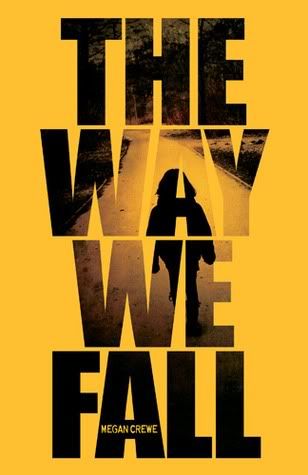
The Way We Fall by Megan Crewe


The cover certainly stands out here, I'm sure if I was to pull up one of those charts that note how many books have these things/this color on the cover that there wouldn't be many other yellow books and it's a little unusual to use the title to create the imagery as well. Very eye-catching so I think it works quite well.


Summary: Kaelyn lives on a small island on the coast of Canada and only recently moved back after living in Toronto for several years which has helped create a rift between her and her old neighbors. She's trying to repair this crack when an even bigger disaster strikes in the form of a mysterious disease that sweeps the island, killing all whom it infects. Quarantined from the rest of the world the island slowly sinks into a panic where all semblance of normal life vanishes and Kaelyn and her family must try to cope and stay alive until this nightmare ends.  

The Good: While it can't strictly be called a zombie book, people don't come back after they're dead and such, Kaelyn does have a very good line about how this virus is a much smarter one because it doesn't make it's victims turn crazy and cannibalistic but rather crave attention and physical contact so that the disease spreads even faster and that was a really smart idea on Crewe's part and helps keep the story realistic. In nearly every zombie story a character will get infected for a really dumb reason and, while I'm not saying that didn't happen here as well, with that explanation of how the virus spreads it was a lot easier to take the characters actions seriously and the whole story felt stronger. There was some romance that came about very naturally that I liked and I liked how there was a prominent, female supporting character (which, as odd as it sounds, I've noticed lately I'm not seeing a lot of them in books that are single point of view, most often the biggest supporting character seems to be of the opposite gender*).

The Bad: The progression of the story is very predictable (infection starts, characters are told there is no hope for outside help and must wait it out, after some time has passed and the characters/reader feel it's safe someone becomes sick and dies, main character goes through tough situation but because of plot armor remains mostly safe, etc) and, while the story is well-written and doesn't feel constrained by it's genre, I do wish that someday I come across a book that does one of those parts very differently. And that was another reason I was hesitant to read the book, I had correctly guessed that this story wasn't going to do anything that I hadn't seen before and I prefer to read books that promise a new concept. Finally, I was a bit frustrated at how vague the ending is (I almost feel like the author was torn on having a happy or sad ending) but it wrapped up as well as I expected (because again, there's a "usual" way these stories end, it was something I had guessed before the book started, not because of how the story progressed).


Despite my criticisms this is a good, solid book, just not the book for me. As such I'll be donating it to the local library when I get a chance and I'm sure there will be plenty of people there who'll enjoy it much more. Heck, I think that many people who've enjoyed zombie stories in the past will enjoy this one (as long as they're not in it for zombie-killing-gore which doesn't really happen here) so I do hope the book finds it's audience and does well.


*which seems to be that way for (straight) romance purposes frustratingly enough.  

Saturday, July 14, 2012

Book Review: The Cabinet of Earths

Another book from the Enchanted Inkpot giveaway, I'll admit I was a bit confused when I got this package since the return address was, if I recall correctly, the Slavic department at UNC Berkly. I figured out what was going on quickly enough but it was an amusing moment none the less.

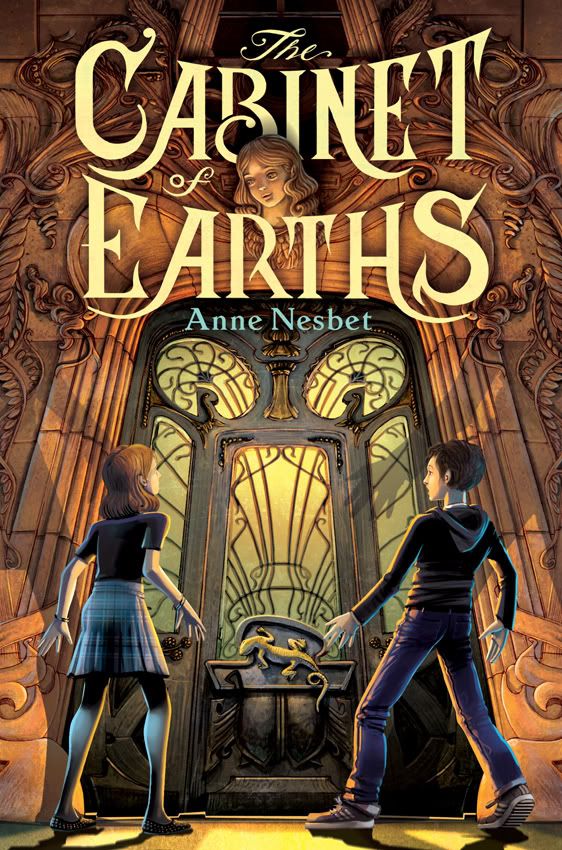
The Cabinet of Earths by Anne Nesbet

It took me a little while to recognize what scene, and characters, were being shown on the cover but I love the art on it regardless. It's very true to the book and has a lovely amount of detail on it and is certainly eye-grabbing.
  
Summary: In order to help her mother recover from cancer, Maya and her family have moved to Paris and Maya is less than pleased about this.  But her unhappiness soon turns to curiosity as Paris turns out different than she expected with strange relatives and seemingly magical houses and then to alarm as her relatives seem to have sinister plans for her younger brother.

The Good: The setting was very neat both because of how it was described with tons of detail and because I come across fewer stories set in Paris (well, France in general) so it feels fresher to me vs another fantasy story set in Generic Small Town America (TM) or England. I also liked how magic worked it's way into the story since it's not another story with magic and wizards on every corner but with magic hiding off in a corner yet very obviously present at the same time. It feels more like magical realism (believe I have the right term here) than urban fantasy and I don't see much of that genre so that was rather nice. 

The Bad: This was a book I wanted to like, thought I would like, and gave it a fair shot but in the end it just didn't grab me at all. I think part of this is that the book feels more like a middle grade book (which are aimed at late elementary school to middle school) vs a young adult book (late middle school to high school) and just didn't have as much "crossover appeal." By that I mean, Maya is young and feels young, she's not as creative about her situation as a slightly older character might be and is more easily manipulated which, when you know how the story is going to end (since books with a genuinely tragic ending are rarely, if ever, published for this age group) and you stop caring about what the character does you stop caring how they get to that point as well.


So in the end this is another book I'll be donating to the local library once I get back to school with the hopes that other people enjoy the story more than I did. It's not bad, it's just not as enjoyable if you don't regularly enjoy middle grade books. And, unrelated to the review, again I am taking next week off so that I can try and reset my schedule so I can get back in the habit of blogging (on time) the week after. The schedule isn't changing, that will probably come late August, September for sure, I'm just trying to adjust a few things on my end in the meantime.  

Saturday, July 7, 2012

Book Review: The Book of Blood and Shadow

I won this book in a twitter contest hosted by Random Buzzers (one of your standard, retweet this tweet and we'll choose winners from that pool) which was rather nice since I've read Robin Wasserman's Skinned trilogy and, since one of my big problems was that it went on too long, I was curious to see how she would do with a one book story instead. With that in mind, onto the review!

The Book of Blood and Shadow by Robin Wasserman
  I actually didn't have this cover on my copy, it was an ARC with a plain black cover with the title in a red script, and while this cover isn't exactly to my taste it's certainly a good and very interesting cover. I love the detail in her eye and it's rather eye-catching.

Summary: When Nora is assigned to translate some old letters instead of the rare book her classmates are working on she's initially rather unhappy, although any chance to be away from her parents who aren't stay together "for the sake of the children" but for the memory of her dead brother is welcomed. And then she discovers that while the book talks about a mysterious, mystical device called the Lumen Dei, her writer actually dealt with the machine and are much more valuable. So valuable in fact that centuries later there are still groups of people out there willing to do anything to get their hands on them and while some of them view Nora to just be in the way others want to capture her as well.

The Good: This is a very tightly plotted book and pulls off the remarkable task of making it not only believable that Nora is able to find and translate all of the letters, most of which have been hidden for at least four centuries, but also that the letters have remained hidden for so long. It's very hard to make that set-up look natural, and considering the story rests upon that it's critical to the story at large, and it's pulled off perfectly at here and never once did one of those revelations jolt me out of the story. And, despite my nitpicks later, the story felt well paced with no revelation coming too quickly or taking too long. Nora wasn't the most memorable lead I've seen but she was strong and well-fleshed out so I certainly liked her, I just don't know how much I'll remember about her (as opposed to the story itself) in a few years time.

The Bad: As I had been afraid, this book still felt too long by the end, my copy clocks in at 430 pages, but again I'm not really sure where to cut it down. It's both long and dense, I felt rather exhausted by the end of the story and feeling like I would have liked it to be a little shorter. Other than that there weren't many problems with it and certainly no major problems that stood out to me. It was a little exasperating at times that Nora had no idea she was about to be betrayed, which was clearly obvious to me as a reader, and likewise it was also frustrating to see that none of the characters seem to realize they were being manipulated at certain points, especially since none of them were portrayed as dumb. I felt like Adriane's characterization was a little flat compared to some of the other side characters but again that wasn't a major issue in the end.


I really liked this story a lot more than I was expecting to and I plan on buying a copy of the book for myself in the future (I'll donate the ARC to the free basket at my library's bookstore, since book has already been out for over six months I don't feel like that'll be a problem and since you can't sell an ARC there's not much else I can do with it). A very strong story and one of my favorite books of 2012 so far (mind you I haven't read many but that doesn't stop it from being a favorite within the category).   

Saturday, June 30, 2012

Book Review: Two Moon Princess

Another book from the Enchanted Inkpot giveaway, although I'll confess that I kept reading the title as Two Moon Princesses and was rather confused for a while why there seemed to be only one princess in the story (well, only one who can be called a main character in any case). But enough of my silly mis-readings of words, onto the review!

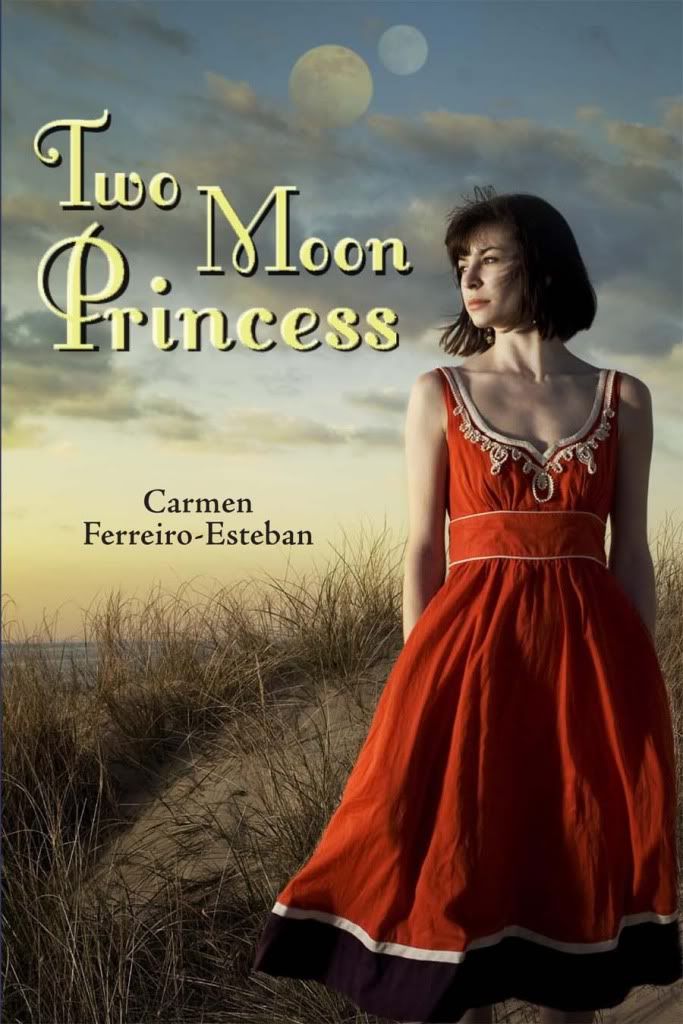
Two Moon Princess by Carmen Ferreiro-Esteban
 
Summary: Andrea is the youngest princess of the country of Zeltia and would rather be a knight than a princess much to the disapproval of her traditional father and even more traditional mother. But her fate begins to look up when she discovers a mysterious passage between her world and California, the birthplace of her mother, although she may have created a terrible problem in the process.

The Good: While the setting is still Western-European-Medieval it's much more heavily inspired by Medieval Spain than say Medieval England which was a nice change of pace and I can't remember the last time I read a story that didn't have a 12 month/365 day calender. Actually, the setting feels a bit more Renaissance than strictly medieval which is also a nice change of pace, although I wish it had a chance to talk more about the ancient civilization that they keep giving tantalizing hints about.

The Bad: Overall the book was just a bit, well, bland and I could never get into the story even though it had a lot of things that should have endeared me to it such as politics and a bit of a different setting (I will admit that as much as I like that it's set in a world that doesn't have a 365 year day it made figuring out character equivalent ages rather difficult and frustrating). Andrea's story is nothing new, her mother is complicated for reasons that never seem to be fully (or even partially) explained, it's painfully obvious that Andrea's friend from California is an idiot, and the romance towards the end felt a bit awkward. 


I know it's a bit of a quick review but it's true that it's much easier to write a review about something you love or hate and this book was just so bland that there's not a lot to talk about. It did have a solid ending but it's another book I'm going to pass along to the library and hope that others enjoy it more than I did.   

Saturday, June 23, 2012

Book Review: Spice and Wolf volume 5

So it appears that before I did have a good reason to worry that Yen Press had only licensed the first six (novel) volumes of Spice and Wolf since that was the case, however recently they announced they had licensed I believe the next three which actually makes me less worried. Sure the whole, 17 volume series isn't licensed but licensing through volume 9 shows that there is a market for them (or at least, the series is selling at or above what they predicted) and that they will license more if there is demand for them. So I guess my job now is to keep reviewing the books and convincing everyone else that they're worth buying huh?


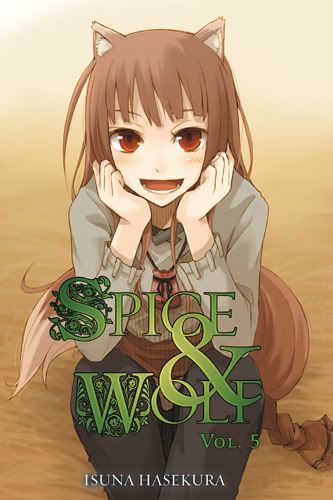
Spice and Wolf (volume five) by Isuna Hasekura, illustrated by Jyuu Ayakura

Summary: Covering the same material as the second arc of the second tv season, Holo and Lawrence have arrived in the town of Lenos where they have heard a town chronicler might have more records of where Holo’s elusive home of Yoitsu lies. A fellow merchant introduces them to him but they want some help in return, help with a risky endeavor involving the town’s fur trade that might end up being more than they can chew.

The Good: The books continue to excel in creating secondary characters that don’t feel like repeats of an earlier side character and are rather fleshed out for characters who (probably) won’t ever appear in the series again. This is a bit easier to accomplish in a story that spends a lot of time with the characters sitting around and talking but when you think about it it’s impressive just how many characters Hasekura has been able to create without repeating traits (and there are still 12 more books to go!). There was also some very good foreshadowing this time around and once again felt like a solid installment.

The Bad: So far the stories have been rather good at explaining the economics and politics that make up the various situations and I’ve been able to follow along (and having already seen many of the stories in anime form has helped) but this one did confuse me quite a bit. This didn’t make me like the story less per-say but when everything was said and done I wasn’t quite sure what had happened and I do hope the economics in the next book are easier to follow.


Despite my trouble with the economic parts I still thought this was a good installment, although I must confess I'm more excited for the next book since then we'll be dealing with completely new material again. Funny enough by now I really want to watch the anime series again, it's been a few years since I've seen it, I've now read all the source material, and Funimation has some rather good prices for both seasons now, hmmmm.

Sunday, June 17, 2012

Book Review: Mistwood

The second book I received from the Enchanted Inkpot giveaway and there's not much else to say to introduce it. I had a basic idea of what the plot was and thought it had potential but I actually went in completely unbiased which is a bit rare for me. In any case, onto the review!

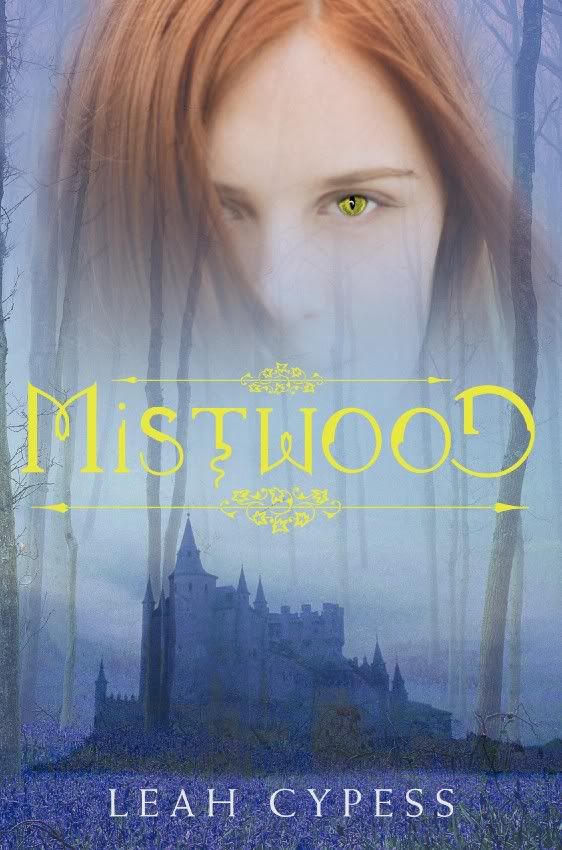
Mistwod by Leah Cypress

I like the font here, it's fancy but not unreadable, and while the colors don't perfectly blend (I find the hair color just a tad too jarring, although the title picks up the color of the eyes nicely) I do like the concept here and think it works well.

Summary: The Shifter is a mysterious, some would say mythological, being that is bound to serve and protect the royal family of Samorna from any and all harm. Or so she is told, she can't recall anything about her life before she ran wild in the nearby woods but accepts these duties and the name Isabel and goes along with them. But snippets of her past begin to emerge and she realizes that the past Prince Rokan has told her isn't the complete truth and that the truth is very messy indeed.

The Good: While it would be erroneous to say that all main characters share the same traits but there are a number which crop up quite frequently and makes them feeling "main character-ish". Isabel however doesn't feel main character-ish in any way yet is undeniably the MC, not a supporting protagonist as her status as body guard might initially imply but a rather interesting character who grows and ends up being quite complex and fascinating to read. The fact that she's one of the best portrayals of a non-human protagonist I've seen in a long time helps and her internal struggles and conflicts with her past and present make perfect sense and are interesting to watch unfold. When I first heard of the book I thought that it was based on a fairy tale and, while I can't find any references saying it was, it has a lot of real fairy-tale aspects to it (like the ever present theme of transformation).

The Bad: Quite honestly I thought this was an amazingly solid book without any major flaws. The only part that bothered me a bit was that there it seemed like there was a murder the hypotenuse to prevent a love triangle from eventually forming, I couldn't see any other reason for said character to be killed and that frustrated me. Other than that, I wasn't sure what the author was trying to accomplish with the character Albin at times, I suppose she was trying to create a more morally ambiguous character which got muddied along the way, but again this was a strong book without any large failings that I noticed.

So, my favorite of the Inkpot books and a keeper for sure. The author has a second book out now, which I believe is unconnected, that I plan on checking out sometime (just when my to-read pile gets smaller, at this rate I'll have enough books to talk about until September). And on one final, slightly unrelated note, I love how all the books I got from this were also autographed; normally I don't care if I'm able to get a book autographed or not but in an odd way it gave this contest a more personal feel and it just made me happy.   

Sunday, June 10, 2012

Book Review: Book Girl and the Corrupted Angel

So, the reason this is going up a day late is that I just plain forgot to write this last night (I was thinking my Saturday seemed remarkably boring but just used the time to do other things instead). I am hoping to get out Sunday's regular post today as well to make up for it however, you would think after having the same schedule for months and months that I would forget things like this less often. Then again, considering that there is now a couple month gap between when I started a book and when I actually get around to reading it it makes a bit more sense. I certainly remember what happened in that latest installment in the Book Girl series, but after reading so many other books since then I had almost forgotten that I had read this one as well. Also, as noted on the Kieli review, unless the art completely changes or is completely amazing I'm not going to include an Art section in the light novel review anymore.

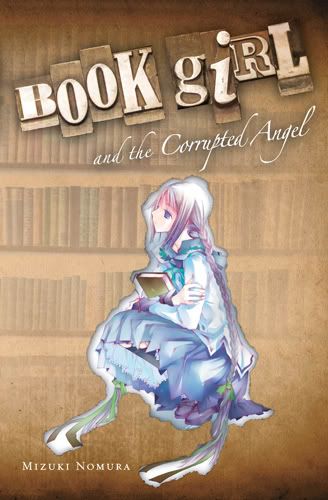
Book Girl and the Corrupted Angel by Mizuki Nomura illustrated by Miho Takeoka


Summary: Book Girl Tohko is busily preparing for her college entrance exams, although Konoha has his reservations if she'll actually get in anywhere. Konoha however finds himself helping out fellow classmate Kotobuki in the music room after school and becomes increasingly involved with her when one of her friends goes missing under strange circumstances. Without Tohko to lead the way Konoha has to fumble through the steps and try to figure out if life is imitating The Phantom of the Opera (who is alluded to in the friend's messages and notes) or if the truth is rather different.

The Good: It took me a long time to get into this story and a big reason for that was because I find Tohko the more likable of the two leads but this story did clear up a few things about Konoha. Before I had been rather skeptical of his panic attacks, he (like many characters in light novels I've noticed) is always so internal it can sometimes be hard to tell just what is going on but this book confirms that yes, he really is still messed up after the events involving his friend Miu years earlier. But around the two-thirds point of the story, when it started to diverge more from The Phantom of the Opera that's when I really got into it and I thought it was a satisfying story. Kotobuki also got some character development here which was good not only because she has ended up being the largest supporting character so far but because, unless I am completely missing the mark, her feelings for Konoha are going to become even more important in the following books (especially with Miu set to finally appear in the next volume).

The Bad: As I mentioned above, I prefer Tohko to Konoha as a lead character since she's much more decisive and interesting so I am a bit nervous now for later books where she may no longer be around (there are only about three months in-story until her graduation I believe). Konoha can hold the story together but he really, really needs a lot more character growth before I can tolerate him for more than a couple chapters at a time. And, another reoccurring complaint of mine, while I know full well that many people do have less than ideal lives where terrible things happen to them or they become so twisted from their own ideas that they almost cause terrible things to happen to them I'm still a bit incredulous about how many of those people Konoha and Tohko run into. I could find the situation involving Kotobuki's friend believable but some of the other characters had to be so twisted to make this story happen that I wasn't able to suspend my belief the entire time and that's just not a good thing.

So, I'm coming to the same conclusion that I did for Kieli, that these books are best read with a smaller gap between them (say one or two months) than the gap caused by the release pattern in the US (six months, although seven this time since the next volume got pushed back a month). I also came to this conclusion after watching some of Hyou-ka, a currently airing mystery anime which has a similar feel to this one, that perhaps a more serialized publishing schedule might work better for stories which have small, volume long arcs but with a more ambiguous overall arc that grows more and more important as the story goes on. Not sure what to do in that case, the final volume won't be out in the US until January 2014, maybe I should start making cliff notes for each volume as well...    

Saturday, June 2, 2012

Book Review: The Shadows (The Books of Elsewhere #1)

For a long time the only book-related blog I followed was one called The Enchanted Inkpot, then on livejournal, which isn't a book review blog but a few times a month would have an interview with a recently published author and I really liked the questions they asked which were generally more about the setting or the research that went into the book than the book itself. In an odd way those interviews managed to give me a really good impression of the books and I tried out quite a few books based on those interviews which I had initially disregarded or had just plain never heard of. Earlier in the year they moved from their livejournal blog to an independent one and held a giveaway to celebrate and I was one of the winners of it. They had three prize packs to choose from and sadly the one I wanted was already taken so I went in knowing none of the 8 books in it (actually, come to think of it I think I only received six of the books, ah well, I've already got enough to read) and started reading them in the order they came in. As of now I've read five out of six of them and again, go check out The Enchanted Inkpot since it's a really nice site.

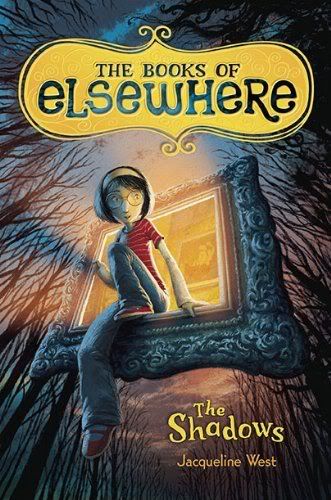
The Shadows (The Books of Elsewhere number one) by Jacqueline West

  
The cover, at least on the paperback version, is actually shiny on the gold bits which is a nice touch and the cover art matches the illustrations inside. Yes, there are some illustrations here and, since I can't find an illustrator credited anywhere I believe Ms. West must have done those as well. They don't especially add to the story but I'm a visual person, I like having pictures in my books regardless.
 
Summary: 11 year old Olive Dunwoody and her math loving parents have recently moved into the old  Victorian mansion and it's last owner died and Olive notices a few strange things about it. She can't find the attic, there's a mysterious cat in the basement and all the paintings are fastened to the walls and seem to move when she's not looking at them. She soon learns that the paintings are magical with a dark history behind them, a history that seems to be coming to life again and threatens her and her family. 

The Good: "Kid moves to strange new house/has to stay at strange new house" is practically it's own sub-genre within fantasy (bonus points if they have to do it without any close family members, which is not the case here) and it works well here. Olive is inquisitive and smart but yet not genius and acts like an 11 year old girl. She has a fairly good relationship with her parents, something which I find rarely in stories, in short she's realistic, likable, and sympathetic from the start and I never found myself getting frustrated by her. The plot was paced well and was more complicated than I initially expected it to be, overall the whole book was much better than expected and I really did enjoy it.

The Bad: While I can partially see how this is simply the first volume in a series, on the other hand I'm not sure what's left to cover in further books. So I suppose it's both a strength and a weakness that the book works very well as a stand alone, honestly I won't be on the look-out for the next book but that's because it's a middle grade book and I'm just too old to enjoy middle grade books as much as I enjoy young adult or adult fiction books. I suppose that's another weakness of the book, while some books have that almost magical quality of being enjoyed no matter what the reader's age is this book just doesn't have it and I don't see this as a book someone will pick up years later for a reread and still enjoy just as much. Again, this book doesn't have any real flaws and it's certainly not a bad book but it's not as strong as other examples in the medium and that really limits who I can recommend this to.

So in the end, what to do with a book I enjoyed, thought was good, but have no intention of re-reading or doubt that I can loan out to friends? (plus have absolutely no room for on my shelves) Normally I'd sell books I don't like to a local used book store for store credit but that didn't seem right here so I inquired and found that the library near my school did take donations so I dropped this one off and hopefully it is enjoying a happy second life as a library book (or has been sold in their book sale and is still being happily enjoyed, I'll be content either way).
 

Saturday, May 26, 2012

Book Review: Kieli volume 4, Long Night Beside a Deep Pool

Unforutnatly it appears that my plan to take March off to catch up with my reading seems to have backfired, currently I'm still talking about books I read back in March so apologies if some of these reviews have been a bit short, I'm starting to get a bit hazy on all the details. Of course, I'm a bit hazy on details of previous light novels in general anyway so there might not even be a difference here. Also, I've decided that since I'm well into each of these light novel series that I'm going to stop talking about the art. By and large the art hasn't evolved much and, rather than say the same thing over and over, so I'll be dropping that part of the reviews unless the art undergoes a major shift.


Kieli volume 4: Long Night Beside a Deep Pool by Yukako Kabei

Summary: After the incident with the spaceship in the third book, Harvey, an Undyding (a super solider from a war decades earlier whom the Church has vowed to hunt down and kill on sight) has left to look for more information concerning Kieli’s mom and it’s been a year and a half since then. When they get a short note from him Beatrix, whom Kieli has been living with all this time, Kieli and the Corporal, the spirit possessing an old radio, set out to find him again. But things haven’t been going well for Harvey since then

The Good: The story continues with a plot point picked up from the second novel, the mystery surrounding Kieli’s parents (particularly her mother) and a few details are answered here (such as who the Undying who was traveling with her). Not all is explained, of course, but it was more than I expected so I felt satisfied there. The story also has developed another interesting thread, Harvey seems to be dying (or at the very least not truly an Undying anymore) and given that none of the characters seem to have realized plus their tendency to get into all kinds of trouble this is sure to become even more important as the series progresses.

The Bad: I’ve realized by now that most of the light novels I read aren’t meant to be read with a 6+ month gap between them because of the way they flow from one story to the next not like separate installments in a series but rather likes parts of one whole story, and I’m having some trouble enjoying them as much. Actually, I thought that alone was the reason for one of my issues in the book, Julius. As far as I could recall he had been a rather young character in the second book, around 8 or 10 at the oldest (younger than Kieli in any case) yet here he acted and had the privileges of someone who was closer to 17 or 18. I went ahead and checked the illustrations of the second book and no, I was right the first time around, Julius feels much too mature for whatever his age is and that really bothered me.  

Saturday, May 19, 2012

Book Review: The Hobbit

I've technically never "read" The Hobbit or any of the Lord of the Rings books before, what happened was that my dad read them all out loud to me, along with a few other books like Tom Sawyer, years ago and I decided that with the film coming out this year that I should go ahead, actually read The Hobbit and the other books as well (in addition to the obligatory movie marathon that is). So, right before I won a few contests and had a ton of books coming, I checked out an old looking copy of the book at the local library, was surprised at just how short it was and wondered how it was supposed to be split into two films.

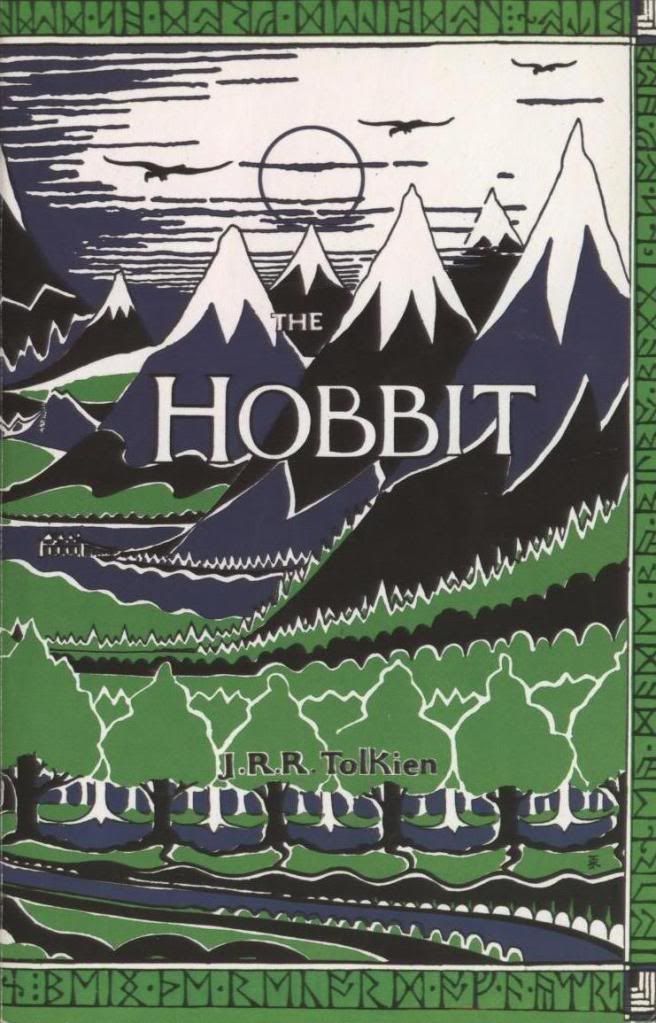
The Hobbit by J.R.R. Tolkien
Not the exact cover I had (a very plain green hardcover with some embossings, the spine actually had The Hobbit written in runes and left me hunting all around for the book at first) but this cover looks a lot like the illustrations in the book and apparently is based off a design Tolkien did (tvtropes says this is the dustcover of the first edition). Yes, my copy actually had illustrations in it which I believe were done by Tolkien himself. There weren't a lot of them, hence why I didn't give this review an art section, but it was an interesting touch and I liked it.

Summary: While Bilbo Baggins comes from a family of hobbits that sometimes has adventures, a most improper thing, he has never felt the urge to venture any farther from his hobbit hole than he has to and doesn't see that changing anytime soon. But an old friend of the family, the wizard Gandalf, drags Bilbo into an adventure with thirteen dwarves to reclaim a horde of treasure stolen from a dragon and Bilbo takes to adventuring better than he expected. 

The Good: Having now read the story myself I do think there is enough material to make two movies out of the story and that this isn't just a "money-grubbing move" by the studio, while short there is a surprising amount of stuff that goes on. The story itself isn't very complicated and doesn't have any real twists to speak of either but again, more happens in the story than you would expect and it's a rather satisfying read. By the end of the story you've seen Bilbo and the other characters get in and out of nearly half a dozen situations and it feels like a full, complete story.

The Bad: The pacing is bit odd at points, sometimes there are action scenes back to back to back and other times it seems like there's a long gap between events, hopefully with the movies adding in some additional stories the pacing will be smoothed out. One thing I didn't recall was how a large number of the characters are a bit unlikable and hard to sympathize with. Everyone knows that elves are snobs and I remembered that some of the people from Long Lake were less than friendly but for the first part of the book Bilbo seemed like he was a character being dragged around by the plot instead of interacting with the plot (tvtropes even lables him on the sliding scale of anti-heroes for this part) and I had forgotten that the dwarves also have their moments. This might not bother some people but I was rather surprised and I'm curious to see if they'll keep such things as Bilbo's early unlikability in there (I hope they do since it really makes him and Frodo very different characters).


As I said the book is a bit on the short side so there's not a lot to talk about without getting into specific plot points but I was happy to see that I enjoyed this more than I expected and I really want to go, (re?)read the Lord of the Rings, watch the movies, and then catch the new movie when it comes out in December. I suspect I'll enjoy LotR more, simply because I like complicated, political high fantasy, but this was still a fun read. 

Saturday, May 12, 2012

Book Review: Click

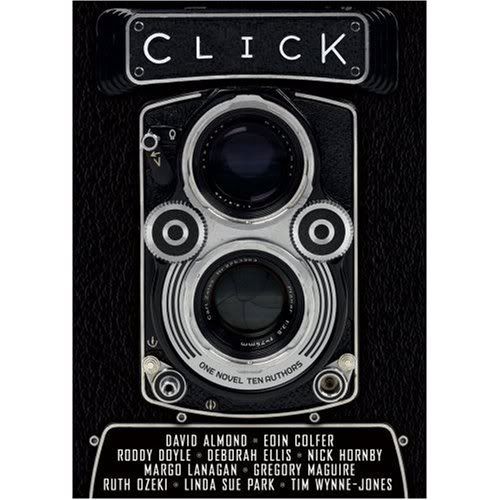
I noticed this book at the library for the cover, you simply don't see a lot of twin-lens cameras on the cover of books, and checked it out for the premise, ten authors all writing a different chapter in a cohesive story. Something that ambitious has the potential to fail horribly of course but with an idea that different I couldn't help but be curious about it, plus it was a fairly short book (around 200 pages, most books I read are around 300-400ish) so there wasn't any reason for me to not give it a go.


Click by David Almond, Eoin Colfer, Roddy Doyle, Deborah Ellis, Nick Hornby, Margo Langan, Gregory Maguire, Ruth Ozeki, Linda Sue Park, Tim Wynne-Jones

Summary: When Grandfather George "Gee" Keane dies he leaves behind a few gifts for his grandchildren, a box of sea shells for Maggie and photographs for Jason. But as a photographer he touched many more lives than just his grandkids and had a few secrets that even his family didn’t know

The Good: There were a few chapters in the book that focused more on the grandfather and, contrary to my expectations, I really liked those stories. One chapter focusing on the girl who thought she was a fish (I believe it's the second chapter, Annie by David Almond) was a great example, someone else’s story with the grandfather only appearing briefly as a side character, it reminded me of some slice of life anime I’ve seen over years where there’s a central, reoccurring character but not every story they appear in is their own. I think I would have liked the book more if the stories had been more like that more about how the grandfather affected their lives than the grand plot it created that tried to go beyond that (another other chapter in the book that was like that was Jiro by Ruth Ozeki, again this chapter felt like a complete short story and didn't contradict anything the reader had already read).

The Bad: As mentioned in the intro, each of the ten chapters was written by a different author and the final result is a bit schizophrenic. Some of the characters have completely different personalities in different chapters (the son Jason was the worst recipient of this, there’s no way he could’ve dealt with all his issues as quickly as he did) and there were simply some really strange themes in there, like some of the characters having the ability to create living duplicates of themselves and live separate lives (while the original is still completely aware of what the duplicate is doing). The time-skips also felt rather erratic, sometimes stories took place one after another and other times there are decades long gaps, it makes me wonder just how much planning, if any, went into the overall flow of the story, it feels more like a round robin than an anthology and just doesn’t quite work.


While some of the individual stories were alright I just can't recommend this book since it just does not work as a cohesive work. Most oddly put together work I've read in a few years, can't say it really made me want to check out the other works by these authors either. 

Saturday, April 14, 2012

Book Review: Life on Mars: Tales from a New Frontier

Back in January when I was at the library trying to find the tv show Life on Mars I was also hunting around to find a few books which didn't seem to be on the shelves like they were supposed to be. So I decided to check out the new books section as a last resort and, while I didn't find the books I was looking for, I found a book called Life on Mars just staring me in the face. I'm not sure if this was the universe's way of mocking me or an apology for the tv show being out but in any case I decided to check this one out, especially since there were a lot of authors in there I didn't recognize (the only authors who I was familiar with were Nnedi Okorafor and Cory Doctorow*).


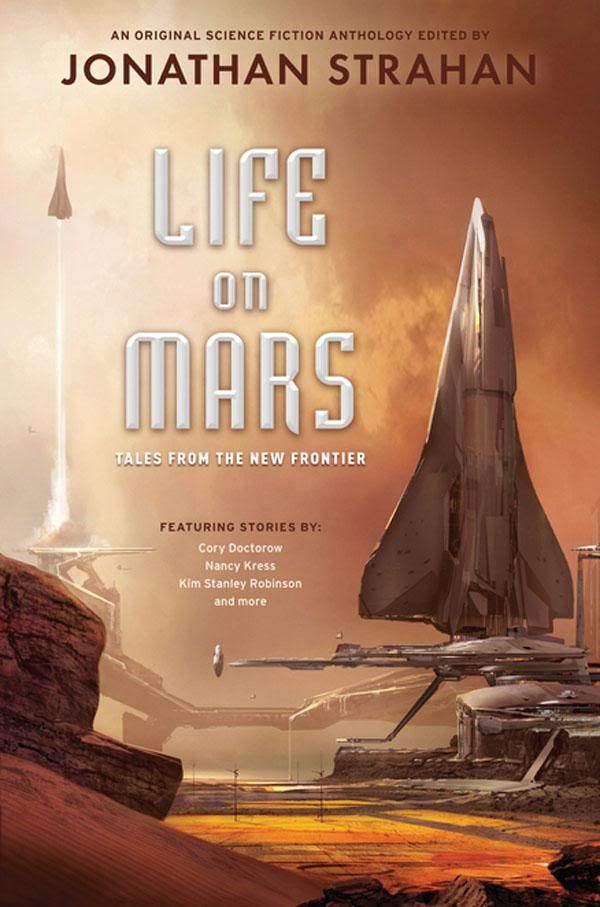
Life on Mars: Tales from the New Frontier edited by Jonathan Strahan


Not much to say about this cover, it works well showing what the book is about but honestly with a title like that the cover doesn't need to do much explaining. I did like the color scheme used though, it was a smart move to use that dusty red-color to tie everything together since that is a color people associate with Mars.

Summary: 12 authors and 12 different takes on Mars, our next frontier, and what kinds of lives we’ll live there.

The Good: There were some genuinely interesting stories in this anthology, I liked the few that dealt with the health aspects of living on Mars (“Goodnight Moons” by Ellen Klages and “Martian Heart” by John Barnes, even though those stories were a bit more tragic) and the ones that focused more on the kind of technology in the future (“The Taste of  Promises” by Rachel Swirsky), and one towards the end which was about the very first steps to Mars (“Discovering Life” by Kim Stanley Robinson). In short, I liked the ones that spent a bit more time thinking about their setting and making it the focus of the story instead of, well, the background. There were details in nearly every story that I found cool (like the journal in “The Old Man and the Martian Sea” by Alastair Reynolds, it reminded me a bit of the books in The Diamond Age by Neal Stephenson) and it is harder to fill a story with details when it’s only 20-30 pages long but in an anthology it’s the details that separate the okay stories from the great ones.   

The Bad: I know that most, if not all, of the stories would have been written without knowing what the other contributors were doing and that you should therefore view each story separately but I was still surprised (and annoyed) at the sheer number of unlikeable lead characters in the stories. I think I only really liked two or three leads (all from different stories), the rest were simply too ignorant, mean-spirited, or just plain boring and I didn’t care about them. I was also sad that out of all of the stories none of them were set on a fully terraformed Mars far in the future, there’s a limit to how many stories you can read set in the exact same setting before it simply gets tedious (I read these over the course of a week and a half alongside another book so it’s not like this was even the only thing I was reading at the time and they still got tedious).

Not a super strong anthology, honestly I would rather recommend people a whole slew of other science fiction books to read instead but who knows, this could still appeal to some people out there I suppose. And it looks like this might be my last science fiction review for a while, glancing at my to-read list it looks like it's once again dominated by fantasy (with some realistic fiction in there, no clue where that came from), little sad that I'm ending such a long streak of sci-fi reviews with a whimper instead of a bang.


*ironically enough, I think both stories by them fit into the canons they had created in the books of theirs I have read. I can easily see The Martian Chronicles game being a progression of the games in Little Brother and For the Win by Doctorow and Okorafor's young adult books are set in a post-apocalyptic Earth where people have developed magical like powers, the same ones described in her short story (although I didn't realize this until I finished reading the story, her works are also set in a 'verse with alternate worlds, an odd combination with post-apocalyptic and it's been a few years since she had a YA book come out).   
 

Saturday, April 7, 2012

Book Review: The Girl with the Dragon Tattoo

This year at my family's Christmas gift swap (we're so large it's easier, and much more fun, to do a White Elephant style gift swap so I never know what I'll end up with) I made off with the first two books in The Millennium trilogy and after I saw the Swedish version of the film I started the first book. I had been warned that it had a slow start thankfully or I might not have continued through with it but it's time for the review itself to talk about that.

The Girl with the Dragon Tattoo by Stieg Larson


Summary: Mikael Blomkvist is an investigative reporter facing jail time for libel after an article of his goes awry. While he is trying to avoid media coverage, mostly to avoid destroying the magazine he co-owns (The Millennium), he is contacted by the elderly Henrik Vanger with an interesting job proposition, to figure out once and for all what happened to his niece who went missing 60 years ago. Before Vanger hired him however he hired the talented and fiercely anti-social Lisabeth Salander, a hacker, to investigate Blomkvist and who took an interest in him. Blomkvist realizes that he needs help himself on the case and tracks her down as they start to unravel the Vanger family’s twist past.

The Good: Larson has managed to create a very intriguing mystery that’s hard to predict yet makes sense in hindsight. He juggles a good sized cast easily, it may be a bit difficult to remember who is related to who but you won’t confuse any of the characters. The pacing, once the story gets going, works well considering the story is spread out over a year (although I can easily see why the Swedish movie shortened and shifted around a few events) and it's nice to see that Blomkvist did not immediately solve the case but that it did take a lot of extra effort and time to bring the facts to light. The ending was also a bit different from the ending of the movie however, while it was interesting to see such a different tone and track taken, I do wonder why Larsson wrote that ending.   

The Bad: Since Stieg Larsson is dead it may be crass to say this but the man apparently could not pace a story to save his life. It takes two hundred pages for the story to get going and lingers on for another hundred pages after the main mystery is resolved. The entire book is nearly 600 pages long and I’m curious to know if he did die before the book was fully edited and if it was published as is, that could explain a lot. I have nothing against long books but the problem here is that most of these extra pages is devoted to giving in-depth backgrounds to one scene characters. Some of these characters might be important in later books, especially since Larsson was planning up to ten books in the series, but wouldn’t it make more sense to do that in a later book? Also, I don’t know if this is a translation issue or if it’s from the original Swedish, but the portrayal of Lisabeth varied wildly during different parts of the book. Sometimes she seemed like an awkward, neuro-typical, young twenty something and other times she seemed genuinely crazy. This happened both when the point of view focused on her and when it was from Blomkvist’s POV and instead of making her a more rounded character she came off as very uneven instead. Finally, I know there is some controversy about this term around the internet, but Blomkvist comes off as a self-insert, Gary Stu at times. There are times when he’s an interesting character and feels well fleshed out and then there are moments, with how noble he is in his journalism and how every women he meets wants to have sex with him (which is apparently very good at), which feel like this is how Larsson wanted to be himself. Blomkvist does not feel like a complete Gary Stu but those traits were just so blatant that they annoyed me to no end.  

In the end this book made me appreciate the (Swedish) film even more for how it took a book with some rather large problems and smoothed them out very well. Currently I don't have any plans to see the American version of the film, I heard that some of the rape scenes were very graphic and wanted to watch it either through Netflix or on DVD (aka, where I would be able to simply fast forward through them) but I expect I will sometime in the next few months.

Saturday, February 25, 2012

Book Review: The Last Little Blue Envelope

I didn't have this book on the list of 2011 books I hoped to get around to reading in 2012 but that was because I had forgotten that Maureen Johnson had put out two books last year, not just The Name of the Star. Actually, I was also a bit surprised that this book exists, it's a sequel to one of her earlier works, Thirteen Little Blue Envelopes, which I thought stood perfectly fine on it's own and didn't see why it needed a sequel. In the original, Ginny Blackstone has received a package of letters from her dead aunt encouraging her to go on a crazy journey all across Europe, grows as a person, discovers more about her aunt (who had been rather eccentric and hadn't been in her life a lot the last few years) and eventually comes across her aunt's hidden collection of paintings and auctions them off. In the process however the last of the thirteen envelops is stolen along with Ginny's backpack and she's resigned herself that she'll never see the real thing, even though she figured out what the contents must've been. It's one of my favorite realistic fiction YA books because it's rather whacky, and who wants to read boring realistic fiction, so even though I was rather confused why it needed a sequel I was completely up for more crazy adventures.

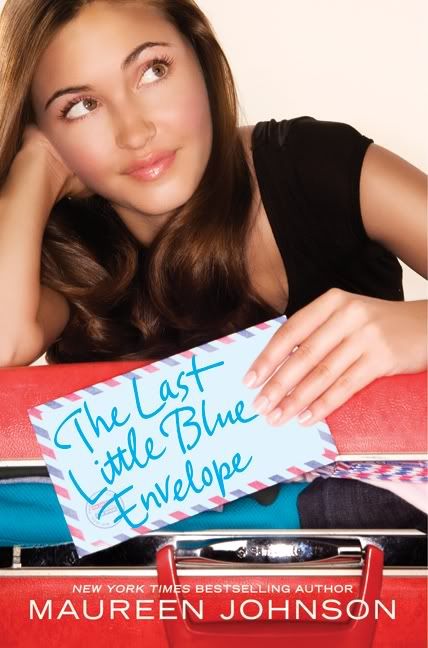
The Last Little Blue Envelope by Maureen Johnson
  I'm not particularly fond of this cover for no real reason (well, it's pretty clear to me that the title was added onto the envelope in post-production which bothers me) but it works. Maybe I just don't like all of the pinks, reds, and blues together, the colors seem to clash a bit.

Summary: Ginny Blackstone's adventurous summer is long gone and, as she's racking her brains trying to come up with a way to fit it into her college application essays, she gets an email from someone who has found her missing envelope and tracked her down. There's a catch however, the boy who found her envelope (Oliver) won't simply give it to her but insists on accompanying her as she follows the final instructions in yet another jaunt across Europe. Ginny's kinda-boyfriend from the first adventure, Keith, and his sorta-girlfriend as they all get involved in various hi-jinks.

The Good: The tone that I liked so much in the first book returns here and Ginny's adventures manage to oddly feel more realistic because of it's weirdness. The main events are certainly stuff that would only happen in a novel (breaking into a restaurant to steal a table? sure!) but I really did love a lot of the little moments, like when all four characters and said table are all trying to fit in a small car. I know that my life has plenty of quirky little moments in it so for me these two books feel a lot more realistic and like my life than most of the realistic fiction out there and it's a nice feeling. I also liked how Ginny progressed here, she's regressed a little bit from the end of the previous book (which is to be expected after she went back to her ordinary life for four months) so it was nice to see her grow back into herself and see that she finally gets some closure about her aunt's death. Really that was my favorite part, seeing her get that closure that she always wanted in the first book and didn't quite bit and letting that help her move forward in life.

The Bad: A small nit-pick, Ginny is applying for colleges in late December/early January (assuming she really did wait until her adventure was over to finish writing her essays) which seemed really late for the US*. As for bigger nit-picks, I understood why Keith was in the story again (Ginny has a history with him and that subplot is unresolved) but he just didn't add anything to the story. His girlfriend for me added much more, even though she seemed a bit extraneous, and Oliver's story felt rather unfinished. It's a short book, just under 300 pages, but I thought for someone who is so important to the story that Oliver would really get more development and in the end all there is is a bit of an awkward relationship. I was also sad that Ginny's uncle Richard didn't get more page time but since he's in London and the story spends over half of it's time not in London that's fairly understandable.

So I liked the tone of the book, really liked Ginny, and thought that every other character came off as unneeded which is odd since without these other characters the story wouldn't have happened in the first place. In the end the book was alright but I really need to reread the first book now to see if Keith really wasn't as nice as I remember or if his apparently personality change happened between the two books.


*in the US you generally apply in October for early admission, where you hear back in late January, and then by late November/mid-December for regular admissions (where you would hear back in the spring). I suppose applications might be open until December 31st but I recall doing mine a few years ago much earlier and with how studious Ginny is set up to be that bugged me.   

Saturday, February 18, 2012

Book Review: The Scorpio Races

This was one of the books from 2011 which I really wanted to read before the new year but just didn't have a chance, happily it appeared in the school library sometime while I was away (I'm starting to think I should just do a feature in June once I've had a chance to track down and read all the 2011 novels). I was a bit cautious going into this book since I liked Lament quite a bit on it's reread but didn't like Shiver and, while there are a few authors who change up styles often enough that I only like part of their works, normally that doesn't happen so I was half expecting to really dislike the book. Thankfully that wasn't the outcome, even though I still like Lament better.

The Scorpio Races by Maggie Stiefvater
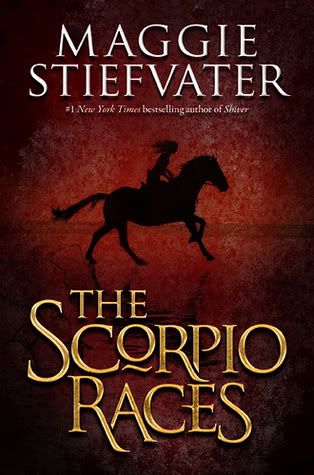
I think this is a pretty neat cover for a few reasons. One, I like the font used for the title itself (the little ~ under the o reminds me of a wave which I'm sure was the intent), the red background cover works well considering how dangerous the races are, and the silhouette (which I'm assuming is of Puck and Dove) clearly shows that this is a book about horse races, not about racing some odd kind of scorpion.


Summary: Every November the island of Thisby hosts the dangerous and infamous Scorpio Races where people (ie men and boys trying to become men) tame horses that come from the sea itself (capaill uisce) and then race then along the beach for fame and glory. Puck actually doesn't know too much about races, her family never followed them and since the capaill uisce killed her parents she and her brothers haven't wanted anything to do with them, but in a desperate bid to keep one of her brothers from leaving the island and to get the money to buy their home she decides to race on her regular horse Dove and take her chances. By contrast, Sean is the reigning champion who plans to race on his almost-tame Cor in order to win the money to buy Cor from his owner. 

The Good: It's an odd little detail but I was surprised at how the American tourist who seems rather interested in Sean comes across. Normally tourists in stories are loud and stupid, especially if they're Americans, but here he felt almost like a audience surrogate and  a clever one at that so I liked his inclusion. As for the bigger picture I liked the idea of the story, it felt like Misty of Chincoteague meets Hildago with some kelpies thrown in for good measure, that's a fairly creative mash-up and it never feels like Stiefvatater has ripped off those stories, rather that this is a story with some similarities to them. In short, the concept makes an old idea feel original which takes skill and is well-grounded in it's setting. It's also a great example of how a setting should affect all parts of a story, none of the conflicts would exist without the island and the culture it's created, so that really pleased me.  

The Bad: A lot of this book consisted of "Puck and/or Sean wondering if they should do something" which, as I've said before, really isn't my cup of tea and the story does take a little while to get going. It's not slow paced per say but to give a good description of the story, like the one I put up, you have to mention things that don't crop up until almost halfway through the story. There is plenty of character interaction and a few subplots that happen but in the end those don't end up mattering a that much and I did just get a bit bored by the earlier bits.

Overall it was an enjoying read and I'd love to see a movie version come to fruition, I know the rights have been bought so who knows where it'll go from there. Now if you'll excuse me, Stiefvater has created a recipe for a fictional dessert she put in the book and I need no excuse to go bake cakes, especially book inspired ones.   

Saturday, February 11, 2012

Book Review: Changeless

As a quick heads up, it looks like there won't be a review tomorrow since I've had just a hard time getting a hold of tv shows/movies to watch. I hate to miss an update like this but I just don't have anything and, looking ahead, I'll have plenty of stuff for the next month or two afterwords. My school has simply spent the first month and a half playing movies I have no interest in and I've had a time and a half getting a hold of Life on Mars (plus I kinda thought that Once Upon a Time and Grimm would be done by now and now it looks like neither of those will be finished until May). Again, sorry to do it but after this I don't foresee this problem popping up for another few months at leas.

So, as for the actual review, I read Soulless quite a while ago and hadn't gotten around to the sequel since I was having even more trouble finding a copy of that then I had of the first book. No idea why but I eventually had to utilize the inter-library loan system to get a copy of the book from half-way across the state and it looks like I'll have to do something similar to get the next few books as well. It's a shame that it's been so hard for me to find these books, it's a fun series, it's regular adult fiction (or possibly romance fiction, I'm not 100% sure) which I don't read that often so it's a nice change of pace and I just don't know what my libraries seem to have against it, maybe it's the publisher?

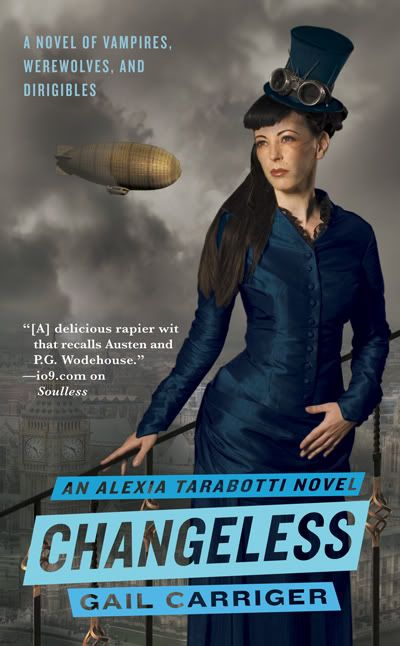
Changless by Grail Carriger

Summary: Picking up where the last story left off, Alexi is now married to werewolf Alpha Lord Conall Maccon and has settled into her role of prenatural (ie, completely unmagical to the point where her touch turns werewolves and vampires into humans again) adviser to Queen Victoria. Recently there have been some strange events that have puzzled everyone in the supernatural society, a "normalization field" where all ghosts in it are exorcised, vampires become human, and werewolves are unable to transform. Conall chooses at this time to run off to Scotland to deal with pack business with a personal connection for him and Alexi has to chase after him, especially since the normalization field is tracking north to Scotland as well.

The Good: Alexi is a clever and competent lead who is quick on her feet and holds her own in arguments, I really enjoyed her as a main character, she's just fun to read about. I also like a lot of the supporting cast, special mention goes to newcomer Madam Lefoux whom I have heard is a reoccurring character in future books, although I was a bit sad that the change of setting meant that some characters got less page time than they had in previous books. The story does a good job at expanding the setting and further establishing it as an alternate reality and I hope that the next book expands it even farther.

The Bad: Unfortuantly a good bit of the conflict in this story arises simply from miscommunication and it's just not a good thing when you have to have characters willing not act in their best interest to draw out a plot. To the story's credit however this was only done by side characters and Alexi is quick to point out how stupid this all is so none of the main characters had to grab the idiot ball for this to pan out (well, mostly, there is some towards the end to create the conflict for the third book which made me wince). There were points in the later half where the story moved a bit too slowly, again mostly because of some obvious and infuriating miscommunication, but the first half moved quite quickly. Also, really don't understand the choice to shove Alexi's half-sister into the story and make her travel with them as well, I really don't understand that choice and don't think she needed to be in the story at all.

I really enjoyed this installment and as soon as my to-read pile becomes a more reasonable size again I'll put in another request for the next book. The fifth (and I believe final?) book in the Parasol Protectorate comes out in March so I don't think I'll have time to read all the other books before that, as was my original time, but hopefully some library will have a copy of it once I get through the next two.