Most of the buzz I saw for Studio MAPPA last fall was their unexpectedly good series Rage of Bahamut: Genesis which I found enjoyable and way better than any card game-based series ever has a right to be, but it was there other series that first caught my eye. I've seen bits and pieces of tokusatsu shows before but the hamminess of Japanese live action is a mild turnoff at the very least so it's not a genre I actively seek out. Put it in anime however, which for some reason has that same hamminess much less frequently, and I'm game for trying it out!
Garo
Over on Star-Crossed Anime Blog, Psgels (I believe this is where I first heard about the series) dubbed this one of the "50 episode Shojo Series of Awesome" and while awesome may be a bit of a strong word I will back him up and say that this is a really great show. I'm more familiar with the shojo demographic of manga than I am with shonen/senien/josei and for me this series was a fun throwback that felt like a mixture of 80s/90s adventure shojo and a number of turn of the century books for girls that I read when I was about ten (The Secret Garden, Heidi, Betsy, Tacy and Tibb, Anna of Green Gables). Those two kinds of stories might not sound that similar at first but they really are, they're almost slice of life stories focusing on the main character as she grows up and her relationships with her friends, her crushes, and the world in general (and the western novels often focus on the girls for years and years which is something you don't really see replicated in any kind of YA fiction these days). And that description fits Nadja to a T, the story starts out with a very small goal but gradually grows in scope until it becomes not quite a coming of age story (merely because Nadja is only 12) but something rather close.
Ashita no Nadja
With so many new books to keep track of this year it's not surprising that one or two nearly slipped my mind, after all it's not like I'm thinking of medieval, nearly-France, or assassins everyday. However my new library system actually has a section within the young adult section (the section forbidden to over-eighteens after 3pm on weekdays and all day on weekends, for once my ambiguous age appearance works in my favor!) dedicated to new books and that has helped me out quite a bit in keeping track of books. Now, if only all the books I wanted to read would magically pop up there....
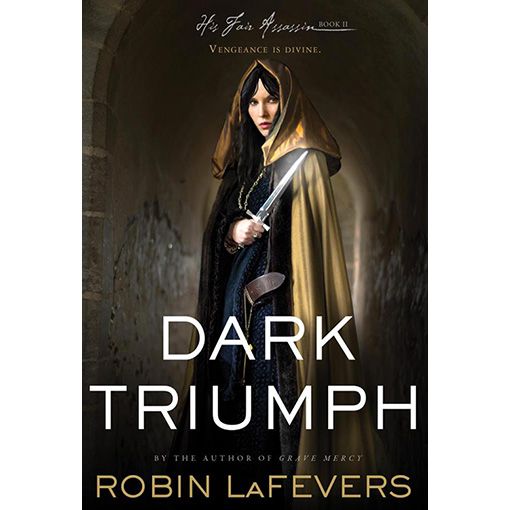
Dark Triumph by Robin LaFevers
For those who don't follow my twitter or tumblr (which I suspect it a large number of people) the past couple of times when I've gone to the library I've just grabbed a ton of books, quite possibly more than I'll have a chance to read this summer! And whenever I do this there will be a number of books in my pile, once I've gotten past the top of the pile with all the books I've wanted to read for a while, where I look at them and go "huh, this could be interesting but I'm not completely sure why I picked this up." Sometimes I end up really liking these books and other times, well, they fail to leave an impression.
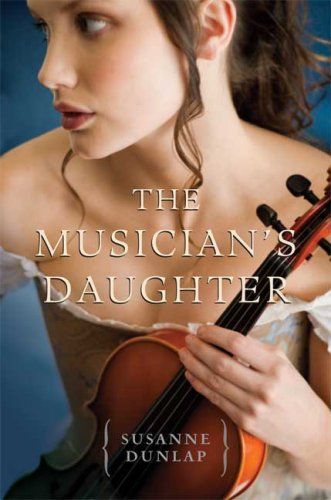
The Musician's Daughter by Susanne Dunlap
Summary: Theresa Maria's father is a court musician in 18th century Vienna and when he's murdered one night she realizes that there was much more to him than that. She then sets out, questioning everyone she knows, about why her father died and what happened to his precious violin in the process?
The Good: This is certainly a setting I haven't seen before, there have been many times when I've seen people complain that so many books (usually fantasy, which this isn't) are set in Europe and I feel like they're being too generous. Austria lies in the middle of Europe and even then that's too far away for many stories to be set, literature is in some ways fascinatingly limited and it's sad that even a setting like this which I've at least heard of from my history classes is almost exotic (especially since they didn't use as much as I think they should have). And on that note I found the underlying plot, regarding freedom for the serfs and land for the Romani, interesting and want to read more (nonfiction) about all of that which is for me what I hope to get out of every historical fiction I read, a renewed interest in perusing history especially history which I'm unfamiliar with.
The Bad: I'm not exactly sure how a book that had intrigue, action, and multiple little climaxes managed it but I found this book just a bit dull. Perhaps it's because I also found Theresa Maria to be a bit of a bland protagonist, yes she was smart enough to be able to keep up with (and was largely unsurprised by) the political machinations that have crept into her life and brave enough to try and save those close to her but she like most of the rest of the book just failed to leave an impression on me. The pacing did feel a little off as well, that there were too many events happening in such a short span of time to feel believable and perhaps if some of the plotting had been simplified to build up the world and Theresa Maria more that would have made the book stronger.
In the end I can only give this book 2.5 out of 5 stars since it was really that dull, even if I want to read more about the time period because I want to read about that since I've never read about it before, not because of how it was portrayed in the book.
I'd heard a few people recommend this series in the past year, most recently the fairy-tale webcomic Erstwhile likes to include recommendations to other works which are adaptions/re-tellings, and found out that convientely enough it was streaming on Netflix. I haven't actually seen any works involving Jim Henson's puppets except for The Muppets (to my knowledge anyway and I think I'd remember something like this) but this seems like as good a place as any to start.
Jim Henson's The Storyteller
Summary: Join and old storyteller and his dog as they retell old tales, happy and sad alike, around the fireplace
The Good: The series is on the short side, clocking in around six hours all told and each episode is a bit under a half hour, and I thought that the pacing worked well and that none of the tales were compressed or overly drawn out (I'd imagine the length also probably helped this reach a wider audience of younger viewers, it feels more like an All-Ages show than one strictly for children or adults). I've read a number of fairy tales over the years so it was nice to see some old ones reappear (such as Stone Soup which was a staple of my childhood) as well as ones I didn't know (such as All Fur, funny enough it's also the same tale Erstwhile is currently adapting). The stories are from all over Western Europe, with one or two coming from Russia of course, and that diversity also let each tale feel distinct. Best of all there were no attempts at shoehorning in a morale at the end of each story, while some had an unstated lesson in them some of them were just stories and sometimes that's what they need to be, just tales told around a fire.
The Bad: A story told in tv or movie format has two very important aspects to it, audio and video (aside from plot, although occasionally some directors seem to think that one is optional) and I'm always more drawn to the visuals of a story than the audio. So when I have a story where the visuals aren't as strong, which was mostly due to the aging which I talk about below, I have much less incentive to actively watch the video instead of simply playing it in the background and I really had that problem here. The stories were interesting, just nothing that demanded a visual and audio medium instead of a text medium and I might have payed more attention in that area. This isn't a fault of the story per-say, it simply didn't grab me enough to make me want to see and hear every detail instead of just listening and popping in and out with the video.
The Audio: The show has the right balance between narration by the storyteller and letting the story progress on it's own and aside from the narration there was some background music but not a lot that stuck with me. A few did, most notably the music played with the ending credits, but perhaps in such a dialogue heavy show it's good that the music didn't overshadow the meat of the story.
The Visuals: The film itself has aged poorly and looking bad by any standard which is always a shame. The puppetry and costuming looked fine, although with the grain and small size of Netflix's viewer it would be nearly impossible to see strings manipulating the puppets or such anyway. It does take a little bit of time to get used to see puppetry instead of CGI, the movements are much more fluid than what CGI can make and that realistic motion almost makes them appear "too real" and in the process stand out even more. It's an interesting change of pace for someone whose so used to CGI and I'd love to show a few episodes of this to other people who also aren't familiar with Henson's works just to see their reactions as well.
An interesting show but I doubt I'll be checking out the other part of it, it seems a few years later the same crew make a second series focusing on Greek myths (which I do like, with a name like Helen you simply can't avoid them) but I don't feel like I'll get anything out of it. Ah well, both series are streaming on Netflix instant for those interesting in trying it out themselves.
I didn't have this book on the list of 2011 books I hoped to get around to reading in 2012 but that was because I had forgotten that Maureen Johnson had put out two books last year, not just The Name of the Star. Actually, I was also a bit surprised that this book exists, it's a sequel to one of her earlier works, Thirteen Little Blue Envelopes, which I thought stood perfectly fine on it's own and didn't see why it needed a sequel. In the original, Ginny Blackstone has received a package of letters from her dead aunt encouraging her to go on a crazy journey all across Europe, grows as a person, discovers more about her aunt (who had been rather eccentric and hadn't been in her life a lot the last few years) and eventually comes across her aunt's hidden collection of paintings and auctions them off. In the process however the last of the thirteen envelops is stolen along with Ginny's backpack and she's resigned herself that she'll never see the real thing, even though she figured out what the contents must've been. It's one of my favorite realistic fiction YA books because it's rather whacky, and who wants to read boring realistic fiction, so even though I was rather confused why it needed a sequel I was completely up for more crazy adventures.
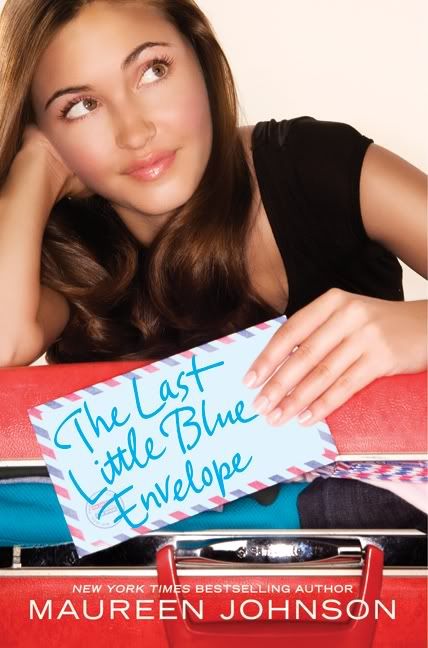
The Last Little Blue Envelope by Maureen Johnson
I'm not particularly fond of this cover for no real reason (well, it's pretty clear to me that the title was added onto the envelope in post-production which bothers me) but it works. Maybe I just don't like all of the pinks, reds, and blues together, the colors seem to clash a bit.
Summary: Ginny Blackstone's adventurous summer is long gone and, as she's racking her brains trying to come up with a way to fit it into her college application essays, she gets an email from someone who has found her missing envelope and tracked her down. There's a catch however, the boy who found her envelope (Oliver) won't simply give it to her but insists on accompanying her as she follows the final instructions in yet another jaunt across Europe. Ginny's kinda-boyfriend from the first adventure, Keith, and his sorta-girlfriend as they all get involved in various hi-jinks.
The Good: The tone that I liked so much in the first book returns here and Ginny's adventures manage to oddly feel more realistic because of it's weirdness. The main events are certainly stuff that would only happen in a novel (breaking into a restaurant to steal a table? sure!) but I really did love a lot of the little moments, like when all four characters and said table are all trying to fit in a small car. I know that my life has plenty of quirky little moments in it so for me these two books feel a lot more realistic and like my life than most of the realistic fiction out there and it's a nice feeling. I also liked how Ginny progressed here, she's regressed a little bit from the end of the previous book (which is to be expected after she went back to her ordinary life for four months) so it was nice to see her grow back into herself and see that she finally gets some closure about her aunt's death. Really that was my favorite part, seeing her get that closure that she always wanted in the first book and didn't quite bit and letting that help her move forward in life.
The Bad: A small nit-pick, Ginny is applying for colleges in late December/early January (assuming she really did wait until her adventure was over to finish writing her essays) which seemed really late for the US*. As for bigger nit-picks, I understood why Keith was in the story again (Ginny has a history with him and that subplot is unresolved) but he just didn't add anything to the story. His girlfriend for me added much more, even though she seemed a bit extraneous, and Oliver's story felt rather unfinished. It's a short book, just under 300 pages, but I thought for someone who is so important to the story that Oliver would really get more development and in the end all there is is a bit of an awkward relationship. I was also sad that Ginny's uncle Richard didn't get more page time but since he's in London and the story spends over half of it's time not in London that's fairly understandable.
So I liked the tone of the book, really liked Ginny, and thought that every other character came off as unneeded which is odd since without these other characters the story wouldn't have happened in the first place. In the end the book was alright but I really need to reread the first book now to see if Keith really wasn't as nice as I remember or if his apparently personality change happened between the two books.
*in the US you generally apply in October for early admission, where you hear back in late January, and then by late November/mid-December for regular admissions (where you would hear back in the spring). I suppose applications might be open until December 31st but I recall doing mine a few years ago much earlier and with how studious Ginny is set up to be that bugged me.