Showing posts with label light novel. Show all posts

Saturday, October 17, 2015

Book Review: Log Horizon volume 1

As I alluded to in my Tokyo Demons 2 review, I was reading a real light novel recently! I really enjoyed the Log Horizon series while they were airing so, since I've already poked into the side material some, it was natural that I'd pick up the light novels and see how everything played out originally.


Log Horizon by Mamare Touno, illustrated by Kazuhiro Hara, translated by Taylor Engel


Sunday, October 11, 2015

Book Review: Tokyo Demons volume 2

"Alright Helen, what's your excuse for not having this review up on time?" Well, it was one I was having some trouble with this review which is never a good sign. Plus, I'm trying to cut back on caffeine but had a soda at work Friday and spent literally nine hours trying not to bounce off of the goddamn walls, made focusing on writing a little hard! And with the fall anime round-up coming up on Monday it's been a little chaotic around here.....

Tokyo Demons: Add A Little Chaos by Lianne Sentar, illustrated by Rem


Saturday, January 12, 2013

Book Review: Kieli: In the Sunlight Garden Where It All Began

Well this is quite a bit later than I expected, I had originally hoped to have this review done months ago but I got delayed purchasing the second book and then I just had so much to read that it got pushed to near the bottom of the stack. But we're getting close to the end folks, the last two books come out this year in English and hopefully I'll have a chance (ie, the money) to pick them up at some point from a TRSI sale.

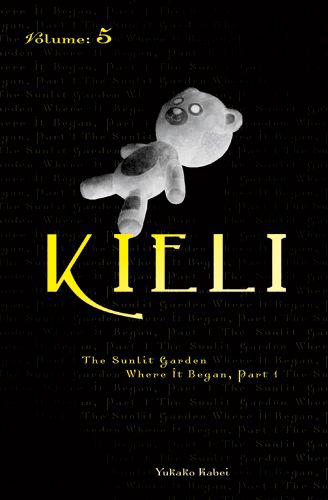
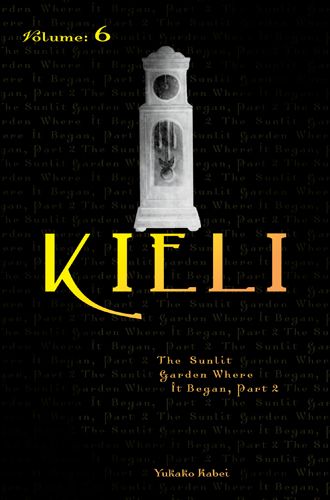
Kieli volumes 5 and 6, The Sunlight Garden Where It All Began Written by Yukako Kabie  


Summary: Kieli and Harvey, still searching for Beatrice, end up in a town that has a lot of memories for Harvey and Kieli learns more about his past than even Harvey can remember.

The Good: Well the story has finally shed some light on Harvey's past and while it didn't do anything I didn't expect it was still solid and brought up one or two interesting ideas (like the fact that the Undying literally are different people than they were in life, so different that you can have a ghost of their past selves that's not just an impression left on a place). The colonel also got a bit more backstory, really by now the story has explain all the main players pasts so I'm curious what it's going to spend the last three volumes doing. 

The Bad: While I was really optomistic that a two book story would really work here it just felt like Kabie was puttering around a lot of the time, trying to fill space with a story that was a bit more than one novel but not big enough for two. There are a surprising number of side stories in here and, even though they all feature characters who become important later on, most of the time they felt like fluff and I was annoyed. I really do think there was a better way to structure this story, even if I'm not sure how to do it myself. Also, we seem to have hit a bit of a dead end for Kiele's story (which was to find out more about her mother and, to a smaller extent, the Undying she had been traveling with) and it's going to take an extremely contrived coincidence to get that subplot moving again which is already bugging me.


So, certainly not one of the series stronger entries but a very necessary one. I think I can see what's turning in the background that will become important in the later books, now to hope that those books meander a bit less than this one. But first, I think I need to catch up with Book Girl (which also ends soon-ish, next January I think) and Spice & Wolf, curse you Yen Press for putting out so many series when I don't have the time or money for all of them!  

Saturday, June 23, 2012

Book Review: Spice and Wolf volume 5

So it appears that before I did have a good reason to worry that Yen Press had only licensed the first six (novel) volumes of Spice and Wolf since that was the case, however recently they announced they had licensed I believe the next three which actually makes me less worried. Sure the whole, 17 volume series isn't licensed but licensing through volume 9 shows that there is a market for them (or at least, the series is selling at or above what they predicted) and that they will license more if there is demand for them. So I guess my job now is to keep reviewing the books and convincing everyone else that they're worth buying huh?


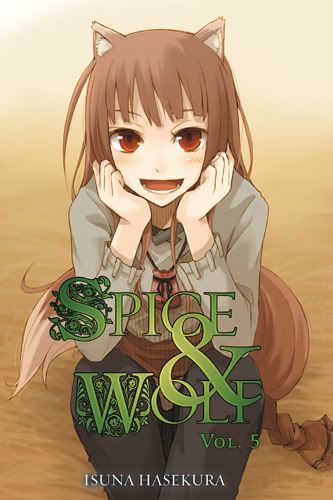
Spice and Wolf (volume five) by Isuna Hasekura, illustrated by Jyuu Ayakura

Summary: Covering the same material as the second arc of the second tv season, Holo and Lawrence have arrived in the town of Lenos where they have heard a town chronicler might have more records of where Holo’s elusive home of Yoitsu lies. A fellow merchant introduces them to him but they want some help in return, help with a risky endeavor involving the town’s fur trade that might end up being more than they can chew.

The Good: The books continue to excel in creating secondary characters that don’t feel like repeats of an earlier side character and are rather fleshed out for characters who (probably) won’t ever appear in the series again. This is a bit easier to accomplish in a story that spends a lot of time with the characters sitting around and talking but when you think about it it’s impressive just how many characters Hasekura has been able to create without repeating traits (and there are still 12 more books to go!). There was also some very good foreshadowing this time around and once again felt like a solid installment.

The Bad: So far the stories have been rather good at explaining the economics and politics that make up the various situations and I’ve been able to follow along (and having already seen many of the stories in anime form has helped) but this one did confuse me quite a bit. This didn’t make me like the story less per-say but when everything was said and done I wasn’t quite sure what had happened and I do hope the economics in the next book are easier to follow.


Despite my trouble with the economic parts I still thought this was a good installment, although I must confess I'm more excited for the next book since then we'll be dealing with completely new material again. Funny enough by now I really want to watch the anime series again, it's been a few years since I've seen it, I've now read all the source material, and Funimation has some rather good prices for both seasons now, hmmmm.

Sunday, June 10, 2012

Book Review: Book Girl and the Corrupted Angel

So, the reason this is going up a day late is that I just plain forgot to write this last night (I was thinking my Saturday seemed remarkably boring but just used the time to do other things instead). I am hoping to get out Sunday's regular post today as well to make up for it however, you would think after having the same schedule for months and months that I would forget things like this less often. Then again, considering that there is now a couple month gap between when I started a book and when I actually get around to reading it it makes a bit more sense. I certainly remember what happened in that latest installment in the Book Girl series, but after reading so many other books since then I had almost forgotten that I had read this one as well. Also, as noted on the Kieli review, unless the art completely changes or is completely amazing I'm not going to include an Art section in the light novel review anymore.

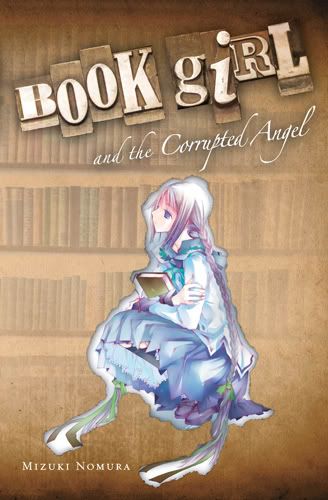
Book Girl and the Corrupted Angel by Mizuki Nomura illustrated by Miho Takeoka


Summary: Book Girl Tohko is busily preparing for her college entrance exams, although Konoha has his reservations if she'll actually get in anywhere. Konoha however finds himself helping out fellow classmate Kotobuki in the music room after school and becomes increasingly involved with her when one of her friends goes missing under strange circumstances. Without Tohko to lead the way Konoha has to fumble through the steps and try to figure out if life is imitating The Phantom of the Opera (who is alluded to in the friend's messages and notes) or if the truth is rather different.

The Good: It took me a long time to get into this story and a big reason for that was because I find Tohko the more likable of the two leads but this story did clear up a few things about Konoha. Before I had been rather skeptical of his panic attacks, he (like many characters in light novels I've noticed) is always so internal it can sometimes be hard to tell just what is going on but this book confirms that yes, he really is still messed up after the events involving his friend Miu years earlier. But around the two-thirds point of the story, when it started to diverge more from The Phantom of the Opera that's when I really got into it and I thought it was a satisfying story. Kotobuki also got some character development here which was good not only because she has ended up being the largest supporting character so far but because, unless I am completely missing the mark, her feelings for Konoha are going to become even more important in the following books (especially with Miu set to finally appear in the next volume).

The Bad: As I mentioned above, I prefer Tohko to Konoha as a lead character since she's much more decisive and interesting so I am a bit nervous now for later books where she may no longer be around (there are only about three months in-story until her graduation I believe). Konoha can hold the story together but he really, really needs a lot more character growth before I can tolerate him for more than a couple chapters at a time. And, another reoccurring complaint of mine, while I know full well that many people do have less than ideal lives where terrible things happen to them or they become so twisted from their own ideas that they almost cause terrible things to happen to them I'm still a bit incredulous about how many of those people Konoha and Tohko run into. I could find the situation involving Kotobuki's friend believable but some of the other characters had to be so twisted to make this story happen that I wasn't able to suspend my belief the entire time and that's just not a good thing.

So, I'm coming to the same conclusion that I did for Kieli, that these books are best read with a smaller gap between them (say one or two months) than the gap caused by the release pattern in the US (six months, although seven this time since the next volume got pushed back a month). I also came to this conclusion after watching some of Hyou-ka, a currently airing mystery anime which has a similar feel to this one, that perhaps a more serialized publishing schedule might work better for stories which have small, volume long arcs but with a more ambiguous overall arc that grows more and more important as the story goes on. Not sure what to do in that case, the final volume won't be out in the US until January 2014, maybe I should start making cliff notes for each volume as well...    

Saturday, May 26, 2012

Book Review: Kieli volume 4, Long Night Beside a Deep Pool

Unforutnatly it appears that my plan to take March off to catch up with my reading seems to have backfired, currently I'm still talking about books I read back in March so apologies if some of these reviews have been a bit short, I'm starting to get a bit hazy on all the details. Of course, I'm a bit hazy on details of previous light novels in general anyway so there might not even be a difference here. Also, I've decided that since I'm well into each of these light novel series that I'm going to stop talking about the art. By and large the art hasn't evolved much and, rather than say the same thing over and over, so I'll be dropping that part of the reviews unless the art undergoes a major shift.


Kieli volume 4: Long Night Beside a Deep Pool by Yukako Kabei

Summary: After the incident with the spaceship in the third book, Harvey, an Undyding (a super solider from a war decades earlier whom the Church has vowed to hunt down and kill on sight) has left to look for more information concerning Kieli’s mom and it’s been a year and a half since then. When they get a short note from him Beatrix, whom Kieli has been living with all this time, Kieli and the Corporal, the spirit possessing an old radio, set out to find him again. But things haven’t been going well for Harvey since then

The Good: The story continues with a plot point picked up from the second novel, the mystery surrounding Kieli’s parents (particularly her mother) and a few details are answered here (such as who the Undying who was traveling with her). Not all is explained, of course, but it was more than I expected so I felt satisfied there. The story also has developed another interesting thread, Harvey seems to be dying (or at the very least not truly an Undying anymore) and given that none of the characters seem to have realized plus their tendency to get into all kinds of trouble this is sure to become even more important as the series progresses.

The Bad: I’ve realized by now that most of the light novels I read aren’t meant to be read with a 6+ month gap between them because of the way they flow from one story to the next not like separate installments in a series but rather likes parts of one whole story, and I’m having some trouble enjoying them as much. Actually, I thought that alone was the reason for one of my issues in the book, Julius. As far as I could recall he had been a rather young character in the second book, around 8 or 10 at the oldest (younger than Kieli in any case) yet here he acted and had the privileges of someone who was closer to 17 or 18. I went ahead and checked the illustrations of the second book and no, I was right the first time around, Julius feels much too mature for whatever his age is and that really bothered me.  

Sunday, October 23, 2011

Book Review: Spice and Wolf (volume four)

Funny story here, I didn't actually mean to get a copy of this book when I did. Back in August I had my mom place a RightStuf order for me (since I was going to be out of town when the final Utena set went on pre-order and I was afraid they would sell out of the rings before I had a chance to order) but a few things went screwy, my mom accidentally placed two orders instead of one and I didn't know about this until TRSI had a Yen Press sale and I went to add this volume to my cart and discovered that not only was it already in one of my orders but it had shipped as well. Oops, although I wasn't too unhappy at this turn of events since I wanted to read the volume soon anyway, especially since volume four was not covered by the anime (season one covered volumes 1 & 2, season two covered volumes 3 & 5) so I was curious to see if there was a reason Brains Base had chosen not to animate this novel.

Spice and Wolf by Isuna Hasekura, illustrated by Jyuu Ayakura
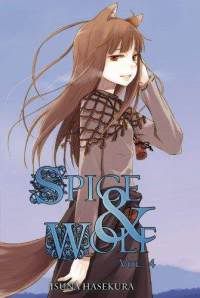
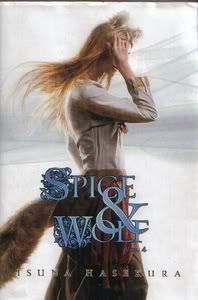
  Here is the American cover which is also better than the previous ones but the plain white background bothers me, sure there are regular novels with white backgrounds but it's usually a very minimalistic style cover and this just isn't minimalism, especially with that kind of font used for the title.

Summary: About a week after their last adventure, Holo and Laurence are searching for an abbey they heard about in Kumerson that has a large collection of pagan tales and hopefully more information on Holo's lost hometown. But when they arrive in the village of Tereo they encounter unexpected resistance and an interesting arrangement between the village and the nearby town of Enberch.

The Good: I'm not sure why this story wasn't adapted into the anime version (perhaps it's too similar to the next story?) because it was a fairly solid story that uses yet another point of commerce for it's conflict and has a rather clever solution in the end. Holo and Lawerence's relationship continues to progress forward slowly (it's a little hard to remember that the novels only have a short gap of time between them, that makes the speed the relationship is developing at seem much more realistic) but there certainly is progress for both of them.

The Bad: The ending does feel a little bit like a deus ex machina (funny enough, it both kinda is and is supposed to be seen as one) but I still thought it was a clever solution. Elsa (the priest in Tereo and one of the major characters) felt a little flat to me despite Hasekura's attempts to make her a more rounded character however. She had quite a few scenes and made decisions but never seemed to have a lot of personality to me and I simply had a hard time caring about what she was doing as a result. The other side characters were much more interesting (such as the village elder, the miller and the bar keeper's wife) so I was sad that Elsa felt so dull for the entire story.

The Art: The illustrator for Spice & Wolf is the same as the previous novels so the art remains unchanged. The designs are a little too simple for my taste (which is odd, generally light novel art is more intricate than manga art which is turn is more complicated than anime artwork) but I really do like Holo's look on the cover.

So another good addition to the series, now to hope that it stays that way for the remaining 13 volumes. Funny enough this is the only Yen Press series I'm not behind on, really hoping that next year I can take advantage of more of TRSI's sales so I can try to stay that way since it's so frustrating to be volumes behind on the releases.

Saturday, May 7, 2011

Book Review: Book Girl and the Famished Spirit

The second installment in the book girl series (which I believe has six or eight main books, three collections of short stories and then another set of three or four side stories) which came out back in January and I've had it since then, I've just had so much to read between then and now. But with this I've managed to catch up with all of the books I currently own so hurray for that, to the library for the next batch!

Book Girl and the Famished Spirit by Mizuki Nomura illustrated by Miho Takeoka
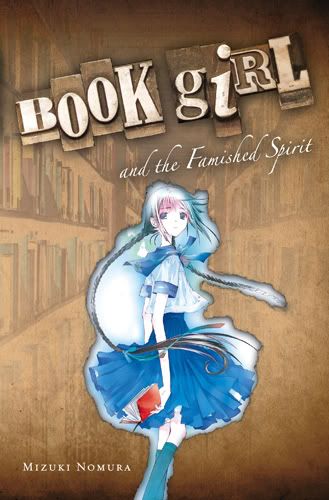
As with the previous cover, Yen Press has taken the original image (of Touku) and then made it part of a collage for the cover with the backwards letter blocks (literally, real letter blocks would go the opposite way) spelling out the title. It works fairly nicely and it's nice to see at least some of the original cover art retained, but I do wonder if Yen Press really needs to remake the cover each time, is it really selling them that many more copies?

Summary: Konoha Inoue is still writing stories for Touku Amano, president of the Book Club and literature eating goblin, and Touku still has the Book Club's mailbox set up for receiving juicy love letters, a favorite treat of hers. But this time around they instead find letters full of strange numbers which were apparently put there by a ghost, a ghost that looks an awful lot like one of the other students, Hotaru Amemiya, who has a very strange and twisted tale to tell.


The Good: Once again Book Girl delivers a surprisingly dark and grim story about how unhinged people can become, not exactly what you expect out of teen literature. The plot is interesting, even if it's a bit too twisty and hard to follow for it's own good at times, and all the characters get ample page time. Like the previous book* there are certain sections which are told from an unknown point of view so the book has reread value which is always a good thing. So, while there still doesn't seem to be an overarching story yet (which I've heard there is) it's still a very solid installment. 


The Bad: The book draws a lot of themes from Wuthering Heights, specifically the romance, and I really hated the romance in Wuthering Heights. It just completely rubbed me the wrong way so the way the romance was resolved here completely rubbed me the wrong way as well and left a nasty taste in my mouth. That left me rather unhappy with the later part of the book and I think I was supposed to sympathize with some of the characters in the end and just couldn't because of how twisted the romance was (in my opinion) and that's just not a good thing.


The Art: Book Girl uses the color pages at the beginning of the book to introduce the cast which is a nice touch. While several of them are returning characters (Konoha, Touku, Maki) others are new (Hotaru and Ryuto, although Ryuto seems to be set up as a future reoccurring character) and each one is accompanied with a quote that sums them up. Other than that, the pictures are interesting and a bit memorable but not necessary to the story as a whole.

I didn't like this book quite as much as the first one but I really didn't like Wuthering Heights when I had to read it for school (the joys of AP English Literature) so I'm not surprised. The next book isn't due out until August so clearly no reviews until then but I definitely plan on getting the third one!
     

*at least, I recall the first book doing something similar but I don't have my copy with me right now to double check.

Wednesday, April 20, 2011

Book Review: Spice and Wolf (volume 3)

Wow, I remember reading volume two way back in August but I just had so much else to read/buy that I didn't get this volume until my local Borders hosted their going-out-of-sale sale back in March. Fans of the anime will recognize this arc as the first half of season two (which is streaming on Funimation's website I believe but not yet out on DVD) and, as before, if you haven't read the previous books or seen the first season of the anime you're going to be a bit confused. Yes the plots of each book is rather self-contained but this is a very character driven drama and, if you don't know where the characters are coming from, you can't really appreciate where they're going.

Spice and Wolf by Isuna Hasekura
 
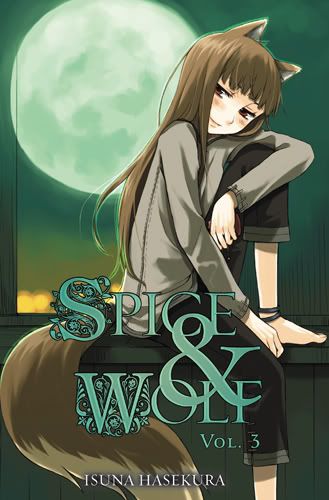
This is the only picture I could find of the American slipcover (I'd provide a better photograph myself but my copy of the slipcover is two hours away) but they're getting more and more similar. My only complain there is for them to get an actual tail and ears for the model to use, the airbrushing in photoshop looks awful and, speaking from experience, the tail and ears aren't even that hard to make.

Summary: Continuing in their travel's north towards Holo's homeland, Holo and Lawrence end up in the town of Kumersun and plan to stay a couple of days to enjoy the festival. But when the young fish merchant, Amati, becomes smitten with Holo and resolves to pay off her "debt" to Lawrence the two end up with a much more exciting stay than they bargained for. 

The Good: It's a new book which means a new economic quandary for Lawrence (and Holo, although she is more the cause of if here and doesn't help out as much) and the solution is very different from what the characters have had to do so far. The book also provides more information on Holo's hometown of Yoitsu (and seems to foreshadow who they will talk to about it in the next book) and hints that there are even more supernatural forces in the world than the duo have encountered so far. The book also tests Lawrence and Holo's feelings for each other even more so the story manages to have character growth, central plot progression and a story that is neatly wrapped up in one volume, not bad at all.
The Bad: Despite how well the story explains the various economic escapades, it's still going to take a little while to understand for the average non-business person to understand Lawrence's plan*. It's also frustrating to see Holo, who is always held to be the more mature one of the pair, simply break down, Lawrence's inability to explain what was really going on and, in the end, it's still somehow his fault and he's the one who has to apologize. Hasekura says that he has finally remembered how to write his characters but they still don't seem quite like the duo from the first book.

The Art: For an 18 or so year old boy, Amati looks awfully young. He looked rather young in the anime as well actually and now it's clear that wasn't a mistake on the animator's part, it comes from the original illustrations. Aside from that bit (which was distracting admittedly, it's hard to take his marriage proposal seriously if he looks that young), the art is consistent with the designs from the other two novels and the cover is rather pretty as well.

So, still liking the story well enough and I believe the final volume has now come out in Japan (volume 16, either that or the final volume will be a collection of short stories, volume 17, haven't seen anyone confirm which one it will be yet, although dammit I found a detailed, unmarked spoiler of the ending on a forum the other day, not happy about that). So just another six more years or so until all the volumes are out in the US, jooooooy.


*I'm speaking from my own experience here, I have a general grasp on economics but it still took me about fifteen minutes of mulling his plan around in my brain before I finally grasped how it was supposed to help him.

Thursday, April 7, 2011

Book Review: Kiele: White Wake on Sand


Back when I was working in the library I became very familiar with their manga section (I remember having to pull everything off the shelves and completely reorganize it several times actually) and grabbed the first volume of the manga adaptation of Kiele and was surprised by enjoying it way more than I thought I would. I later looked it up online and found out that it was an adaptation and decided to go ahead and buy the first volume of the light novels and again ended up enjoying it more than I thought I would. I haven’t gotten a chance to read the second manga volume (it’s a two volume series which I believe covers just the first light novel) but I do know that anyone who liked that manga will like the novels as well.

Kieli: White Wake on Sand by Yukako Kabei
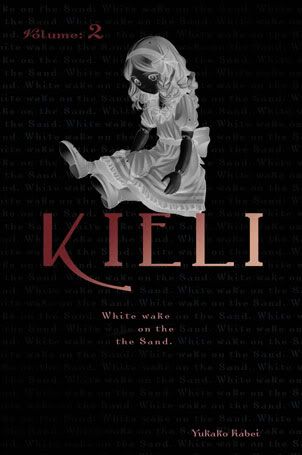
Yen Press got a lot of crap over changing the first volume of Spice and Wolf (which I disliked on the grounds that it was just ugly) but I never hear anyone change about changing the covers for other series and I don't think this is the original Japanese cover, mainly because the title in English is printed over and over again in the background. Regardless, I like the simplicity in the cover and how it has a picture that is very similar to the illustrations of the doll in the book, also like how each book's title is in a different color as well.
    
Summary: In a far off world that barely remembers that it’s a colony of Earth, Kielei is a young girl with the strange power to see ghosts and, since she’s always had a hard time distinguishing between them and the living, has always felt isolated from other people. Harvey is an Undying, someone who was experimented on during the great war 80 years ago and made immortal and unfortunately the Church has decided to kill all the Undyings they can find. The two of them (along with Corporal, the ghost of a solider from the war who is currently possessing a radio and playing underground rock music on it) are traveling the world now for no better reason than to keep moving, maybe because they keep being attracted to strange situations that never let them stay in one place.

The Good: It’s hard for me to describe, but I just like the overall feeling of Kieli. From the way the setting is described as a very plain and barren place (which I remember from the first book as well, it sounds like a very boring place to colonize) just to the general interaction between Harvey and Kieli it just feels right to me. Probably because the story feels like slice-of-life with a plotline (that is, a slice of life story and each book focuses on a specific arc within it), so stuff actually does happen, and I like seeing Kieli and Harvey grow closer to each other (in the end it's more of a character driven story than a plot driven one, character development as a result of plot?). It's the kind of novel where I can just sit down, read it, and feel satisfied in the end and I like having books like that.

The Bad: I do have to wonder, where is this story planning to go in the end? It’s completed in Japan at nine volumes (and it looks like YP has licensed all of them for release here, wohoo!) but there doesn’t seem to any overarching plot present. There are some hints about Kieli’s family which, looking at the summary for the next couple of books, look like they’ll become important but if nothing substantial pops up by the next book I’m going to be a bit worried. Also hoping that the various bit characters make a reappearance in later books since it seems rather silly to build up an emotional connection with them and then just never use it again.

The Art: Light novels have one or two illustrations per chapter and usually have a few color pages at the start of the book and I really like what the artist did with the color pages here. Normally it’s used to show the characters (like Book Girl does) or to show really important/dramatic scenes (like Spice and Wolf does) but here these pages are used to remind the reader what happened in the last novel. Overall I prefer the manga art to the light novel art (the art here just didn’t really seem very special) but I still did like the opening pages. 


Volume three is already out with volume four coming out later this month so I'll try to grab both of those in the coming months. Probably won't be as soon as I would like but I'm getting the rest of these books sometime for sure.


Sunday, December 19, 2010

Book Review: Spice and Wolf (volume 2)

Haven't been able to get a copy of the second Kieli but I found the second volume of the Spice and Wolf light novels quite easily. So again, it's been a while since I saw the anime (especially since this was the first season) and I read the first book back in December so I'd forgotten a few details when I started. Shouldn't interfer with the review at all but thought it's only fair to note.

Spice and Wolf volume 2 by Isuna Hasekura (illustrated by JÅ« Ayakura)
Nice enough looking cover but wait, Yen Press made their own this time too! This time the new cover was a slipcover and the Japanese cover was printed on the book (instead of vice versa) and here's the new cover:
Much better but geeze YP, I've cosplayed Holo and her tail isn't that hard to make and it would've been much better than the photoshopping they did here. So, certainly a better job but hopefully they'll have it down pat by the third novel.

Summary: Lawrence is your average merchant, always traveling and selling goods in the hope that he may some day have enough money to open a shop and rise higher in the world. But these days he has an unusual companion as well, the wisewolf Holo who is an enormous wolf who has taken human form and after many years is returning to her home in the north and Lawrence has agreed to help her as best as she can. And he's probably gotten the better deal out of it, these days it takes everything that he and Holo can come up with to keep themselves out of financial ruin and safe in their travels north.

The Good: Huzzah for medieval economics! And, even though Lawrence came off as more of a womanizer here than the previous book, there's technically no romance here which is a treat for me. Yes he and Holo are becoming quite close and trusting each other quite a bit but it's not romance if you're not wearing shipper goggles. As for the economics, I think I understand them a little better with each story (although whether that's from actually understanding them better of from hearing the story twice I don't know) and the economics do seem to have a lot of basis in real life since it's mostly about supply and demand. So between figuring out what's going on and then figuring out how exactly Lawrence and Holo are getting themselves out of this mess (because yes, that's what happens pretty much every time) I stay pretty entertained.

The Bad: The author admits it in the epilogue, he kinda forgot how to write Holo and Lawrence and it comes across in some passages. Now, like I said earlier it's been a while since I've seen either the adaption (which I imagine ironed out this problem) or read the first novel but it the differences were noticeable in some places. Mainly it was in places were the characters were freaking out (they managed to stay more collected in the previous book) and it is jarring. I'm not sure if all the little problems I had with the book can be blamed on the author forgetting the characters but, considering the book is mainly character action driven it could account for most of it.

The Art: There's about one illustration per chapter but the chapters in S&W are rather long so it's not that many. Still, the art works but the artist seems to be a little lazy about, erm, reverse foreshortening I suppose is the term. They seem to prefer getting a rough outline of how things should look and then do a very quick hatching shadow job on it. And I suppose the shading job is what really irritates me here, rarely do you see a Japanese manga-ka who really embraces all the different pen and ink styles of shading (off the top of my head I can only think of Kaoru Mori's Emma and maybe Naoki Urasawa's Pluto) so it's annoying to see someone use it as a cheap way out of putting more effort into the drawings.

Saturday, December 11, 2010

Book Review: Book Girl and the Suicidal Mime

A few weeks ago, Yen Press was holding a lot of twitter contests (this was back in July actually) and won a copy of Book Girl on the last day. Just a quick note before hand (seem to do this with all my reviews don't I?), it seems that in the US/UK/AU/CA/NZ authors agree on the number of books in a series in their contract ahead of time. The pattern I've noticed for light novels (that's what YA is called in Japan) is that the authors write the first book, get lucky (win an award, the book sells well, gets auctioned for a show/movie, ect)and then write sequels with no clear ending in sight for all of them. So, not only are the books shorter (longer western YA novels that come over like Eragon or Twilight get broken up into smaller novels) but they don't have as strong a central plot thread that a US/UK/AU/CA/NZ usually does. Oh, and they have illustrated pictures, that part of which I wholeheartedly approve of.
That all said, onto the cover!


YP seems to change the covers of all the light novels they have now that I think about it. The change here isn't huge (the original cover was just the picture of the girl) although I'm not sure it looks "better." The only thing that's annoying me is that they use block prints for the logo and those are actually backwards in real life (I know I know, really silly thing to get annoyed about but couldn't they have chosen something else then?).

Summary: Konoha is a former child author (an aspect of his life which really embarrasses him now) who has been dragged into the literature club in his high school to write stories for Tohko to eat. Yes, eat, she's a "literature gobbling demon"* who eats books instead of human food and loves hand written stories the best of all. Plus she's set up a new ploy to get food, a romantic help service with the promise of a written report at the end, but the story shes getting from that is not the kind she was hoping for.

The Good: One thing I find refreshing in light novels/manga in general is the Japanese approach to the supernatural. The West uses the supernatural more as a romantic framing device ("oh look, he's handsome and dangerous" and yes it's always a guy) while in Japanese works the supernatural is just an ordinary part of life for the characters. Even though it's hardly normal to have a book eating schoolmate** Konoha seems to accept the fact fairly easily and just lives with it. Beyond that little detail in the setting, even though I suspected this would be a double-climax book (just by page count as I was reading) it was still neat to see it pulled off and the characters questioning their lives, their purposes, and their revenge was very very Japanese so again, the cultural differences made this a much more interesting read than I had hoped.
The Bad: There were a few times I didn't understand the characters actions (which I shall blame on the fact that Japanese emos seem to be pretty different from American emos) but that was only a few times, so even less than some western YA I read. Probably should have made a character sheet since all the "S" names started getting me tripped up (thankfully a number of the characters are in the illustrated pages) and I am worried about how the next books will be able to hold together as a series but all in all I had no big problems with it.

So, it was a light read but a much better one than I was expecting, deeper than expected as well (and I want to try out some of the Japanese authors mentioned within the story, fingers crossed that translations exist). And it seems that YP has plans to release all 8 of the main novels now but no idea what they'll do for the short story collections or side story volumes (also hope that the movie+OVA come out over here). As for similar stories I'm having trouble coming up with any that are pretty similar. I don't watch/read too many school-focused stories and I do know a lot of stories with spirits in them but they're related to the central part of the manga, as strange as it sounds Tohko's book eating is seen as more of a quirk than anything else in the story. Maybe xxxHolic but I feel like I'm stretching it here, if I think of anything I'll edit this and stick it in.


*sorry, no better way to put it since neither ghost, spirit, faerie, or monster really works, gah, the ambiguousness of the word "yokai"
**Drawing a blank here, does anyone know of a similar Western spirit/faerie? I can't actually recall anything but I was sure we had something like that.