Climbing the Stairs by Padma Venkatraman
Reviews of books, manga, anime, tv shows, movies, and webcomics. If it has a plot then I have something to say about it.
Showing posts with label 1930s. Show all posts
Friday, April 18, 2014
Book Review: Climbing the Stairs
Most of the time I try to make sure that I don't read very similar books one after another (or movies, anime, etc) but I remember that last fall I had a huge stack of books checked out from the library and was just trying to get through them as quickly as I could. So, hopefully everyone here enjoys historical novels and next week's book is sort of historical as well (well, it's set in the past which I think makes it historical....)
Sunday, December 15, 2013
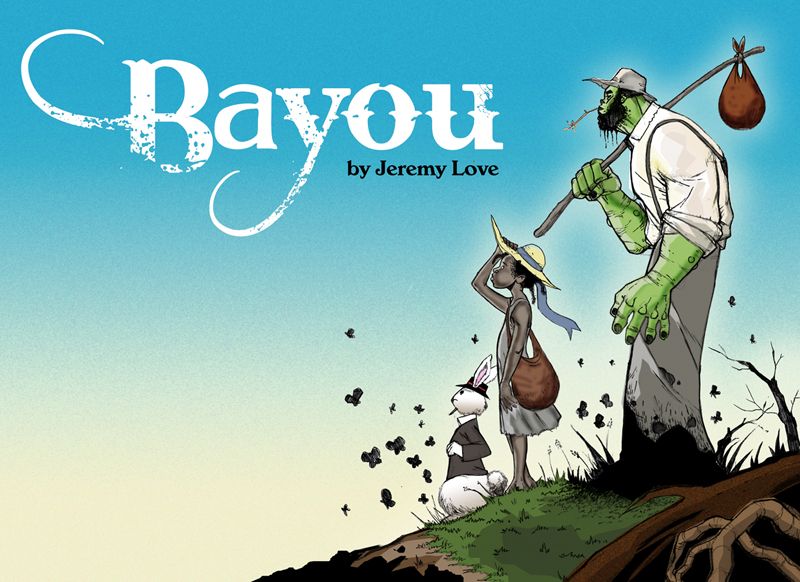
Comic Review: Bayou (Volumes 1 and 2)
Sorry for the delay guys, for some reason I seem to be stuck working closing shifts all the time at work (I've been home for dinner once in the past seven days, hurray) and once I get home I'm so spent from dealing with prissy holiday retail customers and from dealing with your usual mix of coworkers (some great some not) it's hard to write something that I'm satisfied with.
As for the actual review, if I had realized that this wasn't the full series I might have chosen not to review it, since my library had two books I just assumed that was all their was. Of course, having done a little research now I can see that the second volume came out in 2011 and there doesn't seem to be any word on when a third volume will be out which is always worrying. I'm fairly sure that volume two isn't supposed to be the final volume not only because I don't see anything saying that it is but also because, well, it's not a good stopping point for a story.
Bayou (volumes one and two) by Jeremy Love
Summary: Lee and her father are sharecroppers in rural Mississippi and life isn't good, or safe, if you're not white. Determined to prove that her father was wrongfully imprisoned Lee goes on a journey to another world to bring back the truth.
The Good: It's not easy to set a story in the historical American South (historical fiction these days is usually defined as stories set pre-1950 but that statement holds true up until at least the 80s) because all of the opposing forces of American culture and politics, especially in regards to personal beliefs and people's rights to exercise them are amplified to the extreme. Therefore it's hard to write a story that acknowledges them, since they are at least on a basic level a part of everyone's life, and Love I feel like greatly succeeds with his refusal to romanticize or attempt to explain roughly Great Depression area Mississippi near New Orleans. With that as a base the rest of the story flows well, in the real world at least, and I did like the mythology he created, it was both old and new and felt really interesting.
The Bad: I believe I've said this before at some point but making a story by re-imagining another, older one is hard. Doing that with a well-known, trickster character is harder yet and I think a large reason why the second volume just didn't sit as well with me was because of Br'er Rabbit. He was so different from the stories I heard as a six or seven year old and in such a way that it felt like Love was trying to be "edgy" not "an alternate look at a well-known character". The story also seems to be setting itself up for a reveal I'm not a very big fan of in fiction, one that I feel like exists to suddenly give another character sympathy without having to do anything and when that appeared in the last few pages it really did sour my mood on the entire story. Other than that, I do feel like the pacing doesn't quite match the plot, in some ways Lee's story has a very tight deadline but the story seems to meander a bit to give the character's more time for, well, meeting other side characters I guess?
The Art: The art style isn't one I favor, I just don't like the too-soft, as if everything was colored using the gradient tool, art style and the designs were a bit strange as well but there's certainly nothing wrong with it. Although, when you combine the fact that I'm not wild about the art with the fact that I think the story is about to do something I dislike I'm not exactly foaming at the mouth waiting for the next installment.
It's a little hard to rate this, there's not much wrong with the story, aside from the pacing a bit, yet it just didn't connect with me. I think that if I was reading the completed story at once then I probably would have liked it more but again without even a whisper of when the third volume will be out that's not going to happen anytime soon.
As for the actual review, if I had realized that this wasn't the full series I might have chosen not to review it, since my library had two books I just assumed that was all their was. Of course, having done a little research now I can see that the second volume came out in 2011 and there doesn't seem to be any word on when a third volume will be out which is always worrying. I'm fairly sure that volume two isn't supposed to be the final volume not only because I don't see anything saying that it is but also because, well, it's not a good stopping point for a story.
Bayou (volumes one and two) by Jeremy Love
Summary: Lee and her father are sharecroppers in rural Mississippi and life isn't good, or safe, if you're not white. Determined to prove that her father was wrongfully imprisoned Lee goes on a journey to another world to bring back the truth.
The Good: It's not easy to set a story in the historical American South (historical fiction these days is usually defined as stories set pre-1950 but that statement holds true up until at least the 80s) because all of the opposing forces of American culture and politics, especially in regards to personal beliefs and people's rights to exercise them are amplified to the extreme. Therefore it's hard to write a story that acknowledges them, since they are at least on a basic level a part of everyone's life, and Love I feel like greatly succeeds with his refusal to romanticize or attempt to explain roughly Great Depression area Mississippi near New Orleans. With that as a base the rest of the story flows well, in the real world at least, and I did like the mythology he created, it was both old and new and felt really interesting.
The Bad: I believe I've said this before at some point but making a story by re-imagining another, older one is hard. Doing that with a well-known, trickster character is harder yet and I think a large reason why the second volume just didn't sit as well with me was because of Br'er Rabbit. He was so different from the stories I heard as a six or seven year old and in such a way that it felt like Love was trying to be "edgy" not "an alternate look at a well-known character". The story also seems to be setting itself up for a reveal I'm not a very big fan of in fiction, one that I feel like exists to suddenly give another character sympathy without having to do anything and when that appeared in the last few pages it really did sour my mood on the entire story. Other than that, I do feel like the pacing doesn't quite match the plot, in some ways Lee's story has a very tight deadline but the story seems to meander a bit to give the character's more time for, well, meeting other side characters I guess?
The Art: The art style isn't one I favor, I just don't like the too-soft, as if everything was colored using the gradient tool, art style and the designs were a bit strange as well but there's certainly nothing wrong with it. Although, when you combine the fact that I'm not wild about the art with the fact that I think the story is about to do something I dislike I'm not exactly foaming at the mouth waiting for the next installment.
It's a little hard to rate this, there's not much wrong with the story, aside from the pacing a bit, yet it just didn't connect with me. I think that if I was reading the completed story at once then I probably would have liked it more but again without even a whisper of when the third volume will be out that's not going to happen anytime soon.
Labels:
1930s,
comic,
fantasy,
graphic novel,
historical,
Jeremy Love,
people of color
Sunday, April 29, 2012
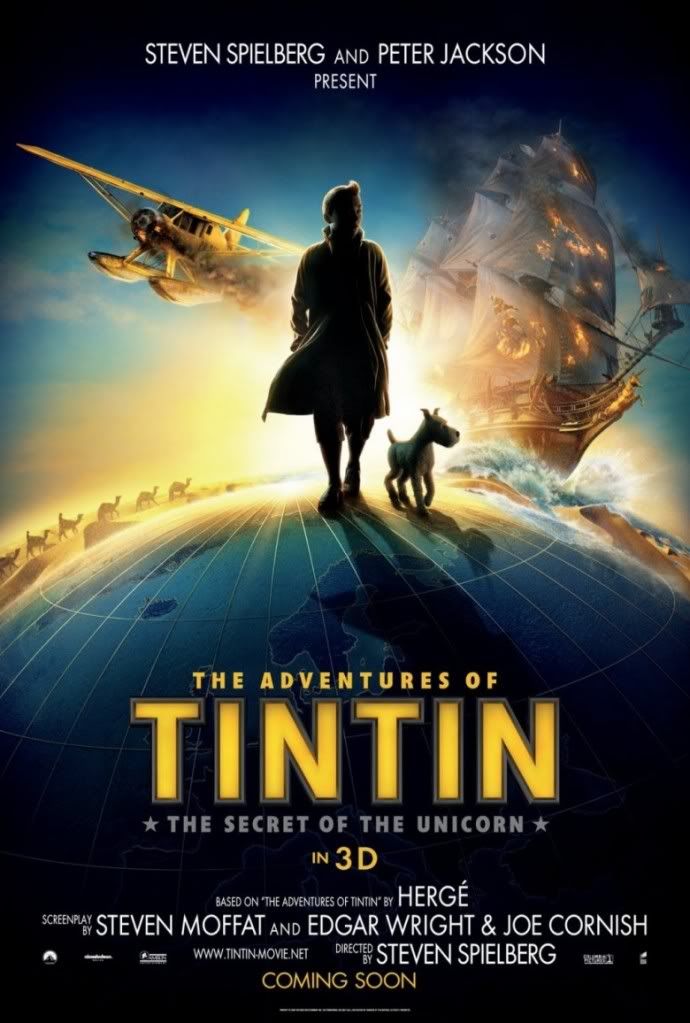
Movie Review: The Adventures of Tintin: Secret of the Unicorn
There are some films that I plan to see at school since I know I'll enjoy them more if I see them with friends and when I saw the trailers for this film I suspected that might be the case. There was nothing wrong with the trailers for The Adventures of TinTin, it just looked a bit silly, I actually managed to figure out that it was CGI instead of live action when I saw the scene where a pirate ships coasts over the waves of a desert and that scene seems to sum up the movie, silly and often illogical but in an entertaining manner.
The Adventures of Tintin: Secret of the Unicorn
Summary: Tintin is an intrepid young reporter with a nose for a story whose been on dozens of adventures already (accompanied by his faithful and clever dog snowy). So when he discovers that the old model boat he recently bought it part of a puzzle involving centuries old treasure he jumps right into the mystery, where ever it might take him.
The Good: With the exception of a few scenes the pacing worked well, despite it's short run time nothing felt rushed and it didn't seem like the characters lingered too long in any one place for too long. I found Snowy to be the most enjoyable character to watch and, much like the penguins in Mawaru Penguindrum, any scene that has Snowy in it has him off in the background doing his own antics (sometimes related to the plot and sometimes just as a joke) and I liked that attention to detail, it was amusing and made me appreciate the thought that went into those scenes a bit more. The movie was filled with details actually, more on that in the visuals, but I was happy to see that they went to a lot of effort to make the "sets" feel just as real as the sets in a traditional live action film would be and that really helped.
The Bad: I was a bit confused by the setting, which seemed mostly like France but with some odd British details, which seems to be a carry over from the original comics but other people have pointed out that the movie also isn't sure when it's set with newspapers giving the date as 1938 yet cars from the 30s, 40s, and 50s making appearances. It wasn't enough to annoy me but it was enough to jolt me out of the movie a few times which is never a good sign. Additionally, I am convinced the reason Spielberg decided to make this film in CGI instead of in live action was so that he could completely ignore the laws of physics for a few scenes and, like a certain scene from Super 8, while those scenes were amusing at first they just dragged on so long that my suspension of disbelief was entirely broken and I got bored by it. In a way, even when the characters are doing something completely unrealistic you still need some realism to ground the scene and give the scene from stakes, without that it's just hard to take any of it seriously and be entertained by it.
The Audio: Even if the visuals make the setting a bit unclear time-wise some of the musical pieces immediately made me think that the movie was set in the 1930s vs the 1940s and that's a good thing, it shows that the music is doing it's job at adding and giving more meaning to what's on screen. Since all the actors did both the motion capture and voices for their characters I suppose it technically doesn't count as voice acting here but in any case everything worked there as well, everything matched up and no one had an out of place sounding voice.
The Visuals: The movie is entirely in CGI, shot using real actors with motion capture technology (and a pull toy for Snowy) and, as tvtropes put it, it seems like we've finally hit the other side of the uncanny valley. It's actually hard to tell at first if the movie is CGI or not and when you figure out it's not because everything looks too perfect or that the characters faces just don't look right, it manages to be both realistic enough that it tricks your mind yet not be so realistic that it becomes creepy. Spielberg takes full advantage of what CGI lets him do and creates elaborate settings, overly complicated chase scenes, and plenty of other things that wouldn't be possible (or at least nearly as easy to do) with a live action film.
In the end I wouldn't call this film an all-ages movie but a kid's movie, I just didn't get enough out of it to justify paying more than a few dollars to see it. It appears that there is a sequel in the works and I might see that if I find it playing at a cheaper theater as well but this film didn't leave me with the burning desire to see the new one as soon as it comes out.
Labels:
1930s,
2011,
action,
adventure,
globe trotting,
middle grade,
movie,
mystery,
tintin
Sunday, April 22, 2012
Movie Review: Hugo
I only heard a bit about Hugo when it first came out but during movie award season (which I don't care about but can't seem to avoid hearing about on twitter) I heard a lot of buzz about the movie and it sounded like the movie was a really good one. I'd already been planning on catching it at school but tried to get too hyped for it, after all it's unusual for me to enjoy movie on the same level that I love my favorite book and anime series, what were the odds of that happening here?
Hugo
Summary: Based on the book The Invention of Hugo Cabret by Brain Selznick, Hugo is a young boy who after the death of his father and being taken in by his uncle takes care of all the clocks in Paris' Gare Montparnasse train station. Whenever he has a moment however he is tinkering with an automaton that his father discovered in a museum and was unable to fix before his death. To find the parts for it Hugo has stolen a few toys from a toy store owned by the bitter old Papa Georges who one day catches him and takes his father's notebook in retaliation claiming it couldn't be his anyway. Hugo enlists the help of Papa Georges' young ward Isabelle to get his notebook back and in the process they discover that Papa Georges' is far more than he seems.
The Good: This is a very strongly plotted story that starts off with a small idea, Hugo trying to repair the automaton, and expands to a very grand scope by the end. The story does not rely on action or romance or over the top explosions to move the story along and distract the viewers but instead carefully paces itself and builds up parallels and metaphors along the way to make the story deeper. Part of this might be because it was based on a book, perhaps I'm biased but I often find richer writing in books than I do in screenplays, but the movie never feels like it's compressing the plot/adding in details to fill out time so it feels like a very smooth adaptation. Hugo and Isabelle come off as realistic kids, Isabelle in particular with her large vocabulary that could easily be explained by her reading and how she enjoys adventure but isn't too reckless*, although it did seem like Hugo was able to repair the automaton a little too easily for someone with his experience. I was pleasantly surprised to see that this film turned out to be a movie about making movies and even more so when I did some research later and discovered that many of the characters were real people and that all of the films they showed were real ones from the period. While it still doesn't justify some of the actions by Papa Georges his back story made him much more sympathetic and I found myself completely empathizing with what was really a tragic story.
The Bad: As I was glancing on tvtropes I was reminded of a few subplots that the movie failed to fully explain by the end (such as the fate of Hugo's notebook) and it sounds like some of those details were resolved by the book but not the movie so that would be the fault of the adaptation (and in it's defense the movie did wrap up quite a few other subplots successfully, it had a lot on it's plate by the end). There are some other small inconsistencies in the movie (if Hugo's uncle was gone who was getting paid/how was Hugo eating) but I don't see those problems bothering anyone but the most detail oriented.
The Audio: I didn't pay quite as much attention to the music as I did the visuals but the music was rather sweet and matched the film well. The music sounds a little whimsical and old-fashioned, I swear it sounds like there is a hand-cranked organ in some of the pieces, and the music helps the movie from becoming too dark overall. It doesn't attempt anything too grand or over the top and that's just fine for this movie and works wonderfully.
The Visuals: I'm a little sad that I didn't have a chance to see this movie in the 3D version since I've heard some surprisingly good things about that but I also didn't feel like I was missing out with anything in the 2D version. It may sound odd to say this about a movie that wasn't overly arty or made copious use of CGI and other grand effects but this movie looked really good. The details in the props, clothing, and locations really add to the setting and manage to establish both the time and the location** without the story explicitly needing to state them. The physical setting of the movie looked gorgeous and the costumes looked like authentic clothing, like someone spent some time researching clothes and didn't raid a costume store and make all the female cast wear flapper dresses.
So in short, I adored this movie and when I was home recently and came across my family watching this film I was unable to sit down and focus at my computer and instead just watched about half of the movie again with them. This is hands down the strongest plotted movie I have seen in years and I'm going to try and read the book this summer to see how similar and different they are (it sounds like the author really liked the adaption so I'm hopeful, also when looking up a few things for this review I came across the book and facepalmed quite hard when I saw the cover since I have seen that book a dozen times yet never made the connection).
*I will admit that I was partially biased to her character from the start since I always love the bookworm characters and it's been a bit of a while since I saw one. Isabelle's balance between obviously loving stories and wanting to have adventures of her own with the carefulness she shows because she knows that her life isn't one of those stories is refreshing since so many people take shortcuts and write bookworms as characters who can't tell reality from fiction which in my experience isn't true at all.
**the location actually wasn't that hard, all you need is a shot of the Eiffel Tower and everyone knows it's Paris but I digress.
Hugo
Summary: Based on the book The Invention of Hugo Cabret by Brain Selznick, Hugo is a young boy who after the death of his father and being taken in by his uncle takes care of all the clocks in Paris' Gare Montparnasse train station. Whenever he has a moment however he is tinkering with an automaton that his father discovered in a museum and was unable to fix before his death. To find the parts for it Hugo has stolen a few toys from a toy store owned by the bitter old Papa Georges who one day catches him and takes his father's notebook in retaliation claiming it couldn't be his anyway. Hugo enlists the help of Papa Georges' young ward Isabelle to get his notebook back and in the process they discover that Papa Georges' is far more than he seems.
The Good: This is a very strongly plotted story that starts off with a small idea, Hugo trying to repair the automaton, and expands to a very grand scope by the end. The story does not rely on action or romance or over the top explosions to move the story along and distract the viewers but instead carefully paces itself and builds up parallels and metaphors along the way to make the story deeper. Part of this might be because it was based on a book, perhaps I'm biased but I often find richer writing in books than I do in screenplays, but the movie never feels like it's compressing the plot/adding in details to fill out time so it feels like a very smooth adaptation. Hugo and Isabelle come off as realistic kids, Isabelle in particular with her large vocabulary that could easily be explained by her reading and how she enjoys adventure but isn't too reckless*, although it did seem like Hugo was able to repair the automaton a little too easily for someone with his experience. I was pleasantly surprised to see that this film turned out to be a movie about making movies and even more so when I did some research later and discovered that many of the characters were real people and that all of the films they showed were real ones from the period. While it still doesn't justify some of the actions by Papa Georges his back story made him much more sympathetic and I found myself completely empathizing with what was really a tragic story.
The Bad: As I was glancing on tvtropes I was reminded of a few subplots that the movie failed to fully explain by the end (such as the fate of Hugo's notebook) and it sounds like some of those details were resolved by the book but not the movie so that would be the fault of the adaptation (and in it's defense the movie did wrap up quite a few other subplots successfully, it had a lot on it's plate by the end). There are some other small inconsistencies in the movie (if Hugo's uncle was gone who was getting paid/how was Hugo eating) but I don't see those problems bothering anyone but the most detail oriented.
The Audio: I didn't pay quite as much attention to the music as I did the visuals but the music was rather sweet and matched the film well. The music sounds a little whimsical and old-fashioned, I swear it sounds like there is a hand-cranked organ in some of the pieces, and the music helps the movie from becoming too dark overall. It doesn't attempt anything too grand or over the top and that's just fine for this movie and works wonderfully.
The Visuals: I'm a little sad that I didn't have a chance to see this movie in the 3D version since I've heard some surprisingly good things about that but I also didn't feel like I was missing out with anything in the 2D version. It may sound odd to say this about a movie that wasn't overly arty or made copious use of CGI and other grand effects but this movie looked really good. The details in the props, clothing, and locations really add to the setting and manage to establish both the time and the location** without the story explicitly needing to state them. The physical setting of the movie looked gorgeous and the costumes looked like authentic clothing, like someone spent some time researching clothes and didn't raid a costume store and make all the female cast wear flapper dresses.
So in short, I adored this movie and when I was home recently and came across my family watching this film I was unable to sit down and focus at my computer and instead just watched about half of the movie again with them. This is hands down the strongest plotted movie I have seen in years and I'm going to try and read the book this summer to see how similar and different they are (it sounds like the author really liked the adaption so I'm hopeful, also when looking up a few things for this review I came across the book and facepalmed quite hard when I saw the cover since I have seen that book a dozen times yet never made the connection).
*I will admit that I was partially biased to her character from the start since I always love the bookworm characters and it's been a bit of a while since I saw one. Isabelle's balance between obviously loving stories and wanting to have adventures of her own with the carefulness she shows because she knows that her life isn't one of those stories is refreshing since so many people take shortcuts and write bookworms as characters who can't tell reality from fiction which in my experience isn't true at all.
**the location actually wasn't that hard, all you need is a shot of the Eiffel Tower and everyone knows it's Paris but I digress.
Labels:
1930s,
2011,
France,
historical,
middle grade,
movie,
plot driven
Thursday, September 22, 2011
Manga Review: Adolf (volume one)
I was browsing through my (college) library's comic section (the one in the nonfiction, not the one near the kids books) and came across this book and I was wondering if it was the same manga I had heard about online (I had heard that the first volume was really hard to find in English) but didn't think so since it looked like it was a one volume series. I then noticed that it was by Osamu Tezuka and decided to check it out since I need to read more of his work anyway (I believe his only other work I've read is Buddha and I didn't care for it that much). When I got home I found someone else mentioning this title online so I went to amazon, found a cover that matched mine and holy guacamole, it's going for $44 used online! It appears that my library doesn't have the other volumes in this series sadly but thankfully they can all be bought for less than MSRP on Amazon, really wonder why that first one is so limited.
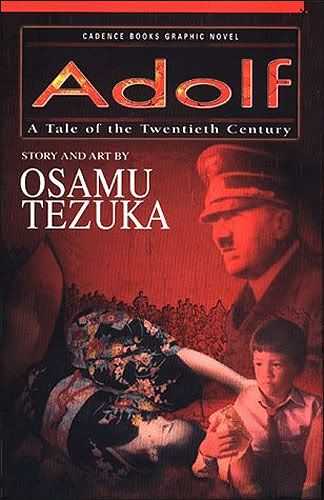
Adolf by Osamu Tezuka
Summary: The story of three Adolfs, it begins during the Berlin Olympics of 1936 when visiting Japanese reporter Sohei Toge gets a mysterious phone call from his brother (who lives in Berlin) and by the time he meets up with him he's been murdered. Toge soon finds his investigation blocked at every possible point and starts to realize that there is something much bigger going on behind the scenes, something that has a connection with the death of a geisha months earlier back in Japan. A couple years later the other two Adolf's are introduced to the story, Adolf K whose German father is a main suspect in the geisha's death and Adolf K who accidentally learns the secret that has set in motion all of these events.
The Good: One thing Tezuka does well is pacing and balancing multiple points of view without every boring the viewer. The first volume focuses on a few, only slightly connected characters but there are already hints about how they will all play an important role later on in the story. The first volume is build up but it's build up done right, never boring enough to make the reader leave and genuinely important to the story, something that many writers today don't seem to grasp.
The Bad: There is a bit of melodrama in this work which made me roll my eyes and didn't seem to fit the more serious mood, such as the typhoon which caused all the dramatic flooding and landslides, and the villains can be a bit over the top as well (such as the associate of Adolf K's father). Honestly, there are a good number of over the top moments in this volume which can be grating on some readers, hopefully they will either become less common as the story goes on or the reader will be able to get more used to them.
The Artwork: As the introduction in the front of the book notes, Tezuka is using a more realistic style than normal in this work (it's also one of his later works) and I enjoyed it more than the art style used in Buddha (I think it was the general lack of over the top, cartoony reactions that many of the character in Buddha had). However, the introduction notes that this art style is still not going to appeal to many, non-manga reading Westners which makes me wonder why they bothered to flip the book (especially since flipping the book does make it a bit harder to follow the panel layout sometimes, plus it's rather insulting to change the artist's vision so that, theoretically, more people can enjoy the work without having to think about it as much). Overall however I liked the art here, although I am also puzzled why they decided to make a composite image of actual photographs for the cover.
I really enjoyed this story and I would love a chance to read more. Like I said earlier, the other volumes of the series are avaliable for much more reasonable prices although I think I'll poke around at all my libraries to see if I can read them there first.
Adolf by Osamu Tezuka
Summary: The story of three Adolfs, it begins during the Berlin Olympics of 1936 when visiting Japanese reporter Sohei Toge gets a mysterious phone call from his brother (who lives in Berlin) and by the time he meets up with him he's been murdered. Toge soon finds his investigation blocked at every possible point and starts to realize that there is something much bigger going on behind the scenes, something that has a connection with the death of a geisha months earlier back in Japan. A couple years later the other two Adolf's are introduced to the story, Adolf K whose German father is a main suspect in the geisha's death and Adolf K who accidentally learns the secret that has set in motion all of these events.
The Good: One thing Tezuka does well is pacing and balancing multiple points of view without every boring the viewer. The first volume focuses on a few, only slightly connected characters but there are already hints about how they will all play an important role later on in the story. The first volume is build up but it's build up done right, never boring enough to make the reader leave and genuinely important to the story, something that many writers today don't seem to grasp.
The Bad: There is a bit of melodrama in this work which made me roll my eyes and didn't seem to fit the more serious mood, such as the typhoon which caused all the dramatic flooding and landslides, and the villains can be a bit over the top as well (such as the associate of Adolf K's father). Honestly, there are a good number of over the top moments in this volume which can be grating on some readers, hopefully they will either become less common as the story goes on or the reader will be able to get more used to them.
The Artwork: As the introduction in the front of the book notes, Tezuka is using a more realistic style than normal in this work (it's also one of his later works) and I enjoyed it more than the art style used in Buddha (I think it was the general lack of over the top, cartoony reactions that many of the character in Buddha had). However, the introduction notes that this art style is still not going to appeal to many, non-manga reading Westners which makes me wonder why they bothered to flip the book (especially since flipping the book does make it a bit harder to follow the panel layout sometimes, plus it's rather insulting to change the artist's vision so that, theoretically, more people can enjoy the work without having to think about it as much). Overall however I liked the art here, although I am also puzzled why they decided to make a composite image of actual photographs for the cover.
I really enjoyed this story and I would love a chance to read more. Like I said earlier, the other volumes of the series are avaliable for much more reasonable prices although I think I'll poke around at all my libraries to see if I can read them there first.
Labels:
1930s,
historical,
manga,
osamu tezuka,
world war II
Saturday, September 3, 2011
Comic Review: The Rabbi's Cat
In case anyone is wondering why this post didn't go up yesterday (erm, Thursday) as normal, I was trying to get the second diversity post up and decided to push this one back a day (since the deadline for the diversity posts was September 1st, it's now been pushed back to October first). And the reason that didn't go up is because I just had a strange day and ended up not having the time to completely write out another 3000-ish word post. So, apologies, the second part of the diversity review should be up in a couple of days and I'll probably re-post/edit them at the end of the month if I have anything new to add.
Comic time! This is a comic that I had seen at my local library many times before and I checked out both volumes of the story since I couldn't tell if it was one continuous story split into two books or a main story and then a second volume that added on to it (turns out it's the later). I mentioned it in the first diversity post since the story revolves around a predominately Jewish cast (as if you couldn't tell from the title) in Algeria in the 1930s which, funny enough, makes it the second comic I've read this summer that features Jewish main characters, a bit unusual but I'm not quite sure that any of the comics I've reviewed this summer could be called "the usual."
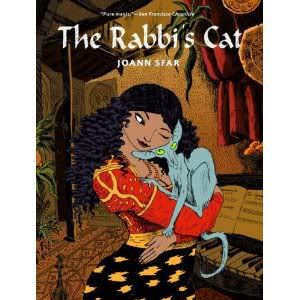
The Rabbi's Cat by Joann Sfar
Summary: One day, a cat who belongs to a rabbi and his daughter, becomes annoyed at their pet parrot and eats him thus gaining the power of speech to his great delight. He takes advantage of this new ability to learn more about the world and to cause mischief where ever he can, all the while offering commentary on the lives of those around him.
The Good: It's a bit unusual to find an animal narrator in stories that aren't children's literature which makes for a nice change and the rabbi's cat is a fun character. He comes off as equal parts trickster and saint (well, perhaps equal parts trickster and observer, although he certainly seems to be the most saintly character at times) and he makes the story interesting. There are some scenes where he isn't in them at all (only a few) but thankfully the story doesn't stagnant there and keeps on moving briskly back to the cat.
The Bad: Aside from the titular cat, I didn't like or sympathize with any of the main characters and found myself much more interested in some of the side characters. Most of the characters came off as rather petty and self-absorbed which is tiring to read after a while, especially how the first book ended. At the end of the first book, the rabbi is mentioning how his faith has been shaken and one of his congregation (would that be the right word?) asks him what he now thought about God and he replies that he doesn't know. It's perfectly alright to be questioning of your faith (I'm agnostic myself) but it was the way that it was done that made it feel like a complete cop-out, as if the author didn't know how their character would react and took an ambiguous middle road to avoid it.
The Art: My opinion on the art varied from panel to panel since there were some panels where I really liked the art style and others where I would just start cringing. I think that my problem with it was that I really didn't like the shading style used in some panels (short ink lines which for some reason just bugged me here, maybe because I'm not used to seeing pen and ink shading on top of colored images) and it just came off as amateruish in many places (and this artist has won awards for his work, clearly this isn't the case). So I really don't know why it rubbed me the wrong way and it's hard to enjoy a comic if you really don't like the art so this didn't help my experience of it at all.
There were other parts in the story I also didn't like but unfortunately are too spoiler-y to include, I just ended up not really liking this story at all even though I was fully expecting to. Even more so than the books this summer, the comics I've been reading have been really hit or miss and I'm not sure why. Perhaps, drawn in by the interesting covers, I keep picking ones that are style over substance which is the exact opposite of what I want? Or maybe it's because I like my comics the way I like my regular books, plot heavy with tons of world-building and those just don't get published in book format (verses webcomics) as much here, unless it's manga which I actually didn't read a lot of this summer (from the library anyway, I may or may not have spent several days straight reading 80s/90s shojo manga at one point....).
Comic time! This is a comic that I had seen at my local library many times before and I checked out both volumes of the story since I couldn't tell if it was one continuous story split into two books or a main story and then a second volume that added on to it (turns out it's the later). I mentioned it in the first diversity post since the story revolves around a predominately Jewish cast (as if you couldn't tell from the title) in Algeria in the 1930s which, funny enough, makes it the second comic I've read this summer that features Jewish main characters, a bit unusual but I'm not quite sure that any of the comics I've reviewed this summer could be called "the usual."
The Rabbi's Cat by Joann Sfar
Summary: One day, a cat who belongs to a rabbi and his daughter, becomes annoyed at their pet parrot and eats him thus gaining the power of speech to his great delight. He takes advantage of this new ability to learn more about the world and to cause mischief where ever he can, all the while offering commentary on the lives of those around him.
The Good: It's a bit unusual to find an animal narrator in stories that aren't children's literature which makes for a nice change and the rabbi's cat is a fun character. He comes off as equal parts trickster and saint (well, perhaps equal parts trickster and observer, although he certainly seems to be the most saintly character at times) and he makes the story interesting. There are some scenes where he isn't in them at all (only a few) but thankfully the story doesn't stagnant there and keeps on moving briskly back to the cat.
The Bad: Aside from the titular cat, I didn't like or sympathize with any of the main characters and found myself much more interested in some of the side characters. Most of the characters came off as rather petty and self-absorbed which is tiring to read after a while, especially how the first book ended. At the end of the first book, the rabbi is mentioning how his faith has been shaken and one of his congregation (would that be the right word?) asks him what he now thought about God and he replies that he doesn't know. It's perfectly alright to be questioning of your faith (I'm agnostic myself) but it was the way that it was done that made it feel like a complete cop-out, as if the author didn't know how their character would react and took an ambiguous middle road to avoid it.
The Art: My opinion on the art varied from panel to panel since there were some panels where I really liked the art style and others where I would just start cringing. I think that my problem with it was that I really didn't like the shading style used in some panels (short ink lines which for some reason just bugged me here, maybe because I'm not used to seeing pen and ink shading on top of colored images) and it just came off as amateruish in many places (and this artist has won awards for his work, clearly this isn't the case). So I really don't know why it rubbed me the wrong way and it's hard to enjoy a comic if you really don't like the art so this didn't help my experience of it at all.
There were other parts in the story I also didn't like but unfortunately are too spoiler-y to include, I just ended up not really liking this story at all even though I was fully expecting to. Even more so than the books this summer, the comics I've been reading have been really hit or miss and I'm not sure why. Perhaps, drawn in by the interesting covers, I keep picking ones that are style over substance which is the exact opposite of what I want? Or maybe it's because I like my comics the way I like my regular books, plot heavy with tons of world-building and those just don't get published in book format (verses webcomics) as much here, unless it's manga which I actually didn't read a lot of this summer (from the library anyway, I may or may not have spent several days straight reading 80s/90s shojo manga at one point....).
Labels:
1930s,
africa,
comic book,
Joann Sfar,
judaism
Subscribe to:
Comments (Atom)