Thursday, September 8, 2011

Comic Review: Trickster

I feel like I had seen or heard about this anthology before I found it at the local library, possibly as part of the Diversity Challenge since it's a collection of Native American tales and (presumably) all or nearly all of the storytellers who contributed the tales are at least part Native American themselves. There are too many contributors to list them all here but I assume you can find them all somewhere online (Amazon doesn't list them and I forgot to take a picture of the table of contents which listed all of them), I can probably track it down if anyone wants me to. 

Trickster Edited by Matt Dembicki
 
Summary: A comic book anthology featuring all kinds of myths and legends from various Native North American cultures.


The Good: A note in the back of the book says that, as far as the editor can tell, this is the first collection of Native American tales in comic form which seems like a shame, especially considering just how important Native Americans have been in American history*. All of the stories were fairly short, making it easy to pick up and read a story or two when there's not a lot of time, and each story seemed well paced and, as odd as it sounds when talking about mythology, logical. There were barely, if any, deus ex machina endings (many felt like traditional European fairy tales where it's the cleverness of the protagonist or supporting character that saves the day) or other strange cop-outs that would leave the reader feeling dissatisfied. That's more than what many of the world's mythologies can say and does make this feel like a stronger work.   


The Bad: Since the stories come from a variety of groups living all over North America there were a lot of overlapping characters which seemed more like a bad thing than a good one. Having some reoccurring characters (such as Coyote) appear in neighboring stories with completely different personalities was really jarring and immediately makes you prefer one story over another, something I'm sure the editor didn't mean to do. It was also strange to see how the tone could completely switch between stories as well which makes me think I would have enjoyed this story a bit more if it had been edited slightly differently to flow smoother.    

The Art: In a page in the back of the book that says how this project came together, Dembicki mentions that all the storytellers involved in this work chose the artist (I believe from a group of people who had said they were interested in the project) so the art styles were all intention. There's a real range of art styles, from more sketchy ones to ones that wouldn't look out of place as a Saturday morning cartoon. None of the styles could be called realistic, although some were certainly more so than others, and unfortunately I only liked a handful or less of them. There wasn't anything bad or wrong about the styles, some of the more cartoony ones irritated me however, but I simply wasn't drawn in by the art and that's half of a comic, that's not a good thing. 

In the end, I didn't enjoy this anthology as much as I had hoped (anthologies in general seem to be very hit or miss with me, emphasis on the miss) is it was aimed at a younger audience than I expected, found the tone a bit jarring and just wasn't interested in many of the stories. I do think this book would be better shelved in the kid's room comic book area instead of the teen comic book area since I think that elementary school kids, the ones who haven't gotten tired of hearing how Thanksgiving happened over and over, would enjoy this more than someone closer to my age would.  


*just in case you guys hadn't picked up on it, yes I live in the US so therefore I think learning about the culture that was here before the current mish-mash is pretty important.

Wednesday, September 7, 2011

Anime Review: Break Blade

Well, at least I warned that this review would be late. For those who haven't seen my twitter, I had double club meetings Tuesday and the mandatory second part ran much longer than I was expecting so believe me, I would have rather been writing this review.

In any case, I first heard about this series at an end of the year wrap-up some of the staffers on ANN wrote and one of them mentioned a series of OVAs he wanted to see brought over which were an interesting mix of fantasy and mecha which they hadn't seen before (to which the forums responded, "um, Escaflowne?"). Initially I just read the manga online (which I didn't even realize had been licensed by CMX at one point) and didn't have the urge to try out the OVAs but eventually I did and watched them at my own pace (hence why this review is so much later than everyone else who has also covered this series). The structure is a bit odd, it's six OVAs (which covers roughly 50 chapters of the manga, almost everything that has been currently published) which were released in theaters first and then put on DVD/BR which I've seen a few other series do lately (Towa no Quon and I think Gundam Unicorn might be doing something similar). I've seen people speculate that we might start seeing fewer tv shows and more OVAs since that's easier on people's budgets and I wouldn't mind that change as much if they had more OVA series like this.

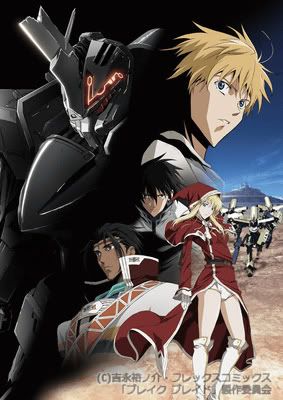
Break Blade


Summary: Set far into the future when Japan is mostly desert and people have gained the magical ability to levitate quartz, a skill they use in almost every aspect of their lives, Rygart is unusual because he can't and lives with his similarly un-gifted brother as outcasts. He is an old friend of the king and his wife however and comes to the capital when they summon him to look at a strange and ancient golem (mech) which might become the key in the war that was just declared against their country.

The Good: Sometimes it bothers me when a series involves a lot of fighting and there either is no collateral damage at all or it never bothers the main characters at all. Break Blade averts this hard with several side and important characters dying and from the start the series seems to show, without beating the viewer over the head with it, that war is not a cool thing. It's hardly a realistic depiction of war but that added bit of realism that many anime lack is a nice thing. Speaking of added realism, finally a mecha story where the characters are actually in their 20s! Several of the characters are even in relationships, happy and non-happy ones, which again is so odd to see in this genre that it's refreshing. Also refreshing is seeing several female characters in both militaries who aren't just the token female character but competent soldiers. Again, this shouldn't be something unusual but it is and it's details like that that help me enjoy a series more. 

The Bad: Since the story compresses 50 chapters of the manga into the equivalent of 12 or 13 episodes it's understandable that some stuff had to get cut, especially towards the end, but unfortunately it was all stuff I liked. Several character deaths were altered (and felt much less powerful), one arc involving Rygart's brother was cut which resulted in a bit of an odd ending and in the end the mood was just different from the manga. Both of them start in the same place but the manga has been steadily getting more and more subdued and depressing, many of the characters have been at least a bit broken by this point, but the story here doesn't change from the slightly happier feeling the story started with. In a sense, the characters just don't grow as much here than they did in the manga and having people grow and change is a major point of any story. 

The Audio: These OVAs are a bit strange since they have an actual opening sequence that is played every time like a tv series does and it was that opening song that convinced me to try out the OVAs. It's a beautiful song and while it might seem odd to have a ballad as the opening to a mecha series the lyrics really work, singing about fate and destiny which is a theme the series has touched on a few times. I didn't find any of the other music in the series quite as nice but since that song (Fate by KOKIA) is one of my favorites of the year that's understandable.

The Visuals: Break Blade is an interesting collaboration between Production IG (who is one of the bigger anime companies right now with a lot of well produced and good looking shows, Bunny Drop, Eden of the East and the Blood franchise ) and Xebec, a lower tier studio that has done some okay work and some bad work (some of their better titles are Pandora Hearts, Legend of the Legendary Heroes and The Third: The Girl With The Blue Eye). The result of this collaboration is that the work looks much better than a regular Xebec production and rather like a regular Production IG work. All of the fight scenes are very well animated throughout the series and everything else looks consistently good. One small advantage this series has over the manga is that, with everything in color, it's a lot easier to keep the armies/soldiers separate, something I had trouble with in the manga. The mechs and uniforms for both sides are drawn rather distinctly but the cast was simply so large that I couldn't automatically remember who was on which side and giving both sides very different colors really helped in that regard. 

In the end, it's hardly a bad OVA series, it certainly looks gorgeous, but by the end it had diverged too much from the manga that I just don't see myself buying this in the future. The manga I would buy except again, it's OOP and I am going to collect all that was released in the US at some point, I don't suppose some other English speaking licensor is putting it out? 

And again, apologies that this is up so late, as you guys can tell I'm still getting used to my new schedule and it's just different enough each week to make the transition a bit more difficult. Maybe I'll get the hang of this before I take a break in November, I certainly hope so!  

Monday, September 5, 2011

TV Series Review: Doctor Who (Remembrance of the Daleks)

The final Classic Doctor Who serial I was able to get through this summer, this time featuring the Seventh Doctor and fan favorite companion Ace (for reasons that become clear in this episode, it involves daleks and baseball bats). This is one of the later serials in the shows initial run (1988, the show was "put on hiatus" in 89) and the last time the daleks would appear until the 2005 episode Dalek (funny enough, the daleks in this episode can already float to get up stairs, I thought that had been an invention of NuWho) and it's a good episode for their last appearance, especially when I started reading about some of the other, not so great dalek episodes.

Doctor Who: Remembrance of the Daleks

Summary: Set soon after the First Doctor left Earth in An Unearthly Child, the Doctor and Ace go to Earth where they become entangled in a dalek civil war who are fighting over a Time Lord weapon that the Doctor left on Earth when he was first there. 

The Good: Even thought Ace comes across as a bit of a dated character she's yet another cool and proactive companion who certainly keeps the story interesting when the Doctor is planning something in the background. Speaking of planning in the background, this serial was the first hint that the Seventh Doctor was a bit darker, more of a schemer, than his previous incarnations and it's a nice twist on the Doctor's previous character*, instead of just getting caught up in the action he now actively tries to manipulate it from the start. Finally, one nice detail about this story was how the dalek's civil war (which revolved around how one group was a tiny bit genetically different than the other) was also reflected in the 1960s setting with a "No Coloureds" sign in a window and a black man in a cafe musing with the Doctor that, if it wasn't for sugar cane, he wouldn't even be in Britain. It was a nice detail to throw in especially since it is un-politically correct history and I'm happy that the show was true to it's setting^.  

The Bad: At times it's a little hard to keep track of what the side characters are doing (there seems to have been a Nazi sympathizer plotline that I completely missed) and they are fairly important to the story. Another complaint I had was, as interesting as it is to see a darker Doctor, why is it that he didn't tell anyone about his plans until they were well under way? I would hope that he trusts Ace enough at this point and normally it's easier to have a plan work correctly if other people don't screw it up (because they understand the plan and know what to do/not to do).

The Audio: The theme music has changed slightly once again and, like the logo, manages to sound more dated than any of the other changes so far. Some of the sound effects also sound dated but that would be the case for any sci-fi show produced in the late 80s, especially one with a lower budget. So what was there worked, sorta, but is going to date the series for modern viewers. 


The Visuals: The logo for Doctor Who has changed some over the years but the logo for this time period looks especially strange (and screams "hey guys, we can do some computer art now!"), some parts of the show look really dated. Wasn't able to tell how period accurate the costumes were but the daleks all looked fine and like, well, daleks. There were a few special effects that looked like early CGI in the episode but nothing really special happened visually.


Sorry for the delay here, I had almost all of that written up last night but I have a head cold which is making me feel out of it. Review should go up tomorrow but I'm not sure when, I have double club meetings and a bit of homework that I didn't get to this weekend because of said cold (and you know, school in general). Later in the school year I might get around to seeing more Classic Doctor Who since it turns out that one of my friends has a lot of the DVDs but currently I don't have any plans to, there are more than enough movie showings at the school to keep me entertained for the moment.


*especially since some people have pointed out that the current Doctor is starting to act more and more like a schemer who keeps others in the dark about his plans until they actually go off (although I'd argue that Seven seems much better at planning things that work than Eleven, Eleven makes his a bit too over the top which is a genuine character weakness). I always find this kind of continuity between Doctors cool and also feel like it makes the story stronger, even though I'm sure some people don't like it.
^also since the serial after this one is the infamous, critical of Margaret Thatcher (the then-current PM of Great Britian) serial which, having seen Nash's review of it, was pretty bad, makes me appreciate how this one was done even more. 

Saturday, September 3, 2011

Book Review: A Love Story Starring My Dead Best Friend

With a title like that, how can you not at least pick up this book? That's what grabbed my attention and what kept my attention was the plot synopsis on the jacket flap hinting that the main character was a lesbian, something a bit unusual and I happen to like GL and BL stories more than traditional straight romances for some reason. I have a theory that, for a straight romance, the author assumes that the audience will sympathize with the characters and be interested in their relationship so they just write a romance and focus on that part of the story. Most of the GL/BL I find however is a mixture of genres, as if the author is worried that readers might not sympathize with someone with a different sexual orientation and includes other things in the story to keep their interest, and I really prefer mixed genre stories to straight up romance. So, with that theory of mine in mind, I checked the book out and just hoped that I'd like it.

A Love Story Starring My Dead Best Friend by Emily Horner
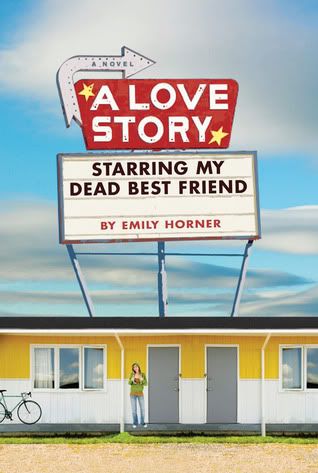
 I have mixed opinions on the cover; on the one hand I like how the sign was used to hold the title (mostly because the text physically fit onto the sign very nicely) but the rest of the image feels odd. I suppose it's of Cass as she's biking around with Julia's ashes but somehow it doesn't fit with the mood of the book very well.

Summary: Cass isn't spending her summer how she initially envisioned it. Originally she and her best friend Julia had planned to travel across the entire country until they came to the Pacific Ocean but Julia's sudden death crushed that dream. Or so it seems, trying to cope with her loss Cass now plans to bike the whole way there, carrying Julia's ashes with her as a symbol of sorts, until she's called back home to help out Julia's friends do their own thing in memory of Julia, put on a play she was writing at the time of her death. Cass spends the summer coming to grips with her own identity and her grief amongst all the things going on.

The Good: I wasn't expecting to but I really connected well with Cass and a lot of things that she said (and that Julia had said) seemed to perfectly sum up that late high school time of your life. There was one scene in particular, Cass is looking in a mirror and discovers that is "not not pretty" and I remember having that exact same moment in my senior year and other scenes seemed to perfectly sum up life at that age. I really liked how the romance between Cass and Heather was handled, even though they hated each other in middle school the progression from people who tolerated each other to people who're in love was nicely done. If anything, at those points it was easier to sympathize with Heather since it's easy to see just how hard she is working to try and make everything work, especially when some of Julia's friends come off as a bit more self-absorbed. It's a book where the characters are the most important element and Cass, Heather, and Julia make this book work.

The Bad: The story is told through alternating chapters, Cass on the road and then Cass after her trip helping make the play, and it doesn't quite work. It's more interesting to read that way but it's strange that some of the character development (especially for Cass and Julia's boyfriend Oliver) happened earlier chronologically but doesn't show up until later in the book. It's as if the characters developed and then forgot until that chapter actually came up in sequence and then they redeveloped for the later scenes in the book. I have have some minor, nit-picky issues with how making of the play went* but that's more of a personal complaint than one that actually hurts the book.


This was my favorite book this summer because of just how much I was able to connect to the characters, even if they aren't like me at all, and it's one of the few books with high school aged protagonists that actually felt realistic to me. So, buying in the future for sure, I really need to start keeping a wishlist on Amazon so I remember to get all of these titles someday.


*I did tech crew in high school some and I have yet to find a work of fiction that realizes there there is a huge difference between the actors and the tech crew (at my school they were two totally different groups of people who never hung out and the tech crew was much more outgoing and strange than the actors, basically the opposite of every work of fiction right there). 

Comic Review: The Rabbi's Cat

In case anyone is wondering why this post didn't go up yesterday (erm, Thursday) as normal, I was trying to get the second diversity post up and decided to push this one back a day (since the deadline for the diversity posts was September 1st, it's now been pushed back to October first). And the reason that didn't go up is because I just had a strange day and ended up not having the time to completely write out another 3000-ish word post. So, apologies, the second part of the diversity review should be up in a couple of days and I'll probably re-post/edit them at the end of the month if I have anything new to add.

Comic time! This is a comic that I had seen at my local library many times before and I checked out both volumes of the story since I couldn't tell if it was one continuous story split into two books or a main story and then a second volume that added on to it (turns out it's the later). I mentioned it in the first diversity post since the story revolves around a predominately Jewish cast (as if you couldn't tell from the title) in Algeria in the 1930s which, funny enough, makes it the second comic I've read this summer that features Jewish main characters, a bit unusual but I'm not quite sure that any of the comics I've reviewed this summer could be called "the usual."

The Rabbi's Cat by Joann Sfar

Summary: One day, a cat who belongs to a rabbi and his daughter, becomes annoyed at their pet parrot and eats him thus gaining the power of speech to his great delight. He takes advantage of this new ability to learn more about the world and to cause mischief where ever he can, all the while offering commentary on the lives of those around him.

The Good: It's a bit unusual to find an animal narrator in stories that aren't children's literature which makes for a nice change and the rabbi's cat is a fun character. He comes off as equal parts trickster and saint (well, perhaps equal parts trickster and observer, although he certainly seems to be the most saintly character at times) and he makes the story interesting. There are some scenes where he isn't in them at all (only a few) but thankfully the story doesn't stagnant there and keeps on moving briskly back to the cat.

The Bad: Aside from the titular cat, I didn't like or sympathize with any of the main characters and found myself much more interested in some of the side characters. Most of the characters came off as rather petty and self-absorbed which is tiring to read after a while, especially how the first book ended. At the end of the first book, the rabbi is mentioning how his faith has been shaken and one of his congregation (would that be the right word?) asks him what he now thought about God and he replies that he doesn't know. It's perfectly alright to be questioning of your faith (I'm agnostic myself) but it was the way that it was done that made it feel like a complete cop-out, as if the author didn't know how their character would react and took an ambiguous middle road to avoid it.

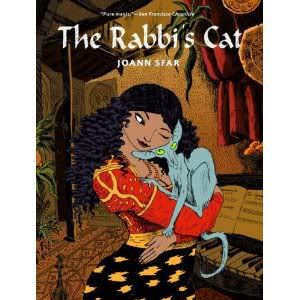
The Art: My opinion on the art varied from panel to panel since there were some panels where I really liked the art style and others where I would just start cringing. I think that my problem with it was that I really didn't like the shading style used in some panels (short ink lines which for some reason just bugged me here, maybe because I'm not used to seeing pen and ink shading on top of colored images) and it just came off as amateruish in many places (and this artist has won awards for his work, clearly this isn't the case). So I really don't know why it rubbed me the wrong way and it's hard to enjoy a comic if you really don't like the art so this didn't help my experience of it at all.   


There were other parts in the story I also didn't like but unfortunately are too spoiler-y to include, I just ended up not really liking this story at all even though I was fully expecting to. Even more so than the books this summer, the comics I've been reading have been really hit or miss and I'm not sure why. Perhaps, drawn in by the interesting covers, I keep picking ones that are style over substance which is the exact opposite of what I want? Or maybe it's because I like my comics the way I like my regular books, plot heavy with tons of world-building and those just don't get published in book format (verses webcomics) as much here,  unless it's manga which I actually didn't read a lot of this summer (from the library anyway, I may or may not have spent several days straight reading 80s/90s shojo manga at one point....).