When I was reading Incareron I wasn't sure if I would read the sequel but I saw a quick review over on Bibliovermis (which is the only place I've seen, other than the webcomic Unshelved, that does picture reviews of books without pictures) and that convinced me to try it out. Okay, I found it at the local library without even needing to look as well, if I can find it easily I'm more likely to try it which I'm sure someone has noticed by now.
Sapphique by Catherine Fisher
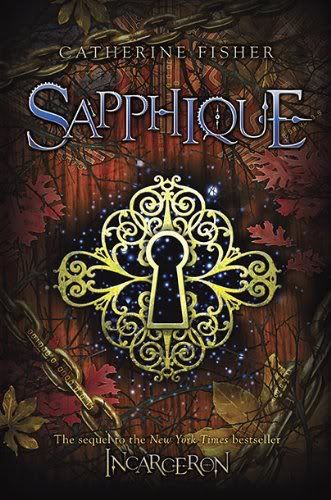
The cover here is composed similarly to the first book's cover (which I think is a good thing, might help the casual browser remember the series and then check out the next book) and again I like the images used and think the font used for the title looks really cool in small doses like this.
Summary: Starting soon after where the first book ended, Finn has escaped the prison Incarceron and returned to the real world where he is now being groomed to be the next king, something Claudia very much approves of, while the Queen plots in the shadows to hold onto her power. Meanwhile Attia and Kiero are still trapped inside the prison and are searching for a way out, namely trying to acquire a legendary glove that once belonged to the mysterious Sapphique and all the while the prison plots a way for it to escape into a new body and leave it's old form behind.
The Good: The story handles the increase in number of viewpoints very well (in addition to Finn and Claudia, Jared's viewpoint is shown more often and Attia becomes a major viewpoint as well) and the story never feels like one character is favored/more important than the other characters. More of the world, both outside and inside the prison, was expanded on which was also useful and it corrected a few incorrect assumptions I had made based on the first book (such as just how long it has been since the Years of Rage). The plot progresses logically and the ending works in a sense, it certainly wraps up all the plot points but it certainly had some issues.
The Bad: It's been a while since I've seen the "character sorta-kinda becomes Jesus" ending to a story (it is an actual trope but thankfully it's used very sparingly) and it seemed like Fisher was trying to create a flashy ending in order to distract the reader from all the plotholes in the backstory. One would hope that a book named after a character would shed more light on the character (especially as Sapphique has become more and more mysterious as the story goes on) but nothing ever is and it feels quite frustrating*. Also frustrating is the technology in this story, Clarke's Third Law is in full effect and, while I half-predicted part of this, the technology didn't quite make sense and since it's such a big part of the setting that really bugs me**.
So, technically the story worked but I felt really frustrated by the ending and I don't really want to check out any of the author's other works now since I had so many issues with her world building. I feel like I should add this to my common problems with sci-fi post, authors not quite understanding how technology has to work for it to actually work in the story....
*I have a personal wild theory that Sapphique never existed at all, rather he was a myth created by the prison at it's creation which somehow got spread to the real world as well and was told so many times that the prison itself began to believe that it was real. There are still plenty of plotholes with this theory but it would at least explain some things in a rather poetic fashion.
**what I predicted was that the "real world" would actually be just another faucet of the prison. That wasn't the case but there was apparently a lot of technology in the world masking what everything looked like and the electrical power to maintain the masquerade is stripped away at the end to show what the real world really looks like. It's rather poetic and all of that but there's no way that that technology could have worked in the first place without the characters have brain augmentation or such so that they didn't just see a pretty building but also could feel it, not feel a rundown building with wires running everywhere (and then Keiro should have seen that immediately since he was born in the prison). There are plenty of other ways this shouldn't have worked but that's the biggest one, you can put really advanced technology in books but you HAVE to put in at least a small line explaining them. And don't get me started about the stuff about at least partially destroying a Moon and stilling the tides, contrary to popular belief it's pretty hard to mess up a celestial body THAT much.
I remember coming across this book a year or so ago at a local bookstore and not being really interested in it but was interested enough to check it out of the library when I saw it this summer (I was puzzled however by the author's name, I had gotten it into my head that this was Cornelia Funke's latest book so I was a bit puzzled). Funny enough, I was actually reading the first part of this book at the same time another person on twitter was and we exchanged a few emails with theories on the book (I had a crazy one that wasn't right, she had one that I had also noticed, we agreed it was too obvious, that was right, even as much as the story later tried to make it ambiguous) and it was funny to see someone, who until then I thought had fairly different readings tastes than mine, feel exactly the same way about the whole first part of the book.
Incarceron by Catherine Fisher
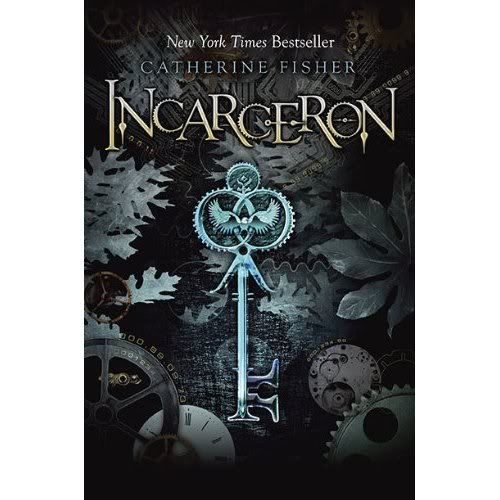
Interesting choice in font, I'm surprised I haven't seen any steampunk books or websites using it since it really evokes the feeling of clogs and clocks. And, considering what's on the rest of the cover, it all fits very well. It was nice to have the key from the book on the cover since, even though it's described so often, it's nice to have a visual to see what it really looks like.
Summary: It may be the future but the world is stuck in the past, trapped by traditions enacted after the world nearly destroyed itself but the protocol that binds Claudia doesn't seem to be doing her any good either. And her's isn't the only messed up part of the world, Finn lives in the great prison Incarceron, initially created as a place to nurture and provide for every need of thousands and thousands of people but instead is a living hell for all it's inhabitants. Finn wants out and Claudia wants out of her arranged marriage with the crown prince and in the process discovers an interesting link to the mythical prison.
The Good: Claudia turned out to be a much more interesting protagonist than I expected and was a very nice mix of clever, curious and yet not too impulsive, the kind of character who goes out and does things but not the kind of things where you want to yell at them for being an idiot. Also, even though this book is part of a duology, most of the plot threads are wrapped up at the end of this book so it feels very complete which is very nice. That's not to say that there aren't a few sequel hooks, some of them rather large ones, but if the book wasn't quite working for you (like it was for me at points) then it's easy to feel satisfied and stop reading at this point.
The Bad: I mentioned earlier that both FelicityDisco and I both figured out a fairly major plot point within the first hundred pages of the book and, since the book tried to make it ambiguous for the next 300 or so pages, that's not a good sign. It's entirely possible that the second book will prove that we were actually wrong but still, I like books with plots so it's annoying to read one where it uses such an obvious trope that I can figure it out so early on. What bothered me more however was how the logistics of Incarceron worked, from minor ones (where does such a large place get enough power to work?) to more major ones (people being born with machine parts in them because "the prison recycles everything" except they were conceived, erm, in the normal way, ie one that doesn't require outside sources). There were other things about the setting that bothered me as well* but this detail cropped up so often that it bothered me throughout the entire book.
Sorry for the delay, busy afternoon and night for me, wasn't expecting certain things (coughbusescough) to take up so much of my time (and I have yet another head cold which always makes writing slightly tricky). Tomorrow's review should be up at a more reasonable time tomorrow and, as normal, I plan on glancing over this when I'm more awake, hope there's nothing major I need to correct....
*I suppose this would actually count as a lying protagonist except it's by accident, having a character who has never seen the real world be the point of view usually means that things get described differently than how someone with a regular worldview would (a good example is The City of Ember) always bugs the hell out of me.