Despite the fact that I follow Maureen Johnson on twitter (and really love her twitter) I haven't read that many of her books. I've read Suite Scarlet (which I didn't really like) and then the two Thirteen Little Blue Envelopes books (which I did) so initially I was only a bit curious about her new series. But then her publisher kindly put up over 50 pages as a preview and I was hooked. Sadly the book came out over the holiday season last year so I couldn't buy it (and I haven't been this tempted to blind-buy a book where I haven't read any other volumes in the series in a long time) but thankfully it showed up at my local library this summer and I was able to finally read the rest of it.
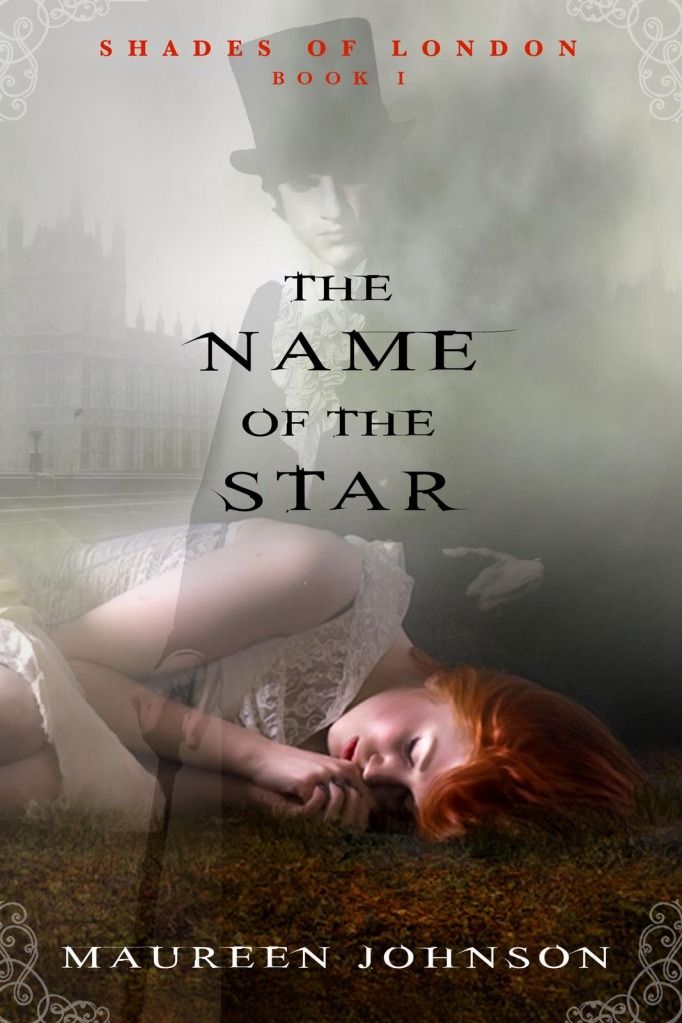
The Name of the Star by Maureen Johnson
A nice cover which, for the hardcover, also has an interesting texture to it (and I mean that in the most literal way possible, it's not quite raised but it has a very slightly more bumpy feeling to it than most covers do). There's something about the colors that feels just a little off to me but it's a good, fairly unique looking image which combined with a title that has no immediate connection to the image (Jack the Ripper fans will probably spot it right away however) and it's a good, grabbing cover.
Summary: Rory is excited to spend her senior year of high school in London not because her hometown in Lousiana is boring but because London is different and exciting. Really exciting as it turns out since someone is going around and imitating Jack the Ripper and Rory's school is right smack in the middle of all the old crime scenes. And nobody has a clue how these crimes are being pulled off even when they have the CCTV footage right in front of them, it's almost like the ghost of Jack the Ripper itself has come back.....
The Good: One thing that I liked a lot about Thirteen Little Blue Envelops was how the characters were realistically weird with a quirkiness that I don't often find in fiction but find a lot in real life. Johnson has once again nailed this, Rory feels like a completely believable character and so do the others, their interactions and relationships also feel perfectly natural for high schoolers. On the flip side of things, I like how the supernatural was integrated into the story and felt like just enough was explained for a first book in a series and in-series that the characters explained everything they already knew. I'm really curious to see where the series goes next, some of the events in the ending went quite differently than I expected, maybe this time I'll be able to buy it right when it comes out!
The Bad: There wasn't much I disliked about the book actually, I felt like some of the side characters dropped out around two-thirds of the way through but since this is a series there's a good chance they'll come back later so I can't complain. I am also a little worried/curious about what the plot of the next two books will revolve around since, if you were to cut out one scene, the story would be entirely self-contained. But even that isn't a really bad thing, or at least it's something that's a bit silly to be worried about at this point.
If I had gotten a chance to read this book back in 2011 it almost certainly would have been on my favorite books of the year list, 2011 was actually a really good year for me when it came to YA books. Come to think of it, there haven't been many books at all that did/will come out in 2012 that I was/am excited for (only three or four I think) and while I have read a few books from this year already I haven't been grabbed as strongly by them either, perhaps that's why I've been reading more adult fiction that usual this year.....
Due to an interesting sequence of events I actually got yet another library card this summer, this time for another town in my county which had some books mine didn't (and it seems like they can't simply ship books between the two systems, boo) and I was pleased to discover that they had an interesting and well-stocked manga section. So I grabbed what looked interesting (including one title that I can't remember sadly) and went to town on it.
Mixed Vegetables by Ayumi Komura
Summary: Hanayu has a problem, her family owns a bakery which she is expected to inherit but her real passion lies with making sushi, something that doesn't go well with sweets. So she hits upon a plan when she encounters her classmate Hayato, eventually become his wife so she'll now have the excuse that her husband is inheriting a sushi shop and they can't possibly do both at once. But it turns out that Hayato is interested in her for the exact same reason.....
The Good: I've seen some rather "mixed" (hey put down those pitchforks!) reviews of this series, some bad and some okay, and the series did turn out better than I expected. Hanayu has some spunk to her and a lot of drive, even if she's ultimately too fixated on just making sushi, and there was some amusing humor in there. It's not a ton but it is enough to keep someone entertained for an afternoon.
The Bad: So the plot point that Hayato also wants out of the family business was mentioned in all the advertising I've seen for the series over the years yet it takes a full manga volume to get to that reveal which honestly frustrated me a bit (partially because it was slow and then partially because it's then revealed that all of his act so far has been a lie and that means the series will be even longer since he then needs to be developed). Also, for a series that is so obvious a romance it certainly takes it's sweet time
The Art: The art here is very average looking shojo, which readers can probably tell from the cover where the characters look like they could be from any number of other series from over the years. It works but I don't remember very clearly any of the details from it (compare with House of Five Leaves which I read around the same time and remember fairly distinctly). I think the art sums up the series, it's not terrible, you won't feel worse off for having read it, but I can't recommend it knowing that there are better shojo series out there (one of which I will get to next week).
Doubt I'll be trying to find more volumes of this series in the future (the library did have more, I just already had so much manga that I decided to hold off checking out the entire series at once), next week's manga will be an interesting one to compare this to at least.
The other anime I had a chance to get through this summer courtesy of the college library (unfortunately you can only check out two DVDs at a time and, since I'm not the only person in the household who likes movies, I was barely able to get through this, Paranoia Agent, and Veronica Mars before the summer was up) which was one I had been curious about since I say people talking about when it came out (fairly recently in 2009). It's high fantasy, based on a series of novels that seem to be fairly well regarded in Japan, has lots of world-building, that sounds like the series for me, right?
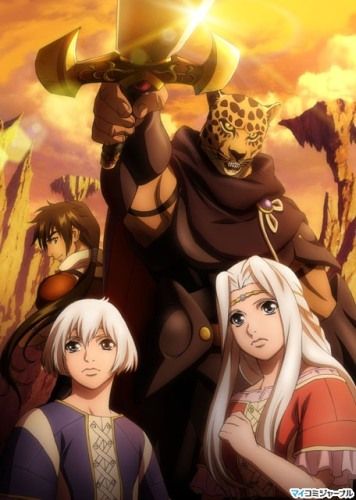
Guin Saga
Summary: In the middle of the night the country of Pharos is invaded by the army of the country of Mongaul* and the twins Rinda and Remus (the heir to the throne) barely manage to escape using an ancient device that seems to be one of the reasons for Mongaul's invasion. But the two do not end up where they mean to be and are ambushed again in a remote forest when they are saved by Guin, a strange man who remembers nothing of his past and has a leopard's head instead of his own. He agrees to help them escape and then regroup to take their country and they all become involved in the even wider politics of the world in the process.
The Good: I knew that this series had to cover multiple volumes in the series but I figured it was between 4 and six, which is standard for most light novel to anime adaptations. According to tvtropes this show crammed in 16 novels in 26 episodes which I'm rather impressed about, there must have been a ton of compression to make this work but the show didn't feel like it was cutting corners, rather that it was just quickly paced. I do have mixed feelings on the ending (on the one hand it was a logical place to end, on the other hand it had two rather large cliffhangers involving different characters) but they certainly couldn't have ended the show any earlier and I doubt they could have fit another few novels in.
The Bad: One of the extra features in the second set (which I didn't see since it was on a separate DVD and I was running out of time) was an interview with the original author who mentioned that she had trouble writing female characters, something I had noticed but I would go so far as to say that she just doesn't seem to be a great character writer. This series should've had me completely hooked on it with it's big politics and setting yet I just didn't like any of the characters (except for Rinda but unfortunately as Remus began to "grow" as a character, read become an ass, her role diminished even further) and just couldn't care about any of them by the end. I will note that I have read some translations of light novels (official and by fans) and I've noticed that Japanese writing tends to make the characters more introspective, which doesn't carry over well to anime most of the time, so part of this problem might be from the adaptation but I feel like my complaint still stands. I'm completely baffled how a female writer doesn't know how to write female characters whatsoever; you write a character, give them a personality, flaws, desires, etc, and then consider what affect their culture will have on them because of their gender. She instead seems to wallow in the idea of "oh they're a woman so they're in love and it makes them indecisive so they'll never be the major mover and shaker of the story!" and even knowing this series started in 1979 it frustrated me.
The Audio: I watched the Japanese audio since I had heard rumors at how bad the English dub got (no seriously, at one point they have a guy singing out loud his internal dilemma which makes no sense at all and the script-writers should have understood from the context) which is a bit of a shame since the Japanese dub is rather average. The opening and ending songs are rather nice however, the opening is an instrumental only piece and the ending is a nice ballad and the lyrics even make sense within the context of the story. Together with the background music they felt like a cohesive soundtrack which had several good pieces, including one which I believe was the main theme (based on how often it appeared in the show).
The Visuals: While the visuals they weren't utterly spectacular as I would have hoped for a fantasy series (think your average, comes out and in a few years people don't remember it, fantasy film vs Lord of the Rings in terms of looks) but again it works. It's simple plain, the colors come off as too bright and flat in many instances, and even the multiple fight scenes didn't draw me in, even the most simple looking of shows should have a style or flair to them that the viewer remembers and that helps out the story in some way.
By the end I was simply slogging through the story (doesn't help that for some reason it was packaged six episodes to a disc which made it feel even longer) and I have no interest in seeing the show again, recommending it, and after finding out that the few novels that were published in the US don't cover even half of what the anime did I have no interest in reading those either. Next!
*which, amusingly to me, is pretty much pronounced "Mongol", seemed fitting for an invader.
I'd seen a good chunk of this movie before during a livestream but unfortunately due to technical difficulties I'd seen barely any of the beginning of it and wanted to properly sit down and watch it sometime. So, when the college library moved all their DVDs around (noooo, just when I had learned where everything was!) I checked out where they had put all the animation DVDs and this was one of the first things in there. I should mention this is the same place where I got Paranoia Agent, Millinium Actress and where the guy at the check out knew about The Dreaming Machine (I think that's it's title?) so clearly I'm not the only fan of Satoshi Kon who uses this library which does make me rather happy considering how few works he had.
Tokyo Godfathers
Summary: It's Christmas time but that doesn't mean much for the homeless Gin, Miyuki, and Hana (a bum, a high school runaway, and a transsexual respectively) who are just trying to stay warm and stay fed in a Tokyo winter. So it's to their, and the viewer's, great surprise when they come across an abandoned baby in the trash one day and set out to try and find who she really belongs to.
The Good: This is the least surreal of any of Kon's films I've seen so far, although considering it's premise and the old luck that follows the characters around for the whole movie it's not quite realistic fiction either (although it does come close). The movie does a fantastic job at fleshing out it's three leads and having a really fun plot in the process, even though it gets heavy and sad when it talks about legitimately sad issues (from what I've read elsewhere Japan really tries to cover up the fact that it has homeless people at all and the scene with the teenagers really happened around the time the movie was made). All in all this is my favorite of Satoshi Kon's works, unless Perfect Blue is even better once I get around to seeing it, and I think I could recommend this movie to someone who might be a casual anime fan or even someone who enjoys a Disney/Pixar film and is in the mood for something Christmas themed.
The Bad: I said the movie is almost realistic fiction but not quite, I'd advise having that mindset going in if you tend to be a stickler for realism since there are quite a few coincidences, call them miracles, throughout the movie that play with the realm of possibility. I had no problem with them, I found them amusing and the movie did hint at a reason for their occurrences, but I'm sure it would bother others so I thought it worth noting. That's pretty much it, the plot wouldn't progress the way it does (or at least at the speed it manages) without these miracles but that seems to be a staple of Christmas movies everywhere so I really can't hate it for that.
The Audio: I do wish they had included some subtitles during the Spanish speaking bits (I watched this movie with my mom who was able to translate a tiny bit of it which helped) and, while I understand why there weren't subtitles at that point I still would have liked them. I watched the Japanese dub of the movie (it appears that there is an English dub of the film but it was done by Animax Asia, ie I don't think there's an American/Canadian or even British dub of the movie) and it worked well. The characters sounded a bit less stereotypically anime than usual, which worked well since this didn't feel like an average anime movie, and I really liked how Miyuki sounded like a real, grumpy, teenaged girl with a lower voice than most female anime characters have
The Visuals: As I noted last week with Paranoia Agent, Kon's films all have a distinctive art style and I'm not talking about the surrealism, I mean that the characters all look like they were created by the same person (Miyuki for example looks a bit like a younger sister or cousins to Paprika from Paprika). Thankfully Kon can design more than six character types so this isn't a problem and I thought the art worked just well here. Due in part to it's movie budget the film looks good with plenty of detail and looks consistently good throughout the entire movie.
This was a very solid movie and I was happy at how much I ended up enjoying it, I hadn't expected to like it quite this much and I think I'll try to pick up a copy of it for myself sometime. It probably won't be immediately, since I have quite a bit of anime (gah, why does everything come out so close together) to buy at the moment but I'll keep an eye out to see if I can snatch it up during a sale somewhere sometime.
This one came up on my radar a while back, I believe I saw an interview with the author over on The Enchanted Inkpot, but really it was the cover that caught my attention again when I came across it at the local library. So that was it, I found a book in the library and simply read it, so onto the review!
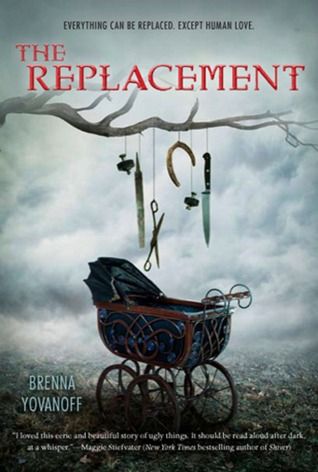
The Replacement by Brenna Yovanoff
It's certainly an eye-catching cover, it's practically everything you wouldn't put over a baby carriage in real life, but the scene is described and explained in the book so it makes sense as a cover (and if you know your folklore then the reason there are a bunch of metal objects, including a horseshoe, over a baby's bed should be abundantly clear from the first glance).
Summary: The town of Gentry is like many other small towns in some ways but very unlike them in others, a fact that non-human Mackie knows all too well. He's a replacement, a changeling left in the crib of a human child and raised by the child's family who are all too aware that he is not the baby they gave birth to and the world of iron and churches is slowly killing him. And so it's when he's becoming weaker and weaker that he learns of the underground world he came from and he becomes drawn in when he hears of another child taken and is determined to help save her.
The Good: As I've said before, since America doesn't really have a mythology to call it's own (if you're not Native American anyway) so I'm always curious to see how authors try to create one, oftentimes drawing on fables and fairy tales from western Europe, and it worked very well here. I'm assuming it's set in the US, since Halloween is mentioned often and I'm told that outside the US no one celebrates Halloween, but it uses a bit of Irish myth and a lot of European fairy tale folklore to create a setting that works very well. But, even better than the setting in my opinion, is that none of the multiple side characters in a book is an idiot. They all have a pretty good idea what is going on before Machie confides in them and it was those moments which really made the setting work, there are few things I find as infuriating than a setting which does not influence it's characters or characters who never once think about how strange the world around them is.
The Bad: The story is a bit slow to get going and Mackie isn't the most adventurous protagonist I've seen in situations like this (it probably doesn't help that I read another book later that has a similar mix of mythologies but with an more interesting lead, it won't come up for a while but people should be able to figure it out when it does). It really is a strong story overall though, apart from a bit of complaining about how the pacing wasn't perfect, and there was a subplot with Mackie and music which I felt like was dropped partway though, I have nothing really worth writing about.
Again, not much to say to wrap up here. It was solid and good, even if it wasn't the most original story it did have some original twists to it which made it work. Think I saw another book by the same author a few days ago but I believe this book is a stand alone, I honestly can't think how a sequel would work since it all wrapped up so neatly in the end.