I noticed recently that there are quite a few noitaminA titles I haven't seen yet so I'm going through and rewatching a few which I haven't seen in years and trying out the rest and this title was first up on my list since it's been at least five years since I saw it. In fact I remember watching it pretty clearly just for the fact that I somehow managed to marathon it in two days even though this was back when I had only an hour and a half of computer time each day (I have an idea of how I pulled it off but I'm still rather impressed at my high schooler self). Also, there was a movie for the series that came out in 2012 and fansubs hit the internet earlier this year and I'm going to be reviewing that along with the tv series here since it's a clear continuation of the story and, unless I miss my mark, is also where the original novel series ended. It certainly feels like a good, solid ending, the tv series one wasn't bad at all but where that felt more like the story had been thematically concluded the movie gave the actual story/plot an ending as well.
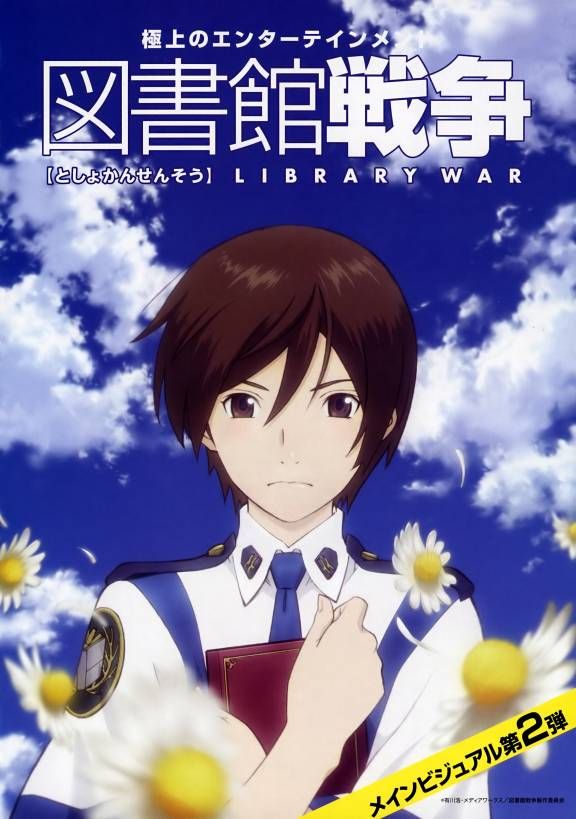
Library War (Toshokan Sensou)
Summary: The year is 2019 and Kasahara is the latest recruit in the Kanto Library Defense Force which is exactly what it sounds like, a military force created by the libraries to fight against the censorship happy Media Betterment Committee who aren't afraid to use guns and underhanded tactics to scare the public and the libraries into giving up their rights to freedom of expression. Kasahara was inspired by a member of the Library Corps who helped her out in high school and hopes to meet him again someday, but for the moment she first has to improve her own performance so she doesn't get kicked out!
The Good: I had forgotten just how much I like Kasahara and Shibusaki (her roommate whose in the information division) because they are really awesome characters. Kasahara starts out as the typical rookie, a bit cocky, doesn't quite understand everything they've gotten into, prone to punching bears in the face (wait what) but she really grows over the course of the story and matures into a much more level-headed young woman. She never loses some of her rash thinking but you can really tell that she's grown up with her quick thinking and how she disobeys her orders far less. Shibusaki is also a really interesting character, she deals with information and plays a role that's rarely on the side of good and when it is, is usually done by a male character. She's not a spy or femme fatale or a seductress, just someone who is very good at manipulating people (even when they're well-aware of her intentions) and putting together the pieces she gets, all of which is also done without the "oh but are they really good or are they actually evil???" tropes that seem to get attached to characters who usually deal in information. In this story there are clear good and bad guys, something I would complain about until I look at recent US politics* and while there area some characters that toe the line I never felt like it was for shock or drama and that it really fit with the story.
The Bad: Oddly enough out of the five main cast members it's Dojo, whose arguably the second most important character in the series, who gets the least amount of character development. Kasahara and her fellow new trainee Tezuka both grow and deal with their own problems, Shibusaki and Komaki are more established but do change some (although Komaki has arguably the least amount of screen time) but Dojo just doesn't really change and he really needs to. I think the idea was "the growth Kasahara is going through is the growth Dojo already had (therefore he doesn't need to keep growing)" but considering how often he loses his cool around her and such, yeah I'm to disagree there. I'm sure that some people will make the argument that those moments are meant to be more comedic and not a reflection of his character as a whole, I'm going to again disagree and say that it felt like lazy writing.
The Production Values: I was a little sad when I realized that the character designs had changed very very slightly for the movie since one thing I really liked about the anime designs was how Kasahara looks like a sturdy, somewhere between stocky and built, tall young woman but in the movie it looked like she had lost some muscle in an attempt by the animators to look prettier. However, considering I watched both versions practically back to back I imagine that most people won't notice, or care, about such little differences. Other than those little nitpicky details there isn't much to say about how the series looks and sounds, the ending song is really catchy however and I was surprised to find that I still remembered some of the lyrics after so many years.
I'm giving this whole series a 3.5 out of 5 for being something that I really did enjoy, not quite as much as when I first saw it although I expected that, and something i would totally buy if I could in the US. However it's not licensed (bootleg version of the series at my local second-hand store notwithstanding) and given how many years it's been since the series was created I don't ever see it getting licensed. Same for the original novels, I seem to recall hearing that they were rather technical as well (explaining why I could never find that much translated or summarized online), and considering that the series and movie covered all four volumes there's no real need either. There is also a manga adaptation of the books (well two, we never got the one volume shonen adaptation) which is being released by Viz. I've noticed that my local library has some of the volumes so I plan to check it out soon, however I noticed on Viz's website that volume 10 (the latest one out here) seems to cover the material episode 10 does so while I probably will buy the manga someday (since that's the only way I can support the series) it looks like this might end up being a rather long series.
*the whole story makes more sense when you realize it's a metaphor for federal vs state rights, the national government putting out new censorship laws for the "betterment" of the people and the local governments/library branches going "hell no". This section of the wikipedia article shows the real-life inspiration for the story and anime/manga fans who follow the news will probably remember hearing about the Youth Ordinance Bill a few years back.
For confused readers, no there isn't a tv series/movie review this week since I just plain ran out of things to review, hopefully this won't be the case next week. And I had hoped with that I'd be able to get back on schedule but yesterday was my fourth day in a row of on and off headaches and I just wasn't able to finish this review in time, when you see the length of it you'll see why.
When the information about this show first started coming out earlier in the year I was uninterested, it was a spin-off of an older franchise (Science Ninja Team Gatchaman or Battle of the Planets) which I was wholly unfamiliar with (considering it's older than me by almost two decades) and that's fine. But then some information began to trickle down, it sounded as if this would be a completely unrelated show that a newcomer could watch and it was a sentai show with a female lead. Now, girl leading characters aren't uncommon in anime, they probably make up about a third to a half of all main characters, but outside of magical girl shows with heavy sentai influences (like Sailor Moon) I couldn't think of any with a female lead and that got me interested, even excited. And then I saw a bit more about what the show was like and went "yeah, this is going to end up being one of my favorite shows of the year isn't it?"
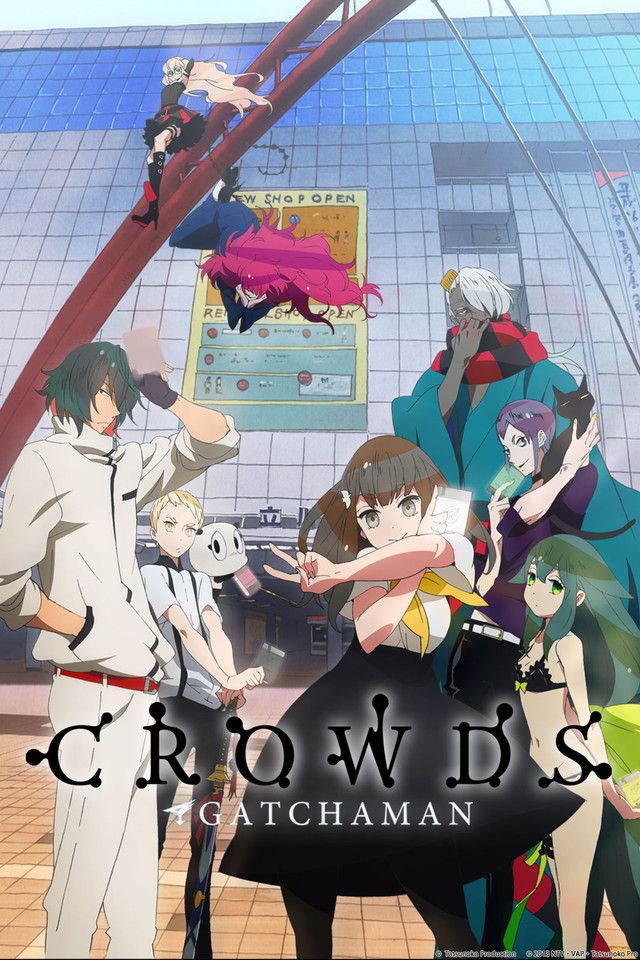
Gatchaman Crowds
Summary: Hajime is a happy go lucky high school girl who doesn't even bat at eye at the fact that she was just chosen to protect the world from alien threats and given the power to transform into a Gatchaman. And it seems like she was chosen at just the right time, an old foe of the Gatchaman has reappeared, determined to make humanity self-destruct and Hajime has just the right outlook on life to deal with it.
The Good: Man oh man, where do we start. Well, as mentioned above, we have a female lead in a genre that usually doesn't, huzzah! There are a few problems with Hajime, noted below, but that's with Hajime herself, not because she's female* and in fact originally Sugane, a male character a year older but whose been a Gatchaman for five years, was supposed to be the lead which makes me curious what kind of show it originally was since without her it would have never done what it did. And what it did was pretty slick, I'm sure by now many nerds have seen a superhero show or movie where towards the end the main character goes "what's the point, why do we do this, why are we superheroes?" and if done early that because the raison d'etra of the story and if done late usually causes a breakdown (or breakup of a team) but then they rally again behind the motives they started with to save the day. Hajime questions this at the very beginning of the second episode, getting it out of the way earlier to focus on the show's real theme (communication) and the show comes to some interesting conclusions on the topic by the very end. Related to all of this is Hajime's foil, a young man named Rui who created a super intelligent artificial intelligence which he uses to run a social media site where users get points for doing good deeds in the real world (so Klout with real world clout). He was also given alien powers, the ability to make someone's soul manifest in the real world and can give the power to others but only does for a select few since, in contrast to Hajime's optimism and understanding, he fears what people do when left to their own devices. Oddly enough he's even the more idealistic of the two, hoping to "update" the world so that these carrots and rewards are no longer needed, and guess what, these two guys aren't ever enemies! Sure they do debate a bit but again, the main theme of this show is communication and you can't communicate if you're enemies. The show also proves that it understands social media better than any other thing I've seen in the media for years, it both acknowledges trolls and the power they have yet has unwavering faith that the majority of humanity is good that that is where we should place our trust (which is especially interesting given how most American superhero films as of late have focused on shielding people from themselves in a dark world, some have even pointed out that by comparison this makes American movies oddly Confucian and Crowds more idealistic and populist).
The Bad: I mentioned earlier there is a bit of trouble with Hajime the character, the problem is that she's less of a character and more a force of nature. She doesn't really undergo character development, is rarely wrong, without her the plot would have never moved the way it did, and you know what I'm okay with that. Part of it is that the show took a sterotype (the ditzy seeming female character, complete with a verbal tic) and made her both exactly what she seemed to be (a bit off the walls) yet also a deep thinker and it takes a while for both the audience and the characters to catch on not because she hides it but because she can be subtle when needed (plus we were both thinking of that old stereotype). And some people just won't like her because of the stereotype, I won't deny that she's a bit much at times but I have a tolerance for those things after trying out many moe shows over the years (heck at least she doesn't trip over invisible objects all the time). There is a problem with the last few episodes however; to remain spoiler free, the first half of episode 11 is a recap with the side characters all articulating how Hajime has helped them to grow and change, the second half is new material as is all of episode 12 and then the story seems to end without having tied up one major plot point and one more minor one. And after the credits scene seems to partially resolve one of those but yet, especially since the director did a huge public apology recently, the show has been rushed from the start, and there's a special event later in the month a number of fans are wondering if we didn't actually see the entire show. The show oddly enough had only 22 minute long episodes instead of 25 to start with, there were a couple of episodes earlier on where I felt like a scene was missing, and it was such an odd place for a recap I really do wonder if they scrambled to tell the best story they could in the time they had and then use that to delay to finish it up. If anything ever comes of this I'll edit this post, or I'll at least note if nothing else does happen, but the fact remains that one large thing gets tied up off-screen and a Chekov's gun appears to have never been fired, leading me to wonder if they were one and the same.
The Production Values: As noted it appears this show was a bit rushed and there were parts where the art looked a bit sloppy (heck, I think there was an element missing from the first episode since it seems like the characters were looking at something which wasn't on my screen!), I expect it'll be a bit touched up for the BR/DVDs. I liked how the show used bright colors, like last year's tsuritama, and while I didn't notice it on my own I've seen a number of people blog about the composition and lighting of certain scenes and the inclusion of some modern art in the background as well (which, given that the title of each episode referred to a style of art, must be deliberate). As for the audio, I still adore the opening theme but was rather confused by the lyrics and made more confused after I found a fan translation, thought it worked very well, and then found out the lyrics were actually nonsense**. I also fell in love with the soundtrack, I went through it on youtube one day and loved how upbeat and fun the techno was, it perfectly matched the series and made me even more pumped to watch the next episode. But what I suspect most fans will remember even more is Mamoru Miyano's performance as the series villain Berg-Katze because of how over the top and hammy Katze usually was but also for how many other voices he had to do when Katze impersonates others. It certainly sounds like he had a rollicking time doing it, if Sentai Filmworks chooses to dub this show they'll have their work cut out for them to have someone be able to match the intensity and wildness of Miyano.
And so I quite happily give Crowds a 4 out of 5 for being wonderful fun yet showing that it both understands how the world works in many ways as is cheerfully optimistic that everything will work out if everyone pitches in by the end. It's wild, fun, tackles quite a few issues better than most shows do, and unfortunately for me has raised the bar on what I expect out of superhero shows now. Crowds, along with the original Gatchaman, has been licensed by Sentai Filmworks/Section 23 and is available for streaming on their website and on Crunchyroll.
*fun thing other fans noticed, the show also has a couple of characters who are the "contact characters" with the police, fire department, mayor, self-defense force, and civil servants. A lot of these are traditionally male roles but the SDF and police have female contacts and you could argue either way that the civil servants contact was Joe (a gatchman so he almost doesn't count) or his two female co-workers. While the show does still have more male characters than female in both main and supporting roles I get the impression that they did go out of their way to include female characters and the arguably flattest character in the entire show is male as well, that's all amazingly awesome.
** this is one of the many times I wish I was musical since I'd love to hear an English fan cover of the fan lyrics given how well they seem to fit the show, I can't remember the last time I heard an OP/ED that really was just nonsensical.
I'd seen a good chunk of this movie before during a livestream but unfortunately due to technical difficulties I'd seen barely any of the beginning of it and wanted to properly sit down and watch it sometime. So, when the college library moved all their DVDs around (noooo, just when I had learned where everything was!) I checked out where they had put all the animation DVDs and this was one of the first things in there. I should mention this is the same place where I got Paranoia Agent, Millinium Actress and where the guy at the check out knew about The Dreaming Machine (I think that's it's title?) so clearly I'm not the only fan of Satoshi Kon who uses this library which does make me rather happy considering how few works he had.
Tokyo Godfathers
Summary: It's Christmas time but that doesn't mean much for the homeless Gin, Miyuki, and Hana (a bum, a high school runaway, and a transsexual respectively) who are just trying to stay warm and stay fed in a Tokyo winter. So it's to their, and the viewer's, great surprise when they come across an abandoned baby in the trash one day and set out to try and find who she really belongs to.
The Good: This is the least surreal of any of Kon's films I've seen so far, although considering it's premise and the old luck that follows the characters around for the whole movie it's not quite realistic fiction either (although it does come close). The movie does a fantastic job at fleshing out it's three leads and having a really fun plot in the process, even though it gets heavy and sad when it talks about legitimately sad issues (from what I've read elsewhere Japan really tries to cover up the fact that it has homeless people at all and the scene with the teenagers really happened around the time the movie was made). All in all this is my favorite of Satoshi Kon's works, unless Perfect Blue is even better once I get around to seeing it, and I think I could recommend this movie to someone who might be a casual anime fan or even someone who enjoys a Disney/Pixar film and is in the mood for something Christmas themed.
The Bad: I said the movie is almost realistic fiction but not quite, I'd advise having that mindset going in if you tend to be a stickler for realism since there are quite a few coincidences, call them miracles, throughout the movie that play with the realm of possibility. I had no problem with them, I found them amusing and the movie did hint at a reason for their occurrences, but I'm sure it would bother others so I thought it worth noting. That's pretty much it, the plot wouldn't progress the way it does (or at least at the speed it manages) without these miracles but that seems to be a staple of Christmas movies everywhere so I really can't hate it for that.
The Audio: I do wish they had included some subtitles during the Spanish speaking bits (I watched this movie with my mom who was able to translate a tiny bit of it which helped) and, while I understand why there weren't subtitles at that point I still would have liked them. I watched the Japanese dub of the movie (it appears that there is an English dub of the film but it was done by Animax Asia, ie I don't think there's an American/Canadian or even British dub of the movie) and it worked well. The characters sounded a bit less stereotypically anime than usual, which worked well since this didn't feel like an average anime movie, and I really liked how Miyuki sounded like a real, grumpy, teenaged girl with a lower voice than most female anime characters have
The Visuals: As I noted last week with Paranoia Agent, Kon's films all have a distinctive art style and I'm not talking about the surrealism, I mean that the characters all look like they were created by the same person (Miyuki for example looks a bit like a younger sister or cousins to Paprika from Paprika). Thankfully Kon can design more than six character types so this isn't a problem and I thought the art worked just well here. Due in part to it's movie budget the film looks good with plenty of detail and looks consistently good throughout the entire movie.
This was a very solid movie and I was happy at how much I ended up enjoying it, I hadn't expected to like it quite this much and I think I'll try to pick up a copy of it for myself sometime. It probably won't be immediately, since I have quite a bit of anime (gah, why does everything come out so close together) to buy at the moment but I'll keep an eye out to see if I can snatch it up during a sale somewhere sometime.