Friday, January 14, 2011

Book Review: Silver Phoenix

As a quick note,  I'm hoping to get two reviews out on each Saturday and Sunday to keep this blog moving along and I have finally caught up to the stuff I was watching/reading over winter break with this book. Although, winter break was three weeks long and I read/watched a lot of stuff during it....

Silver Phoenix by Cindy Pon
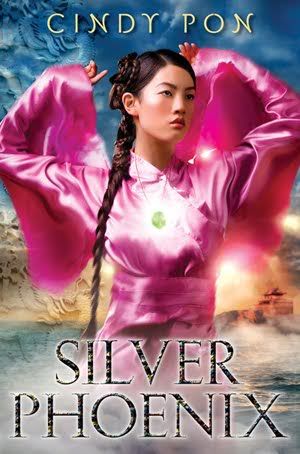
 I really like the  bright pink on the cover, it really catches your eye, and yay for an actually Asian model on the cover of an Asian inspired fantasy, but I'm a little puzzled by the rest of the cover. Is she supposed to be wearing a kimono there? Aside from the fact that this book seems to be set in a Chinese inspired world (not Japan), if she is wearing a kimono then it's tied backwards, you know, the way they tie the kimono on dead people. Moving beyond that, the girl's hairstyle confuses me because it was specifically mentioned half a dozen times in the book that unmarried girls wear their hair in one long braid and servant girls wear their hair in two buns, so why does she have both of those hairstyles? Never mind that actually, how does the model have that much hair?!? Sure it's nitpicky but this stuff really does bother me, plus having the author's name and the title of the book in two widely different fonts looks strange and this is coming from someone who doesn't normally care about fonts, I think I like the cover of the paperback edition much better.

Summary: Ai Ling is an oddity since she is 17 years old and still unmarried but she minds this much less than either of her parents do. Her life starts to get a little more abnormal after her father leaves to advise the emperor and doesn't return for months. Facing the prospect of being forced into marriage with an unscrupulous merchant, Ai Ling leaves home for the capital to figure out just what is going on and because even more confused when creatures from the underworld start targeting her with alarming frequency. She finds a friend on the road in Chen Yong, a young man traveling to get away from his home for a bit. And with all the nasties after her Ai Ling is going to need all the help she can get, especially when she sees what fate has in store for her.

The Good: Very nice world building, normally I only come across Asian inspired worlds in anime or manga, I believe the author herself is Asian, so it's always a treat to see an author creating a different kind of world. I've read a little bit of central Asian mythology (fairly sure I read Journey to the West a few years back) and the description of the monsters, heaven, and gods themselves really felt like Chinese mythology to me. Beyond that, there were a number of other little details in the book (clothing, food, fighting) that helped set up a clearly defined and interesting world that also wasn't just a copy of ours.

The Bad: The pacing on this story was waaaay to fast. The book is a good 352 pages long but has enough stuff for a 400+ page book crammed into it. Too much happened in too short of the time and there was no time down time for the reader to connect with the characters. There were a couple of major character deaths but since the story had been paced so fast I didn't feel any connection or emotion over the deaths. The motives of the characters are a bit murky as well, the villain's motives are explained in the end, but very late into the story (heck, the story takes a while to come out and say that yes, there is a central villain responsible for everything). The other characters' reasons for this whole journey could be summed up as "they are the tool of the gods/are tagging along with the tool of the gods." There are ways to do that right (Greek mythology did it right, Megan Whalen Turner's books are pulling this off very well) but here it feels like Pon had a central conflict for the story, had some characters for it but couldn't quite figure out how to connect it all and resorted to "fate said so so just do it" to make it work.

I'm a little conflicted about how I feel on the ending of the book. On the one hand, I found myself going "augghhhh, it's like Kimi ni Todoke!" But, after thinking about it for a while I realized that the ending is actually one I wish more authors would take a risk more often and pull off (it has to do with romance and, if this blog hasn't made it clear already, I'm fairly unromantic). And then found out there is to be a sequel to the story (what about I'm not sure, the conflict was wrapped up in this volume after all) which will probably undo what I did like about this ending and go for a more standard YA ending.

Lastly, when reading this book I was reminded of another book I read this past summer, Gateway by Sharon Shinn. Also an Asian inspired fantasy (although this one was more like Victorian Great Britian except with Chinese trappings instead of British ones) and I think I liked it slightly better, and again I liked parts of the ending for taking a risk and then it did something else that I didn't like after all. So, probably no re-read for either of them and no buys either, but I will check out the Silver Phoenix sequel when it comes out this spring.

Thursday, January 13, 2011

Webcomic Review: Gunnerkrigg Court (volume 1)


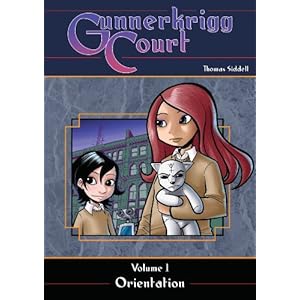
I discovered Gunnerkrigg Court a couple of years ago (one of the libraries had a print copy) and almost didn’t start reading it because of the art in the first few chapters. Almost, thankfully I had the good sense to peak at the later chapters and see that the art did in fact get better and it’s now one of my favorite webcomics. So when I found the first book at my college library I took the chance to reread the first 14 or so chapters (which is what I’ll be primarily reviewing here since the comic isn’t finished yet) and see what foreshadowing I missed the first time around.

Gunnerkrigg Court by Tom Siddell


Summary: Antimony Carver is a new student at the titular Gunnerkrigg Court after he mother passes away and her father goes missing. She is a quiet child who keeps to herself and spends a lot of her time exploring this strange new place. She soon makes a friend in Katerina Dolan, the daughter of two of the teachers and who has lived at the school her entire life, and both of them are constantly discovering that the court is a much stranger place than either of them would have imagined.

The Good: In terms of plot, this webcomic series has one of the strongest out there and I was surprised how much foreshadowing there was in the earlier chapters. Nothing huge, just small details in the background, but the nice thing about foreshadowing is that is proves the author has thought a lot of the story out beforehand* and it gives readers an incentive to reread (ie, buy the books). The first book also ends at the end of the first year so, even though there isn’t an overlapping story arc for the first volume, the book still feels complete.

The Bad: The art is a deterrent and the first few chapters feel a bit disjointed, as if Tom wasn’t quite sure how to start the story so he settled for showing just how strange the Court is until he got going. This book also focuses more on Annie and Kat while the later chapters focus a lot on side characters as well, understandable if you consider the book an introduction to the series but a fourteen chapter introduction is rather long. Finally, Gunnerkrigg Court is a story with a lot of mysteries and a long build up to the reveals so this volume in particular introduces a lot of plot points that aren’t resolved

The Art: Full color pages and it really does get better, loads better later on and that is the case with a number of webcomics actually. The character and background designs start off as simple and awkward drawings (which to be completely frank are rather ugly) but slowly become more defined, more detailed, and less strange to look at. The art shift is notable in this book (the art at the end is much nicer than the first chapter’s) and even more so when compared to the latest chapters, so please don’t let the art put you off. The early chapters in the book are kinda important, so you really can’t skip them, and the art really does become truly gorgeous at points later on.

I’d forgotten until I started writing this review a line said by Annie at the end of the first book “but my father didn’t appear for two more years” and that in verse it’s been almost two years since that point. Considering there have also been a few big reveals recently I think the story is starting to build up to the climax which makes me really excited. I’ve seen a few stories recently that had so much potential in the build up but failed on the delivery (coughTsubasaResevoirChroniclescough) and so far Gunnerkrigg Court is delivering surprising but well foreshadowed twists. You can read the whole thing online for free (legally or I wouldn’t be linking to it) here and the first two books are available for sale on Amazon for a reasonable price. I plan on buying all the books (and possibly some of the prints, like I said, the art now is amazing) someday, maybe it’ll be easier to get my friends hooked on it if I lend them the books….


*Which seems to be my main complaint with various manga series these days, although oddly enough I don’t have that complaint very often about webcomics, huh

Wednesday, January 12, 2011

Anime Review: Nodame Cantabile


Sorry, would've had this up yesterday but, in addition to homework and such, I also got a 24 hour bug that left me a little woozy. I'm hoping that by the end of the week I'll have a better grasp on my schedule and will be able to get these reviews out on a more timely pace, fingers crossed!
Since Nodame Cantabile is another noitaminA show it’s been on my to watch list for a little while but, since it wasn’t licensed in the US, I was holding off on it and watching other stuff in the meantime. So I was delighted to see someone post on the ANN forums that crackle.com was legally showing it, albeit dubbed (by Animax Asia), trotted over to see it, and really liked what I saw.

Nodame Cantabile


Summary: Shinichi Chiaki loves music and some would call his piano and violin playing skills genius but what he really wants to be is a conductor. However, due to a fear of flying and traveling by boat he is confined to Japan and accepts that he’ll never be able to realize his dream. Megumi Noda (Nodame) is a piano major who wants to be a preschool teacher rather than a concert pianist even though her playing (while unorthodox) is amazing. The two of them meet and often end up in the same places (to Nodame’s delight and Chiaki’s chagrin) and navigate their last few years of college while trying to figure out what they really want to do.

The Good: I was a bit worried that this series would turn out a lot like Honey and Clover (which I do like, don’t get me wrong) in that the eventual romantic subplot would eclipse the “music students learning music” part of the plot. Happily that doesn’t happen, probably because Nodame already has a crush on Chiaki and Chiaki doesn’t seem that interested in romance for most of the series and the rest of the romance is played for laughs. There is also a well-defined story arc (again, another problem I had with Honey and Clover) covering Nodame and Chiaki’s lives from their junior year until graduation and the story manages to feel wrapped up while leaving room for a sequel (and there are two). Unlike most noitaminA series, this show is 23 episodes long and the length of the series worked out perfectly for the story it wanted to tell. Having never read the manga I can’t say how faithful this adaptation was, but the pacing felt good and the anime can stand on it’s own without the manga.

The Bad: I’m rather curious as to why Nodame is the titular character of this work instead of Chiaki since the story seems to focus more on him. Not only that, but his backstory (ie, why he can’t leave Japan) is elaborated on while Nodame’s is hinted at and then gets a three minute explanation in one of the last episodes which simply was not that satisfying. Actually, the series has a rather large cast of side characters and most of them don’t get much character development over the course of the series as well.  While it is fun to watch them all play off of each other, Chiaki and Nodame are the stars here and the show ultimately revolves and them and their struggles (I’m also told the side characters don’t appear in the sequels so it could also be that the manga-ka didn’t want to waste time on developing them, it still feels like a bit of a waste however).

The Art: One thing Nodame Cantabile is noted for is the motion capture technology used to accurately show the placement of the musicians’ fingers while playing (they do this for the strings, woodwinds, drum, and piano players). It does look a bit uncanny valley-ish but I liked all the extra effort put into it. Thankfully most of those scenes are close-ups of the hands instead of shots showing the hands and traditionally animated faces and bodies (which would have looked even stranger) and there are also quite a few still shots during the orchestra performances and those make up the majority of those scenes. Kudos to JC Staff for taking on a project that presents such a tricky visual challenge and dealing with it quite well, it would have felt cheap to use just still shots and the use of CGI was rather creative thinking. The art for the rest of the series is fine as well, some of the background characters start to look similar but remain distinctive from each other and everything seemed consistently well drawn.

The Music: Since this is a show that focuses on a music school it clearly has a lot of music in it, specifically it has quite a bit of classical music in it (I even recognize the names of more composers after seeing this show). The music seems very solid, I can’t tell if the music really is off when the characters are playing it wrong, but the orchestra scenes were done very well (not too long but clearly the high point of the episode and there wasn’t a performance every episode but there was a practice almost every episode, ie, the characters seemed like real students who were improving over time). The opening and endings are catchy (although not classical music) but I liked the imagery there better than the songs. As for the dub, the first thing I thought when I saw it was “wait, when did Izzy get interested in music?!?” and I’ve never seen digimon, that’s just how young Chiaki sounded and so I have nicknamed the series “digimon goes to college.” Looking at the dub cast* just as many of them worked on Code Geass as Digimon and it was certainly a competent cast. One thing I also noticed looking at the list is that they have a lot of people doing four or five minor roles (the cast actually struck me as a bit small for a series with so many background characters, many of the orchestra members have at least one line and orchestras are big) which would explain why some of the background voices sometimes sounded a bit cartoony, the VAs were probably doing as many voices as they could. But it sounds fine so the fact that this is dubbed shouldn’t deter any but the most hardcore sub fans from watching the series.

I’m honestly surprised that this show hasn’t been licensed in the US yet (I could see either Section 23 or Rightstuf picking it up but I have heard that this was one of noitaminA’s more successful shows so maybe the licensing cost was too high) since it’s a solid slice of life series that you don’t have to be a music lover to like (I’m about as unmusical as they get and I clearly loved this series). I’d buy it in a heartbeat if it ever came out here (if not, maybe I can import it from somewhere) but in the meantime I’ll cross my fingers and hope that crackle gets the second and third seasons to stream as well.


*All American actors, which is odd since this is the Animax Asia dub but, since they are usually known for bad dubs and this isn’t one, maybe that’s why they used US VAs?

Monday, January 10, 2011

Movie Review: Summer Wars


Really fast, sorry for not updating yesterday, I’m back at school now so I’m going to have to cut down on the number of reviews each day I do, I just don’t have the time to write up two reviews each day. So, I’ll try my hardest to get one out each day or at least every other day and I’ll see if I can get two a day up on the weekends (since I still have a large backlog to get up) but it’s going to get a little slower here for a while, sorry!

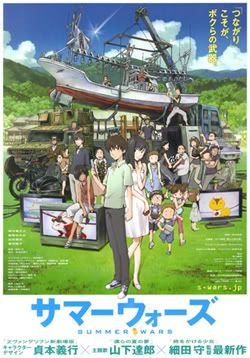
Back when Funimation was first announcing the cities that would have Summer Wars showings I was disappointed that the closest city to me was 10 hours away. However my city did get a showing after all and it managed to coincide with the end of my winter break. So, what else was there to do but to grab a friend (who didn’t even look up any information on the movie besides seeing the Cyrus Virus movie, that made things interesting for her I think) and go over to see it. Just seeing it was fun since it wasn’t in a normal theater but rather a small room off to the side with comfy chairs and sofas like a VIP lounge that my anime club could’ve filled up, makes sense since there were only five of us watching but it certainly made for an interesting experience.

Summer Wars

Summary: Kenji is an eleventh grade mathlete who is less than thrilled that the only thing he has to do this summer is his part time job of being a moderator on the computer network OZ (which has basically replaced the internet). So when his crush at school, Natsuki, asks if he could come along to her family reunion/great-grandmother’s 90th birthday as help he readily agrees.  And his vacation is set to get even more interesting after an AI called Love Machine hacks OZ and sends the whole world into chaos and Kenji with the rest of the clan seem to be the only people trying to stop it.

The Good: This is an unbelievably fun, over-the-top (just watch the scene when the family is preparing for the attack on Love Machine) and exciting film. In short, it’s a summer blockbuster film that’s accessible for all ages, I would’ve loved this movie just as much at ten as I did the other day. The central theme of the movie, family is important, was also done well, it’s constantly present yet never feels anvilicious and not all kids movies can pull that off. Another thing done well in the movie is the large cast of characters, none of who feels like cutouts or resort to stereotypes to flesh them out. Great-Grandmother Sakae was a great example of how a character doesn’t need to be an action hero to accomplish something (Kenji as well since his great skill is being able to do math super fast) and the large cast manages to feel very human throughout the film.

The Bad: There are a few instances of almost deus-ex-machina and the plot is one of the weaker parts of the story. It’s consistently there (Love Machine is taking over OZ, how do we stop it?) but this story is really more about the characters and their actions than a really clever plot (like I said earlier, this is the anime equivalent of a summer blockbuster and those films aren’t know for their plots either). Some of the more dramatic moments of the film come off as a bit silly and some of the technology (like Love Machine) feels rather implausible. It's not a style or substance movie, but it is a character driven movie instead of a plot driven one.

The Art: The art is bright and vibrant in OZ and slightly toned down in the real world but it was good looking no matter which world it was in. The backgrounds were well done, all of the extensive cast looked different from each other, and the layout of OZ actually made sense (many films dealing with cyberspace have some odd ideas about how it should be portrayed and manage to look dated after a few years, I don’t forsee Summer Wars having this problem). Of course this is a movie and movies have bigger budgets so it should look good and it certainly did. I think I was also watching a BR of the movie instead of reel (or however they show movies in theaters these days) so I can say that the BR looks pretty good now too. One stylistic thing that caught my eye however, in most American films if we cut to say, a clock ticking down, usually the movie cuts to the clock just a couple of seconds before it hits zero and in Summer Wars those kinds of cuts seem to happen a few seconds earlier  (like, instead of seeing the clock go 3 2 1 it was more like seeing it go 5 4 3 2 1). If it was supposed to make the moment even more dramatic I'm sad to say it didn't work on me, but I do wonder if this is one of the differences between Japanese and American movie making or a stylistic choice on Hosoda's part.

The Music: Didn’t notice much background music actually, although the movie did make good use of the times when everything was silent for extra dramatic effect. The room’s volume was up a bit too high for me but everything sounded good other than that. This showing had the dub playing and no problems there, my friend and I were commenting at how many names and voices we recognized in the cast (well, by this point we’ve started to recognize the names of the Funimation staff as well) and Funimation brought in a lot of their regulars so no weak spots in the dub*.

So yes, I went in expecting an anime version of a summer blockbuster and that’s what I got out of Summer Wars so of course I liked it. Definitely going on my BR “to-buy” list (I just, you know, need to get a BR set up first) and have been recommending it to all my friends in the area to get out and see it too. I don’t think it’ll get nominated for the Oscars (I don’t think they had enough submissions to have five nominations instead of three in the Animated Film category, otherwise I would say that Summer Wars had a good shot of being nominated) .


*I don't know what the reviewer on rottentomatoes was going on about "squeaky voices," maybe they saw the sub? Which is still odd since our leads are in the eleventh grade, there are a few little kids who don't get much airtime and then a lot of adults, how were any of them squeaky?

Saturday, January 8, 2011

Book Review: Fire and Hemlock


Another of Diana Wynne Jones' many novels and another one I'd had recommended to me. So I picked it up right before my winter break (and had a bit of trouble renewing it over the break)

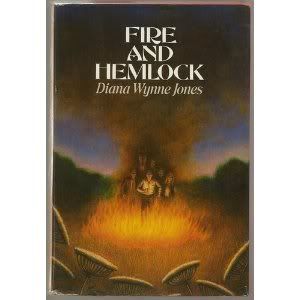
Fire and Hemlock by Diana Wynne Jones
Normally I would call this a pretty ugly cover because of the muddy colors but this is the titular Fire and Hemlock photograph from the book (well, the cover artist's version of it) so it's actually a really neat idea for the cover.

Summary: Set in modern day (ie, 1980s England) Polly is home from college at break and in her old bedroom when she catches herself staring at an old photograph titled Fire and Hemlock. She thinks about how odd it is that when she was younger she was convinced that the photograph looked differently than it really was but, upon examining her memories to figure out why she thought this, she discovers that she has two sets of memories for many years of her life. One set holds the ordinary memories of day to day life she thought was the truth but the other ones seem to tell a story about legends come to life and she goes back through her memories to figure out just what she did.

The Good: One thing that all of DWJ books do very well is that they have competent adult characters. Many MG/YA authors seem to have a hard time balancing out competent adult characters while still having a young protagonist be the one who knows best. Here you never get the sense that one character is “right” and the other is “wrong,” there are simply characters and each one has flaws. I really liked Polly’s grandmother for being such an important prescience in her life especially as she was slowly disillusioned about her parents and trying to love them anyway (DWJ also gets credit for making divorce a pretty big subplot in a book for children in the 1980s and again she manages to show that Polly’s parents aren’t bad people but deeply flawed ones).The plot also is a nice twisty one that combines old legends with something that is probably magic but not explicitly stated to be so (another staple of DWJ's older works) and it was also nice to read a story where the character ages over course of it (compared to many modern day YA stories that take place over the course of a week, taking place over ten years makes Polly's character growth much more believable). It was a satisfying read and a more interesting take on magical memory loss than your typical "I have amnesia as a plot device" story.

The Bad: There were parts about the ending that I simply did not understand, even after re-reading and spending time thinking about them. One thing about DWJ’s works is that the hero doesn’t normally triumph from winning a big fight or something like that, usually it involves a character’s own resolve and cleverness and that’s what confused me this time around. I think Polly’s triumph had to do with thinking the way the villain wanted her to think but also differently at the same time and that’s just a guess, for all I understood it could’ve been the opposite. So a confusing end is certainly a minus, actually, after the flashbacks end the whole story gets a little confusing. Some of this is a good thing (since our character is dealing with a world that remembers the past differently than the way it really happened) but there are a few things that aren’t explained well enough even when everything is said and done. This is a highly praised book of hers so it’s certainly possible that I just didn’t get something (and it does deal with one or two old English legends that I'm not very familiar with), but if I didn’t get something after a rereading and thinking about it (and this is a YA book, not a piece of literary fiction) then something went wrong.


I’m not sure whether or not I should be happy that the reviewers on Amazon also aren’t sure what to make of the ending. On the one hand, at least I didn’t miss something really obvious, one the other, lovely, now no one can explain it to me! I foresee a reread of this book sometime although I’m not 100% convinced on a buy, there are other stories by her I like more but if I ever happen across a cheap copy of it I’m sure I’d grab it anyway.