Showing posts with label ancient history. Show all posts

Friday, February 15, 2013

TV Series Review: Doctor Who: The Aztecs

So the BBC (or at least BBC America) has decided to show a serial from each of the previous Doctors, one a month in order, this year and started with a well-known serial from the first Doctor's run, The Aztecs (well known for it's line about how you can't change history, funny enough the producers, of the current episodes, were quoting it in the behind-the-scenes look left and right even though they like to ignore the idea when it suits them.....). First time seeing the first Doctor, hoping that Netflix has more serials to help tide me over until the new episodes in March.


Doctor Who: The Aztecs


Summary: The Doctor, his granddaughter Susan, and school teachers from 1960s England Ian and Barbara have landed back in ancient Central America at the height of the Aztec civilization and Barbara is mistaken as a reincarnation of a former high priest. The group goes along with it, mainly since they accidentally locked the Tardis in said former high priest's tomb and can't get it out but all run into cultural differences as they try to sort their way through the political structure and choose whether or not to try and interfere with history.

The Good: One difference I’ve noticed between the classic doctor who and Nu Who is how the companions feel less like people who accompany the Doctor and more like people who are just traveling along with him. In Nu Who the Doctor comes in, something is strange, and he, along with the companion(s), try to fix it. In Classic Doctor Who, the Tardis lands somewhere, the Doctor goes off to explore, everyone else goes off to explore and everyone ends up having, well, adventures that end up intersecting throughout the course of the story. It makes the companions feel much more like rounded characters instead of the story devices they sometimes come off as in the new series (heck, in the new series it’s been stated that the Doctor keeps people around to keep him from doing stupid stuff, the story even acknowledges that they are partially devices). I’m finding that I prefer this approach a bit more than the way it works in the Nu Who series, although I think part of the reason the new series doesn’t do this as much is because the stories are shorter time wise and this would be tricker to pull off in one hour vs two or three.

The Bad: Despite all of this I found myself not looking at the screen much or looking at stuff in another window for a lot of the story which usually means it's not as engaging. Of course, part of this could be that the visuals weren't that impressive, or even the fact that it was in English and I didn't have to read subtitles meant that I wasn't missing much, if anything, of the story by not looking but I still feel like this means the story didn't grab me as much as it could've if I did think about doing something at the same time. And part of this may be because while I saw part of the serial on BBCA I had to turn in and caught the rest on Netflix and couldn't recall exactly where I stopped and had to rewatch a good chunk to find my place, all in all it was a very solid story but it did seem like it was missing just one or two important things.

The Audio: Not much to say here, it's fun to hear how similar, yet different, the opening and ending themes are for the show almost fifty years ago and the serial itself was well mic-ed so I could hear everyone clearly.

The Visuals: As mentioned earlier, the show was shot in black and white, is letterboxed, and somewhat grainy. So it's not super great to look at but it's not terrible. The costuming seemed fairly good (although my knowledge of Aztec costumery is sadly lacking) and they created quite a few settings (although you can tell that the background for one of the rather dramatic scenes is just painted on which is a bit distracting and the material used for a lot of the sets looks distinctly, fake as well). Also, still no idea how they thought to pass Susan off for a student (middle school? high school?) back in the very first serial, here she looks much older and it really makes me shake my head and wonder what they were thinking there.


So I'll give this one a hearty recommendation for being accessible to relative newcomers of Class Doctor Who (holy crap it's a serial that has no aliens in it aside from the Doctor and Susan!), has a good story, and is a bit slow but overall well paced (streaming on Netflix for those interested but you have to search Classic Doctor Who, searching Docto Who: The Aztecs takes you to the DVDs but not the streaming section oddly). Now, onto Tom of the Cybermen!

Sunday, August 19, 2012

Book Review: Spirit's Princess

 (Apologies that this is late, moving into a new apartment and all that whatnot) Another book I got from Random Buzzers, this time through a visiting author on their forums (I have no idea how this one works, do the authors choose who gets a book? The mods? Is it random? Based on the question asked? Doesn't really matter for me, I can always get the books later if I don't win one there, but I am curious) and I've been interested in this author's works for a while now (probably because one of her protagonists shares my name) and was happy to finally get a chance to read them. Like the other books she's written this one will be a duet and is based on a real, historical female figure from ancient times and I suppose I should just get to the review at this point.

Spirit's Princess by Esther Friesner


Summary: Himiko is the daughter of a chieftain in third century Japan and ever since her birth some people in her village have believe she was destined for greatness. She feels drawn towards the path of village shaman but encounters resistance from her father because of his own past experiences. Despite that however she's determined to learn even more and starts to realize that her destiny lies outside of her small village after all.  

The Good: It may be an odd detail to point out but I think this is the first time I've ever seen a polygamous relationship portrayed in a positive light in fiction and, considering the popular culture in the US generally makes it out as something terrible that will never work, I just liked how it was included and felt rather natural in the story. I also loved the setting, despite all the anime/manga I consume I rarely find anything that's set more than a few hundred years ago and certainly nothing almost 2000 years ago which made the setting here fascinating and it managed to feel real through it's details (and even some of the weirder ones, like creating sake through chewing rice, I've encountered elsewhere so I know that's a real detail). And it really was those details that let me enjoy the story, they helped the story stand out and they made the setting work (and I do consider the setting the most important part of the story for it's overarching effects on every character and their actions, which it did wonderfully here).  

The Bad: Himiko, despite all of her character development comes off as just a bit flat at times. Hopefully as she continues to grow in the next book she'll feel a bit more rounded (I think the problem is that most of her complaints are too reasonable or can be written off by the fact that she's rather young, she's almost too normal in a way) and she certainly wasn't a flat character, just not as rounded as she could've been. I do wish they had touched more on the spirit world in this volume, there were only a few scenes focusing on it which left a lot of things unanswered, but again I expect that to come up in the next book so I'm not overly worried about it.


A solid read but not one where I'm dieing to read the next book immediately (thank goodness since this was an ARC, the hardback is out by now but it's going to be a little while before the next volume is out), although it has reminded me that I need to go check all of my libraries again and see if they have any of Friesner's previous works in, they've certainly had enough years to do it!  

Saturday, April 28, 2012

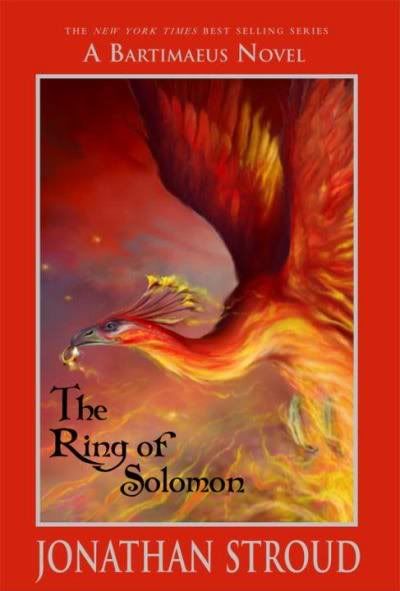
Book Review: The Ring of Solomon


Not quite a prequel to Jonathan Stroud's Bartimaeus Trilogy, set in an alternate, modern day London where the technology doesn't seem quite as advanced but where magicans have been summoning spirits (what we, and they, call demons) since ancient times and I enjoyed the trilogy quite a bit. So when I came across this book at the local library, well over a year since it came out (I had seen it around in bookstores before but hadn't heard much of it so I had forgotten to look around my libraries for it) I figured it was about time to jump back into the series and see how it fared.

The Ring of Solomon by Jonathan Stroud

Summary: Long before Bartimaeus was ever summoned to London he served under hundreds of other masters and like many dijinn one day he found himself in Jerusalem under a cruel master who was one of King Solomon’s highest magicians and thus his servitude begins anew. But while things look bright for Israel other nations resent how high and mighty Solomon has become and how he now taxes their nations, if they refuse they will feel the full wrath of his ring that can summon untold numbers of spirits. The Queen of Sheba is the latest person to be approached with these demands which she does not like one bit and so she sends one of her most faithful guards, Asmira, with the daunting task of killing Solomon and retrieving the ring. Of course, given that Bartimaeus becomes involved in this story it doesn’t go nearly as smoothly as anyone plans….

The Good: The story is a nice call back to the original trilogy where Bartimaeus often boasted that he had talked with Solomon, normally followed by a fellow spirit going “well who didn’t, the man got around”, and it’s nice to get more than bits and pieces of his original adventure (although I would have loved to hear about his time with Ptolemy in Egypt even more). The book, even though it's not a true prequel to the story, fits in well thematically, Bartimaeus is lazy but clever (with many footnotes), all magicians/people in positions of power are conniving bastards (with the lone character who fits into none of those categories is supposed to be sympathetic but is a bit dumb), and all the plans end up being more complicated than they probably needed to be (but in a fun way). In short, if you enjoyed the original trilogy you'll like this but if you aren't already familiar with the series this isn't as great a place to start.  

The Bad: One of the things that made the original books so much fun was the multiple points of view (Bartimaeus, Nathaniel and then later a third person named Kitty) and sadly Asmira is not as interesting a character nor as good a balance as those two were (this book actually reminded me of the first book of the trilogy a bit, neither Nathan nor Asmira felt real enough to me as Kitty did). The story never feels grounded enough and with a fantasy story you do need a certain amount of grounding, without that it’s hard to take any detail, fantastical or mundane, seriously and that’s when a story starts to fall apart. I also had a hard time figuring out if Solomon was supposed to be a multi-faceted character or if Stroud decided close to the end that he needed Solomon to be more sympathetic or the story wouldn’t work.


In the end I was disappointed by this, the story wasn't nearly as strong as I was expecting and none of the characters, yes even Bartimaeus, just weren't interesting. The setting was a nice change of pace, I've been studying ancient history lately so it was nice to read something actually set in the time period, but that was all I got out of it. I'm in two frames of mind over whether or not to recommend it; on the one hand I'm sure some fans liked it better than me, on the other I just didn't get anything out of reading it and don't have the urge to buy it (and I do already own the other three books). So I guess the review will have to speak for itself this time then.