Saturday, May 5, 2012

Book Review: Goliath

Bit later than I would have liked this review to be up, like it's predecessors this book was released back in the fall but between waiting for the library to get it and my large to-read pile (I, erm, may have bit off more than I could chew, combined with my March break I have more than enough books to review for a long time) it took a while to get to it. So no I do not have a copy of this book yet but fully intend to get one soon, if my anime expenses don't take over my budget for another month....

Goliath by Scott Westerfeld, illustrated by Keith Thompson
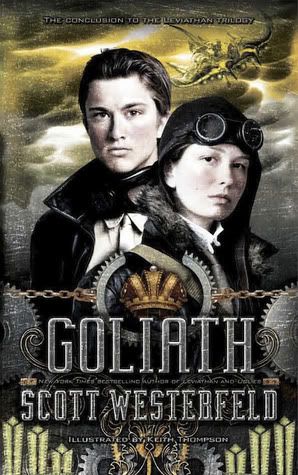
Summary: Deryn and Alek continue their trek eastward on the Leviathan as the world falls farther and farther into war. But the Leviathan might have the solution to the end of the war, along the way they pick up renowned scientist Telsa who claims to have a weapon that could level cities at a glance, a weapon that force anyone to stop all the fighting and what Alek is banking on. Deryn and the other Darwinists have their doubts however and Deryn is finding that it's becoming harder and harder to hide her true identity and the more involved she becomes in the world's affairs the more dangerous it becomes to reveal it.  

The Good: Westerfeld continues to expand his world by showing off Japan and the Americas and their blends of technologies and ideologies was nice*. Also nice was some characters from the second book reappearing, I’ve grown rather used to trilogies which have different expanded casts in every book that this was a nice surprise. The book actually balanced a large cast very well with even more factions being introduced and no one felt like a flat, background character. This was helped in part by the pacing, a lot happens in the story and the Leviathan covers even more ground than the first two books and it never feels like one area or place drags on too long or is breezed by too quickly, everything flowed very well.  Finally, fans should go to Westerfeld’s blog and read the extra chapter set after the series which was quite fun.

The Bad: While the ending wasn’t bad and was what I had been expecting, since I knew the actual history Goliath was borrowing, so it wasn’t quite as satisfying as I had hoped. Again, it’s a reasonable ending, makes sense (hence I had predicted something rather close), it just didn’t hit the right emotional notes with me (not the very end end, the whole ending in general). I was also a bit underwhelmed with what the Lorises were really supposed to be, it does sound like Doctor Barlow broke a major rule while creating them but I still fail to see why they were ever supposed to be important to the conflict. Overall, the ending was a bit underwhelming and played out fairly close to what I predicted and, as someone who likes tricky plots I found it a bit unsatisfying. 

The Art: The art continues to be stunning and while I felt like some of the crowd scenes weren’t quite as detailed as the ones from the second book but the art has noticeably improved from the first book (which wasn’t bad, it simply got even better). The art continues to be the easiest way for me to promote the book to friends (it’s much easier to flash a few pictures from a book rather than find time to make someone read a few passages that they hopefully like) and it’s the biggest reason that this book is on my to-buy list (and on a similar note I'm excited for the companion guide which will have even more illustrations in it, coming out later this year I believe). 


Despite the ending not being quite as interesting as I hoped this was still a very strong installment to end on and I'm looking forward to whatever Westerfeld writes next. Actually, come to think of it I don't think I've heard of what his next project is (other than the pre-Uglies graphic novels and the companion book for this), hope it's interesting!


*although I question that the [American] South, the god-fearing South which today still has issues with “moral debates” today (I mean, for god's sake my state votes on a constitutional amendment against gay marriage even though it's already illegal) being the half that had fabricated beasties, I can see where he was going with the North and their machines but it didn’t quite work for me, an East-West split with an industrialized East and a fabricated West would have made much more sense.

Friday, May 4, 2012

Comic Review: Koko Be Good

Another book that I came across at the library, interestingly enough even though I've heard good things about this publisher (First Second) for a few years now it's only been within the past year that I've started finding their books at the libraries as such (which I will take as a good sign that the libraries are now starting to pay attention to them and will get more of their releases). Maybe I should keep an eye out for them in bookstores too, although the ones I go to barely have any non-superhero Western comics.....

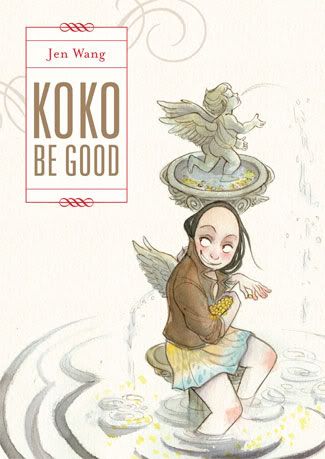
Koko Be Good by Jen Wang


Summary: Jon hasn't quite figured out to do with his life but when his girlfriend offers him a chance to come with her to Peru and do missionary work there he decides that this sounds like a good thing to do. Koko on the other hand doesn't do "good" things until she runs into Jon one night and, envious of how collected he seems to be, decides that she'll try to be good as well. But figuring out what you want to do and trying to do good are both hard tasks, especially if you haven't quite figured out who you are.

The Good: There are hundreds, thousands of coming of age stories (I consider it to be a genre unto itself) and it's really hard for me to get excited or interested in those stories after seeing so many (even though, given where I am in my life I should easily be able to sympathize with them). This story is one of the better examples I've seen in the genre and I think part of the reason it worked was because it felt a little more low-key than usual. While Koko is over the top in trying to create a new identity to be happy, Jon is much more low key and knows from the start that he isn't sure of what he wants to do, he's just going along and willing to try something he knows might not work out in the end. I think it was good that his girlfriend was a major influence in him, the scenes where she cautions him about going along with her (showing that even she isn't totally sure this is what she wants to do) really helped flesh them both out and it was great to not see another instance where one half of the relationship is completely confident and sure of themselves and drags the other half along, here with both sides hesitating felt a lot more true to life. I was surprised that Koko's friend Faron was developed as much as he was as well, originally I had thought he was going to be just a foil to Koko but in the end Wang showed us a chapter in his coming of age story as well and I'm amazed she was able to fit three such stories into one so smoothly.

The Bad: While I liked Jon a lot and was surprised by how much I liked Faron in the end as well Koko just never grew on me. I never understood her motivation to "become good" (I know that it was supposed to be that she was envious of Jon's life and tried to emulate him but the story only told that, never showed it) so all of her attempts to do good just felt awkward to me (they were supposed to feel awkward but they also managed to feel awkward in a way I don't think Wang intended). I was also leery at bits that Jon would dump his girlfriend and go for Koko (since the rule is that if you have two straight characters of opposite genders in a story they're gonna fall for each other) and, while that didn't quite happen, there was some chemistry between them that I didn't understand. In short, despite the fact the book is named after her and her adventures I just never understood half of what Koko did and, while the story wouldn't have worked if she wasn't present at all, half the time I didn't see the need for her.

The Art: Like the cover, the art is colored in various soft sepia tones and I absolutely loved how it looked. I liked the art style a lot as well, it had a lot of energy and the pages flowed well, but the coloring was what sold me on the book. It really reflects the mood of the story, even with all it's action it's rather introspective and calm and the best thing a visual work can do is to enhance and add to the mood already created by the story which it succeeds at marvelously here. Like I said, the art really sold me on the book and it makes me want to go and pick up my own copy as well, I don't know if I would have had the same reaction if the art had been any different.


I was very pleased with this book, especially since I just picked it up on a whim since I was in that section of the library anyway, and I'll be keeping an eye out for a copy of it in a store near me. It doesn't appear that Jen Wang has published any other books (aside from being in a volume or two of Flight and honestly it seems like every indie comic artist in the US has been in there at one point or another) but I'm going to also try to keep an eye out for their future works and see what they do next.     

Monday, April 30, 2012

Anime Review: Nastume Yuujinchou Shi

Apologies that some of my recent reviews have been a bit on the shorter side, I've finally hit exam time so I've been juggling a bit more work than normal and haven't quite had the energy to make as detailed posts. That aside, I suspect that even if I had more energy this particular post would still be on the shorter side since I've already talked about the first three seasons and hate to repeat myself which leaves me with a bit less to say here.

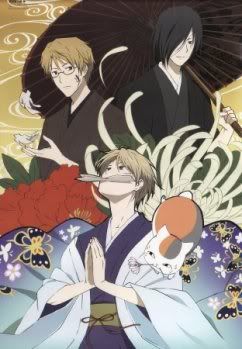
Natsume Yuujinchou Shi


Summary: Takashi Natsume is a high schooler with the ability to see yokai (spirits) and possesses other immense spiritual talents, inherited from his maternal grandmother Reiko Natsume. While this used to bother him and cause all kinds of trouble he has since gotten used to it and now enjoys the company of a number of yokai, people with talents like him and the ordinary people in his life.

The Good: The series has slowly become more and more ambitious and wastes no time getting into the thick of things with a two parter opener and the series first three episode arc rounding off the series. In general I prefer the more plot heavy, multi-episode stories and enjoyed all four of those arcs quite well and was even happier to see that one of those arcs and a stand alone episode both focused heavily on Natsume's past (and even happier one dealt with his parents a bit, it's about time we heard something about his family!). Even the one obligatory anime original episode (featuring a very odd choice this time, the backstory of another exorcist who has appeared a few times) was well done this time and I don't think there was a single episode I didn't enjoy.

The Bad: I have come to the conclusion that it is for the best not to think of this series as a show with four, distinct seasons but rather a show with 52 (!!! never thought we would have so many) episodes. While I liked the two parter that opened the season it just wasn't the right episode to open with and we're starting to have a problem where side characters will appear often one season but barely at all the next which feels a bit odd. Also, again this is given my preference for the more plot heavy arcs (and this is a problem carried over from the manga) I do wish the series would finally give us more information about Natsume's family. This season does clear up a few things about his parents (and Matoba dropped an interesting hint about Natsume's mother) but I think nearly every fan wants to know by now just what happened to Reiko.

The Audio: This is one of the few series where I consider the music to be more important than the visuals, possibly because the original manga is a bit sparse in design, and the music here continues to hit all the right notes and add to what are already emotional scenes. The voice acting continued to work just fine and while I didn't like the opening and ending songs as much as I did the ones for the third season they worked fine here (and as a bonus I did enjoy the ending song from the start, unlike the first two seasons where both of them took a while to grow on me).

The Visuals: Like the third season it seems like the fourth season had a bit more budget, the lines look cleaner, the colors bolder, and there are some nicely animated scenes throughout. I've always thought that while the character designs aren't necessarily plain some of their outfit choices were (I cosplay, I look for these things!) but this season introduced some more elaborate outfits (which caused the fanart community to go nuts) and it was nice to have a bit more visual flair in the series.


So far there aren't any plans for a fifth and sixth seasons (geeze guys, calm down! The show has always been split cour, which requires six volumes of manga and the 13th volume just came out as the fourth season started) but I do hope the show continues since I would love it to continue all the way to the end (and for the series to end in a conclusive fashion someday but I might be in the minority there). All four seasons are streaming for free on crunchyroll for a variety of countries and NISA has announced that all four seasons have been licensed for a US release, more information coming hopefully soon. 

Sunday, April 29, 2012

Movie Review: The Adventures of Tintin: Secret of the Unicorn

There are some films that I plan to see at school since I know I'll enjoy them more if I see them with friends and when I saw the trailers for this film I suspected that might be the case. There was nothing wrong with the trailers for The Adventures of TinTin, it just looked a bit silly, I actually managed to figure out that it was CGI instead of live action when I saw the scene where a pirate ships coasts over the waves of a desert and that scene seems to sum up the movie, silly and often illogical but in an entertaining manner.

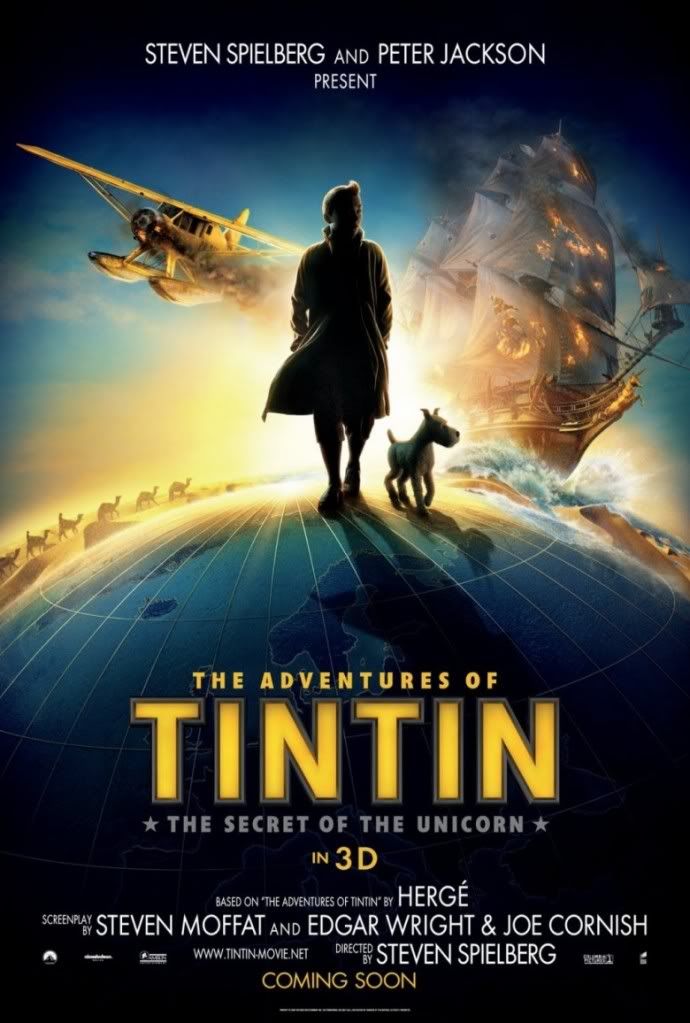
The Adventures of Tintin: Secret of the Unicorn


Summary: Tintin is an intrepid young reporter with a nose for a story whose been on dozens of adventures already (accompanied by his faithful and clever dog snowy). So when he discovers that the old model boat he recently bought it part of a puzzle involving centuries old treasure he jumps right into the mystery, where ever it might take him.

The Good: With the exception of a few scenes the pacing worked well, despite it's short run time nothing felt rushed and it didn't seem like the characters lingered too long in any one place for too long.  I found Snowy to be the most enjoyable character to watch and, much like the penguins in Mawaru Penguindrum, any scene that has Snowy in it has him off in the background doing his own antics (sometimes related to the plot and sometimes just as a joke) and I liked that attention to detail, it was amusing and made me appreciate the thought that went into those scenes a bit more. The movie was filled with details actually, more on that in the visuals, but I was happy to see that they went to a lot of effort to make the "sets" feel just as real as the sets in a traditional live action film would be and that really helped.

The Bad: I was a bit confused by the setting, which seemed mostly like France but with some odd British details, which seems to be a carry over from the original comics but other people have pointed out that the movie also isn't sure when it's set with newspapers giving the date as 1938 yet cars from the 30s, 40s, and 50s making appearances. It wasn't enough to annoy me but it was enough to jolt me out of the movie a few times which is never a good sign. Additionally, I am convinced the reason Spielberg decided to make this film in CGI instead of in live action was so that he could completely ignore the laws of physics for a few scenes and, like a certain scene from Super 8, while those scenes were amusing at first they just dragged on so long that my suspension of disbelief was entirely broken and I got bored by it. In a way, even when the characters are doing something completely unrealistic you still need some realism to ground the scene and give the scene from stakes, without that it's just hard to take any of it seriously and be entertained by it. 

The Audio: Even if the visuals make the setting a bit unclear time-wise some of the musical pieces immediately made me think that the movie was set in the 1930s vs the 1940s and that's a good thing, it shows that the music is doing it's job at adding and giving more meaning to what's on screen. Since all the actors did both the motion capture and voices for their characters I suppose it technically doesn't count as voice acting here but in any case everything worked there as well, everything matched up and no one had an out of place sounding voice.

The Visuals: The movie is entirely in CGI, shot using real actors with motion capture technology (and a pull toy for Snowy) and, as tvtropes put it, it seems like we've finally hit the other side of the uncanny valley. It's actually hard to tell at first if the movie is CGI or not and when you figure out it's not because everything looks too perfect or that the characters faces just don't look right, it manages to be both realistic enough that it tricks your mind yet not be so realistic that it becomes creepy. Spielberg takes full advantage of what CGI lets him do and creates elaborate settings, overly complicated chase scenes, and plenty of other things that wouldn't be possible (or at least nearly as easy to do) with a live action film.


In the end I wouldn't call this film an all-ages movie but a kid's movie, I just didn't get enough out of it to justify paying more than a few dollars to see it. It appears that there is a sequel in the works and I might see that if I find it playing at a cheaper theater as well but this film didn't leave me with the burning desire to see the new one as soon as it comes out. 

Saturday, April 28, 2012

Book Review: The Ring of Solomon


Not quite a prequel to Jonathan Stroud's Bartimaeus Trilogy, set in an alternate, modern day London where the technology doesn't seem quite as advanced but where magicans have been summoning spirits (what we, and they, call demons) since ancient times and I enjoyed the trilogy quite a bit. So when I came across this book at the local library, well over a year since it came out (I had seen it around in bookstores before but hadn't heard much of it so I had forgotten to look around my libraries for it) I figured it was about time to jump back into the series and see how it fared.

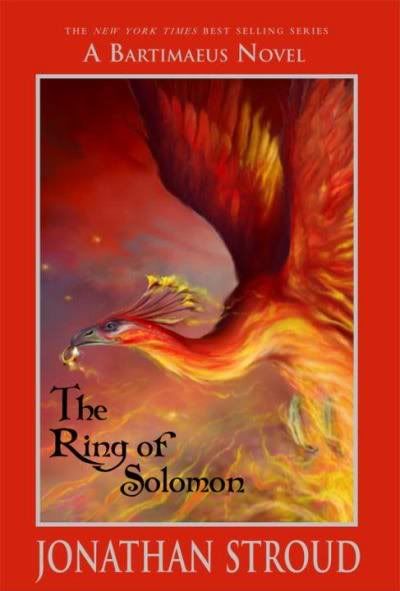
The Ring of Solomon by Jonathan Stroud

Summary: Long before Bartimaeus was ever summoned to London he served under hundreds of other masters and like many dijinn one day he found himself in Jerusalem under a cruel master who was one of King Solomon’s highest magicians and thus his servitude begins anew. But while things look bright for Israel other nations resent how high and mighty Solomon has become and how he now taxes their nations, if they refuse they will feel the full wrath of his ring that can summon untold numbers of spirits. The Queen of Sheba is the latest person to be approached with these demands which she does not like one bit and so she sends one of her most faithful guards, Asmira, with the daunting task of killing Solomon and retrieving the ring. Of course, given that Bartimaeus becomes involved in this story it doesn’t go nearly as smoothly as anyone plans….

The Good: The story is a nice call back to the original trilogy where Bartimaeus often boasted that he had talked with Solomon, normally followed by a fellow spirit going “well who didn’t, the man got around”, and it’s nice to get more than bits and pieces of his original adventure (although I would have loved to hear about his time with Ptolemy in Egypt even more). The book, even though it's not a true prequel to the story, fits in well thematically, Bartimaeus is lazy but clever (with many footnotes), all magicians/people in positions of power are conniving bastards (with the lone character who fits into none of those categories is supposed to be sympathetic but is a bit dumb), and all the plans end up being more complicated than they probably needed to be (but in a fun way). In short, if you enjoyed the original trilogy you'll like this but if you aren't already familiar with the series this isn't as great a place to start.  

The Bad: One of the things that made the original books so much fun was the multiple points of view (Bartimaeus, Nathaniel and then later a third person named Kitty) and sadly Asmira is not as interesting a character nor as good a balance as those two were (this book actually reminded me of the first book of the trilogy a bit, neither Nathan nor Asmira felt real enough to me as Kitty did). The story never feels grounded enough and with a fantasy story you do need a certain amount of grounding, without that it’s hard to take any detail, fantastical or mundane, seriously and that’s when a story starts to fall apart. I also had a hard time figuring out if Solomon was supposed to be a multi-faceted character or if Stroud decided close to the end that he needed Solomon to be more sympathetic or the story wouldn’t work.


In the end I was disappointed by this, the story wasn't nearly as strong as I was expecting and none of the characters, yes even Bartimaeus, just weren't interesting. The setting was a nice change of pace, I've been studying ancient history lately so it was nice to read something actually set in the time period, but that was all I got out of it. I'm in two frames of mind over whether or not to recommend it; on the one hand I'm sure some fans liked it better than me, on the other I just didn't get anything out of reading it and don't have the urge to buy it (and I do already own the other three books). So I guess the review will have to speak for itself this time then.