Letter Bee is one of those series where the anime was pretty good, the original ending was even decent, but as soon as I read past the point where the anime and the manga diverged I was unhappy that the anime hadn't gone the same way. Again, the anime is hardly bad and I think above average, but the manga is just superior in terms of storytelling and tearjerker moments (thank you Viz for licensing it).
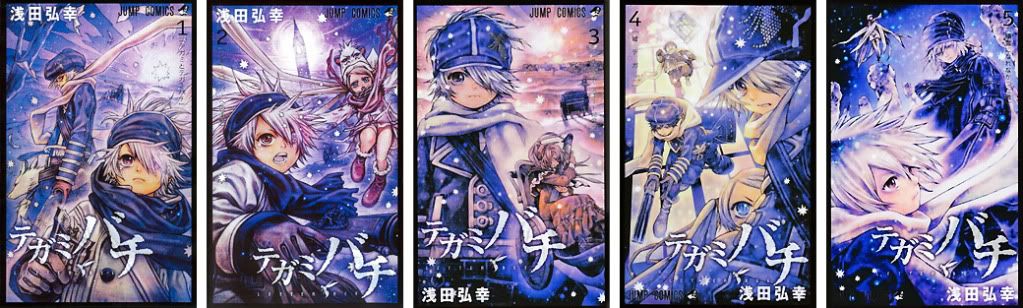
Letter Bee (Tegami Bachi) by Hiroyuki Asada
In the land of Amberground, there is no sun and only the elite who live in the capital of Akatsuki get the full light of the artificial sun, for residents of the farthest regions the sun is never brighter than the full moon. And not only are people restricted from crossing between areas of Amberground but Gaichuu, giant metal bugs, attack anyone who dares to travel and eat their hearts which makes being a postal carrier (a Letter Bee) the most dangerous job in the country since they carry people's hearts in their letters. Lag Seeing has just become a bee after being inspired by Gauche Suede, a bee who delivered him when he was a child, and is crushed to discover that Gauche disappeared years ago and no one knows where he is or even why he vanished. Despite all of this the manga manages to be upbeat and heartwarming at many parts, even when more and more of the backstory comes to light, and, as strange as it sounds, I love how this manga almost makes me cry so often. By this point it's hard to tell who is going to live, who's on what side (never mind their motivation) so, even though I do believe the story will have a good ending, I have no clue how it's going to get there or what is going to be sacrificed for it.
Reviews of books, manga, anime, tv shows, movies, and webcomics. If it has a plot then I have something to say about it.
Saturday, November 12, 2011
Wednesday, November 9, 2011
Manga Shorts: Kuragehime
Normally I go with the English name for a series but I don't like the English title as much (Princess Jellyfish, I think that The Jellyfish Princess flows better but clearly whoever decided on the localization thought otherwise) and I suspect that more people are going to recognize the Japanese title than the English one. I started reading the manga after I saw the anime version last fall, which I thought was a fun little series (even if it had a rushed ending), but now I think that the manga is the superior version of the story.
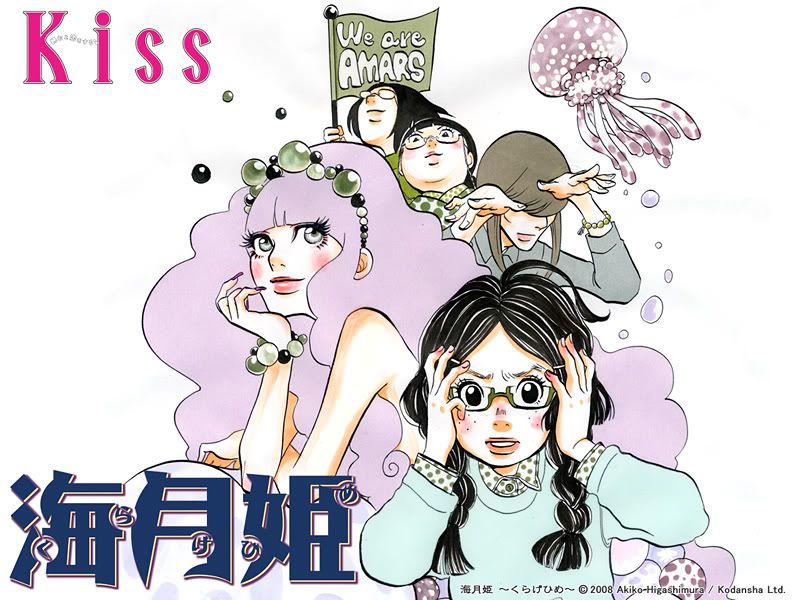
Kuragehime (Princess Jellyfisht) by Akiko Higashimura
The first nine episodes of the anime follow the first bit of the manga pretty well, a group of female otaku (and by that I mean obsessive fans, of trains, jellyfish, old men, none of anime) called the nuns all live in an old boarding house and a essentially terrified at contact with the outside world. Tsukimi, the jellyfish otaku and main character, is one night freaking out over a mistreated jellyfish she finds at a pet store and with the help of a passing stylish lady she rescues it and takes it home, only to have the stylish lady crash at her house and turn out to actually be a man the next morning. Kuranosuke is actually the (illegitimate) son of a local politician and nephew to the PM, not that he cares about all of that, he just wants to cross dress and have fun. But it turns out that his father and brother are involved with a group that is buying up the neighborhood for redevelopment and the nuns have to fight them. The anime choose to take some of the idea from the manga and compress them into two episodes, here the manga chooses to have them throw a fashion show to get awareness and raise money to buy the boarding house for themselves which has introduced some new characters but more importantly brought some actual character development. In the anime I complained that Kuranosuke was the only character who seemed to actually grow, which I found ironic (even if he's the titular character), but here Tsukimi has started to grow, Maya, Chieako have started to develop a bit and it looks like Jiji is going to have some character development soon as well. Shuu, Kuranosuke's brother, also has some character development in the manga which was nice, in the anime I couldn't understand why so many people shipped him and Tsukimi but after seeing them interact even more in the manga I can understand it now. I really hope the nuns get more character development soon (I believe the scanlations are close to where the Japanese manga is) especially with the new challenges they're facing. Currently the series is unlicensed, and since it's josei I doubt it ever will be here in the US, but I'm really enjoying the series now and hope it gets released here anyway.
Kuragehime (Princess Jellyfisht) by Akiko Higashimura
The first nine episodes of the anime follow the first bit of the manga pretty well, a group of female otaku (and by that I mean obsessive fans, of trains, jellyfish, old men, none of anime) called the nuns all live in an old boarding house and a essentially terrified at contact with the outside world. Tsukimi, the jellyfish otaku and main character, is one night freaking out over a mistreated jellyfish she finds at a pet store and with the help of a passing stylish lady she rescues it and takes it home, only to have the stylish lady crash at her house and turn out to actually be a man the next morning. Kuranosuke is actually the (illegitimate) son of a local politician and nephew to the PM, not that he cares about all of that, he just wants to cross dress and have fun. But it turns out that his father and brother are involved with a group that is buying up the neighborhood for redevelopment and the nuns have to fight them. The anime choose to take some of the idea from the manga and compress them into two episodes, here the manga chooses to have them throw a fashion show to get awareness and raise money to buy the boarding house for themselves which has introduced some new characters but more importantly brought some actual character development. In the anime I complained that Kuranosuke was the only character who seemed to actually grow, which I found ironic (even if he's the titular character), but here Tsukimi has started to grow, Maya, Chieako have started to develop a bit and it looks like Jiji is going to have some character development soon as well. Shuu, Kuranosuke's brother, also has some character development in the manga which was nice, in the anime I couldn't understand why so many people shipped him and Tsukimi but after seeing them interact even more in the manga I can understand it now. I really hope the nuns get more character development soon (I believe the scanlations are close to where the Japanese manga is) especially with the new challenges they're facing. Currently the series is unlicensed, and since it's josei I doubt it ever will be here in the US, but I'm really enjoying the series now and hope it gets released here anyway.
Labels:
akiko higashimura,
josei,
manga,
modern day,
noitaminA,
slice of life
Sunday, November 6, 2011
Anime Review: Croisee in a Foreign Labyrinth
Back during the summer round-up I said that I had seen the first episode of this series, thought it was cute, but was going to have to drop since there wasn't a legal stream for it. Lo and behold only a few days after I posted that one did appear, it had been licensed by Sentai/Section 23 and I quite happily watched a delayed stream of that all summer.
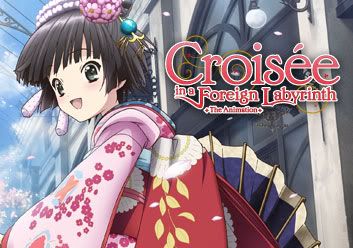
Croisée in a Foreign Labyrinth (Ikoku Meiro No Croisee, Crossroads in a Foreign Labyrinth)
Summary: Claude is a young blacksmith in 1880s Paris who is trying to make a living in a mall made up of traditional stores while they lose more and more business to a new department store. So he’s obviously frustrated when his grandfather Oscar brings back Yune, a young girl, from Japan and suddenly has this new problem to deal with as well. But Yune really wants to learn about her new home and slowly Claude begins to open up to her as they both deal with culture shock.
The Good: With Tamayura~Hitose I complained that the show was trying too hard to be a sweet and “healing” show, it never felt like Croisée had to try to do either of those things but simply was a rather sweet show. From what I’ve heard the show expands a lot on the original manga but I wouldn’t have known otherwise, the story flowed well and, even though it’s an episodic show there is an overarching theme to it and it feels like the show both starts and ends at logical points. I was surprised at how much I liked Alice, a French girl who comes off as rather grating at first, by the end of the show. She gets more character development than I had expected and there were times when she sounded like an early feminist so I’d love to see how she grows up and who she grows into. Heck, I’d love to see more of all the characters, I feel like this was just Act One in their stories and there are still several more acts to go.
The Bad: That said, it sounds like there probably won’t be a sequel (sold badly, not a lot of manga material left since it comes out so slowly) which makes me rather sad. I’ve tried some of the manga but, much like Kamisama Dolls, there is something about the way the anime is directed that I find much more appealing than the source material. I also hope that Section 23 puts the extra episode (I believe it’s called 4.5) on their DVDs since it sounds like that added in some extra back story between Claude and Camille (Alice’s older sister), although I am curious why it wasn’t in the anime proper if it was as important as everyone has made it out to be. So while I do like the series quite a bit I feel that if it isn’t continued that it will feel a little weaker, it’s a good stopping point but obviously not the stopping point for the entire series.
The Audio: I was surprised at how well the opening and ending songs worked for the series. I didn’t think that a Japanese song in a French setting would work well but both of them managed to be cheerful songs without being overly bubbly and fit the show nicely (the opening music also sounded a little more European than normal which also helped). The voice acting was also good, Yune sounded sweet and young without that artificially cute voice you hear in so many places and everyone else's voices matched equally well. The first episode was a bit awkward (since you have to remember that every time Yune talks to Oscar they’re speaking Japanese but everyone else is speaking French) but after the first episode it’s no longer an issue, would be interesting to hear a French dub of the series but I don’t know if this series has even been licensed in France yet.
The Visuals: Appropriately enough Croisée had French animators working on parts of the show as well (you can see some of their work on the backgrounds here) and the backgrounds are beautifully detailed. All of the visual details seem to be era appropriate as well, from the props to the clothing, the color schemes worked well, and overall the series was just gorgeous to look at and I would love extras on the US DVD(/BR?) release that has a closer look at some of the work that went into making this.
I'm looking forward the US release for this series quite a bit, even if I do think that Sentai's sub-only, not many extras releases are priced a bit high. I suppose that's what sales and coupons are for, plus a release date hasn't been set yet so I have until at least next spring to save up which is also plenty of time for everyone else to check out the show streaming on TheAnimeNetwork (it's free to subscribers and it's free to sign up).
Labels:
1800s,
2011,
anime,
France,
historical,
slice of life
Saturday, November 5, 2011
Manga Shorts: Broken Blade
As I mentioned back in the review for the movies, I started reading this series back in the beginning of the year when it was given a passing mention in the end of the year round-up on AnimeNewsNetwork and discovered a few months later that the manga had been licensed at one point by CMX. Only three volumes were put out before their closure, and must not have been that popular since you can still find them online for very reasonable prices, but it's one of the few mecha series I really enjoy and the only story I currently follow, maybe because (despite the flashy battles), it's a bit more down to Earth than the rest of the genre.
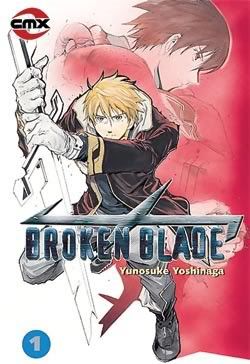
Broken Blade (Break Blade) by Yunosuke Yoshinaga
In the future, presumably after a civilization destroying war, Japan looks very different from the way it does today and the people are a bit different as well. The landscape is sandy and barren and the people all have the ability to manipulate crystal quartz, some better than others, and all technology is built around this talent. This is a problem for Rygart however, he and his brother are "un-sorcerers" who live as farmers far away from anyone else. Rygart is friends with the king [of Krishna] and jumps at the chance to come to the capital and help them study an ancient mecha they recently unearthed that no one has been able to move. Surprise surprise, it requires someone who can't manipulate quartz to pilot it, Rygart falls into the cockpit and figures out how to manipulate it enough to prevent his friend the king from being killed by a former friend who is the son of that country's leader. This is the first strike in the war between Krishna and Athens, a war that is both bloody (no bloodless deaths here!) and one that has the characters constantly questioning their decisions. The anime covered about the first 50 chapters, after that the manga even has a subtitle added to it, and it's clear that manga-Rygart has had a harder time and it becoming a much colder character, something that doesn't usually happen in anime or manga (or if it happens then it's only in backstory, not in the main story). The manga also introduces a third faction, the Kingdom of Orlando who claim to be supplying help to Krishna but plan to invade them should they succeed in staving off Athens (who are invading because they need the resources). That also gives the war a bit of messiness that is present in all wars in real life but rarer in fiction and I like that. The story is also developing it's odd, broken love-triangle a bit more (I believe this is the first time I've seen a story set after the love-triangle was resolved and when all the characters are unhappy at the solution) and I just hope that sub-plot at least will have a happy ending.
In short, the story does a few things differently, from character development to setting, and I like it when stories do things differently so I'm hooked. The fight scenes also are drawn very nicely and it's only a full, multi-person battle that lasts more than a chapter, this is another monthly series that understands the pace it needs to keep to work. I would love it to get relicensed but, since that seems rather unlikely, I'll just have to see if it's being published in English in any other region.
Broken Blade (Break Blade) by Yunosuke Yoshinaga
In the future, presumably after a civilization destroying war, Japan looks very different from the way it does today and the people are a bit different as well. The landscape is sandy and barren and the people all have the ability to manipulate crystal quartz, some better than others, and all technology is built around this talent. This is a problem for Rygart however, he and his brother are "un-sorcerers" who live as farmers far away from anyone else. Rygart is friends with the king [of Krishna] and jumps at the chance to come to the capital and help them study an ancient mecha they recently unearthed that no one has been able to move. Surprise surprise, it requires someone who can't manipulate quartz to pilot it, Rygart falls into the cockpit and figures out how to manipulate it enough to prevent his friend the king from being killed by a former friend who is the son of that country's leader. This is the first strike in the war between Krishna and Athens, a war that is both bloody (no bloodless deaths here!) and one that has the characters constantly questioning their decisions. The anime covered about the first 50 chapters, after that the manga even has a subtitle added to it, and it's clear that manga-Rygart has had a harder time and it becoming a much colder character, something that doesn't usually happen in anime or manga (or if it happens then it's only in backstory, not in the main story). The manga also introduces a third faction, the Kingdom of Orlando who claim to be supplying help to Krishna but plan to invade them should they succeed in staving off Athens (who are invading because they need the resources). That also gives the war a bit of messiness that is present in all wars in real life but rarer in fiction and I like that. The story is also developing it's odd, broken love-triangle a bit more (I believe this is the first time I've seen a story set after the love-triangle was resolved and when all the characters are unhappy at the solution) and I just hope that sub-plot at least will have a happy ending.
In short, the story does a few things differently, from character development to setting, and I like it when stories do things differently so I'm hooked. The fight scenes also are drawn very nicely and it's only a full, multi-person battle that lasts more than a chapter, this is another monthly series that understands the pace it needs to keep to work. I would love it to get relicensed but, since that seems rather unlikely, I'll just have to see if it's being published in English in any other region.
Labels:
fantasy,
future,
manga,
mecha,
science fiction,
yunosuke yoshinaga
Wednesday, November 2, 2011
Manga Shorts: Blue Exorcist
And here's the first in my little manga reviews for the month of November (which again will be a lot less formal than my regular reviews, think back to my webcomic reviews vs my regular manga reviews). Going alphabetically I'm starting with Blue Exorcist (I swear the anime review is coming, it's just the very last summer title) which is currently the only shonen title I follow. I've actually read a good deal of shonen, I've read about 400 chapters of Naruto and 300 of Bleach (I've long since dropped both), probably around 150 of both D. Gray Man (dropped after the author's huge hiatus) and Nurarihyon no Mago (which just stopped interesting me), about five years ago I was caught up with the US release of HunterxHunter (which was either at the end or towards the end of the Greed Island arc, i'd like to read the rest someday), and 80 or so chapters of Soul Eater (dropped after the rescue Kid arc). I did read Psyren to the end (but I started when it was almost over and the ending had to be rushed or it was going to be cancled) and also read all of Fullmetal Alchemist but FMA is odd since it doesn't favor the tournament fighting style of plot that nearly every other shonen series I just listed does and so far Blue Exorcist doesn't either. It might be because Blue Exorcist is still much smaller than any of those titles (not even at 3o chapters yet) but as long as it avoids the tournament style fights I'll probably stick with it.
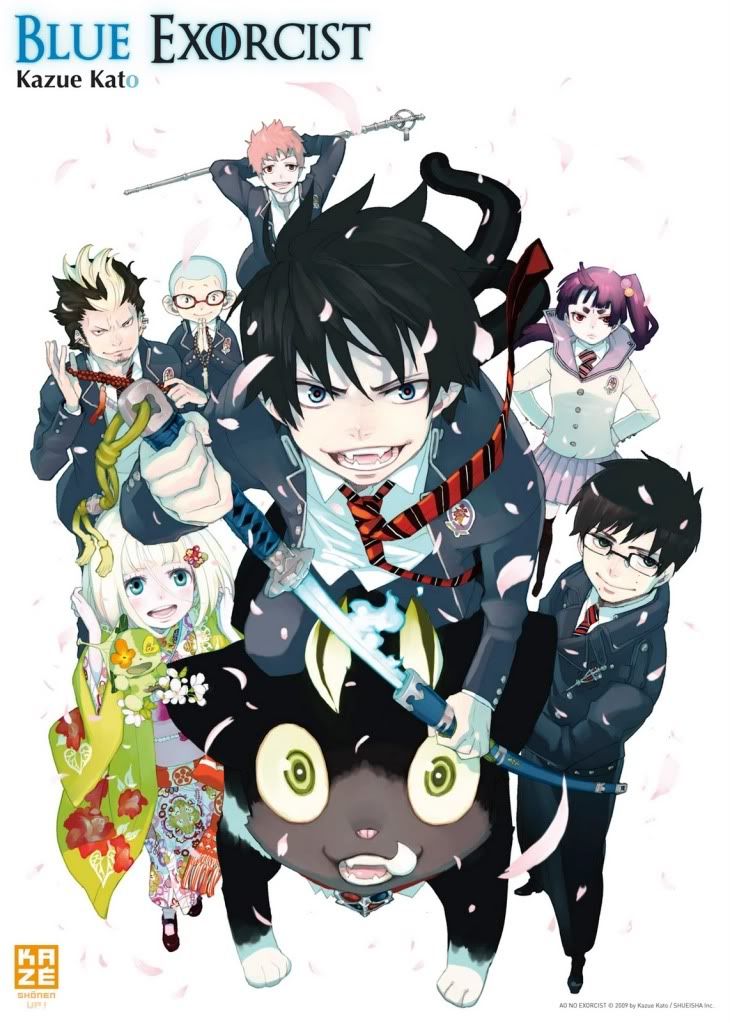
Blue Exorcist (Ao no Exorcist) by Katou Kazue
That above statement pretty much sums up why I'm following Blue Exorcist right now, it's not the most original of premises but it works well, is entertaining, and understands what kind of pace it needs to succeed as a monthly manga (even if the chapters never seem like they're long enough). Rin is the son of Satan and has inherited many of powers but he's made it his goal to kill Satan in revenge for killing his foster father and for that reason he enters the True Cross Academy to train as an exorcist and hon his demonic powers. Having a good reason to hate your parents is hardly a new trope (best example I could find for it was Archnemesis Dad) and going to a magical school to train for revenge is also hardly new in any medium. But the fact that Rin isn't an emo teen whose whole life is structured around this revenge, he's actually a pretty friendly and likeable lead character, does make the story a little different and here it's all the characters that make the story interesting. About half of them have been fleshed out with backstory so far (and I'm sure the rest will be sooner rather than later) and it was refreshing to see how the characters didn't immediately accept Rin's demonic powers once they found out about them but instead were, rather realistically and like real people, unnerved and it took a while for them to come around again. That leads to the problem I had with the anime in the end, they didn't handle that part of the story nearly as well (partially because that's where the anime diverged) but that's a subject for a different review. But for now, Blue Exorcist is a fun series with interesting characters, nicely done fight scenes, has a good mix between enough action and enough non-action interesting things happening, and the actual background of the series (the magic and the demons) proved more interesting than I was initially expecting. I am following the scans for this series and haven't started buying the print copies yet (I'm always a little leery to start buying such long series when they're not even close to over and this is going to be a long one) but I do want to start buying some of the volumes soon and look forward to what's going to happen next.
Blue Exorcist (Ao no Exorcist) by Katou Kazue
That above statement pretty much sums up why I'm following Blue Exorcist right now, it's not the most original of premises but it works well, is entertaining, and understands what kind of pace it needs to succeed as a monthly manga (even if the chapters never seem like they're long enough). Rin is the son of Satan and has inherited many of powers but he's made it his goal to kill Satan in revenge for killing his foster father and for that reason he enters the True Cross Academy to train as an exorcist and hon his demonic powers. Having a good reason to hate your parents is hardly a new trope (best example I could find for it was Archnemesis Dad) and going to a magical school to train for revenge is also hardly new in any medium. But the fact that Rin isn't an emo teen whose whole life is structured around this revenge, he's actually a pretty friendly and likeable lead character, does make the story a little different and here it's all the characters that make the story interesting. About half of them have been fleshed out with backstory so far (and I'm sure the rest will be sooner rather than later) and it was refreshing to see how the characters didn't immediately accept Rin's demonic powers once they found out about them but instead were, rather realistically and like real people, unnerved and it took a while for them to come around again. That leads to the problem I had with the anime in the end, they didn't handle that part of the story nearly as well (partially because that's where the anime diverged) but that's a subject for a different review. But for now, Blue Exorcist is a fun series with interesting characters, nicely done fight scenes, has a good mix between enough action and enough non-action interesting things happening, and the actual background of the series (the magic and the demons) proved more interesting than I was initially expecting. I am following the scans for this series and haven't started buying the print copies yet (I'm always a little leery to start buying such long series when they're not even close to over and this is going to be a long one) but I do want to start buying some of the volumes soon and look forward to what's going to happen next.
Labels:
demons,
katou kazue,
magic,
manga,
modern day,
shonen
Subscribe to:
Comments (Atom)